Coastal hotels and resorts use glass everywhere: sea-facing balconies, pool fences, shower rooms, lobby entrances, restaurant terraces, guest room partitions and frameless glass doors. These details make the property feel open and premium, but the environment behind the design is demanding.
Salt air, high humidity, pool chemicals, wind-driven rain, cleaning agents and frequent guest contact all affect glass hardware. A fitting that performs well in a dry inland hotel may show tea staining, surface rust, finish discoloration or rough movement much faster in a seaside resort.
In coastal projects, corrosion risk is not decided only by the product material. It is decided by exposure level, cleaning routine, finish type and where the hardware is installed.
This is why coastal hotel and resort glass hardware should not be selected with one simple rule such as “use stainless steel.” Different areas of the same property may need different material grades, surface finishes and maintenance expectations.
Coastal Resort Projects Have Different Exposure Zones
A coastal resort is not one uniform environment. A guest room corridor, a pool fence, a sea-facing balcony and a semi-outdoor restaurant are all exposed to different conditions.
The first step is to divide the project into exposure zones.
| Project area | Exposure level | Main hardware concern |
|---|---|---|
| Sea-facing balcony or terrace | High | Salt air, wind-driven rain, railing fixing and finish durability |
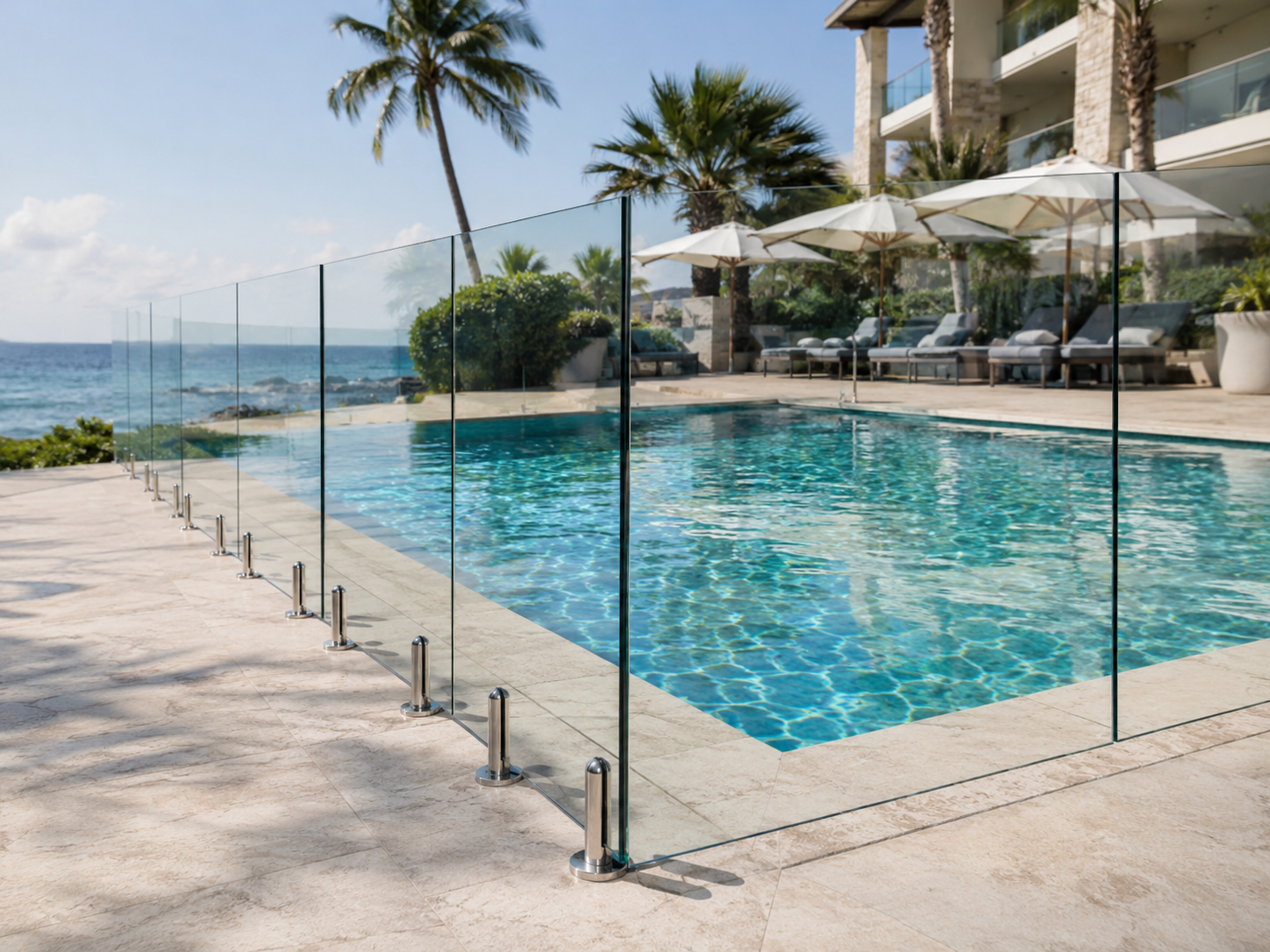
| Poolside glass fence | High | Chlorine, water splash, safety hardware and moving gate parts |
| Semi-outdoor restaurant or café | Medium to high | Humidity, cleaning water, fingerprints and track maintenance |
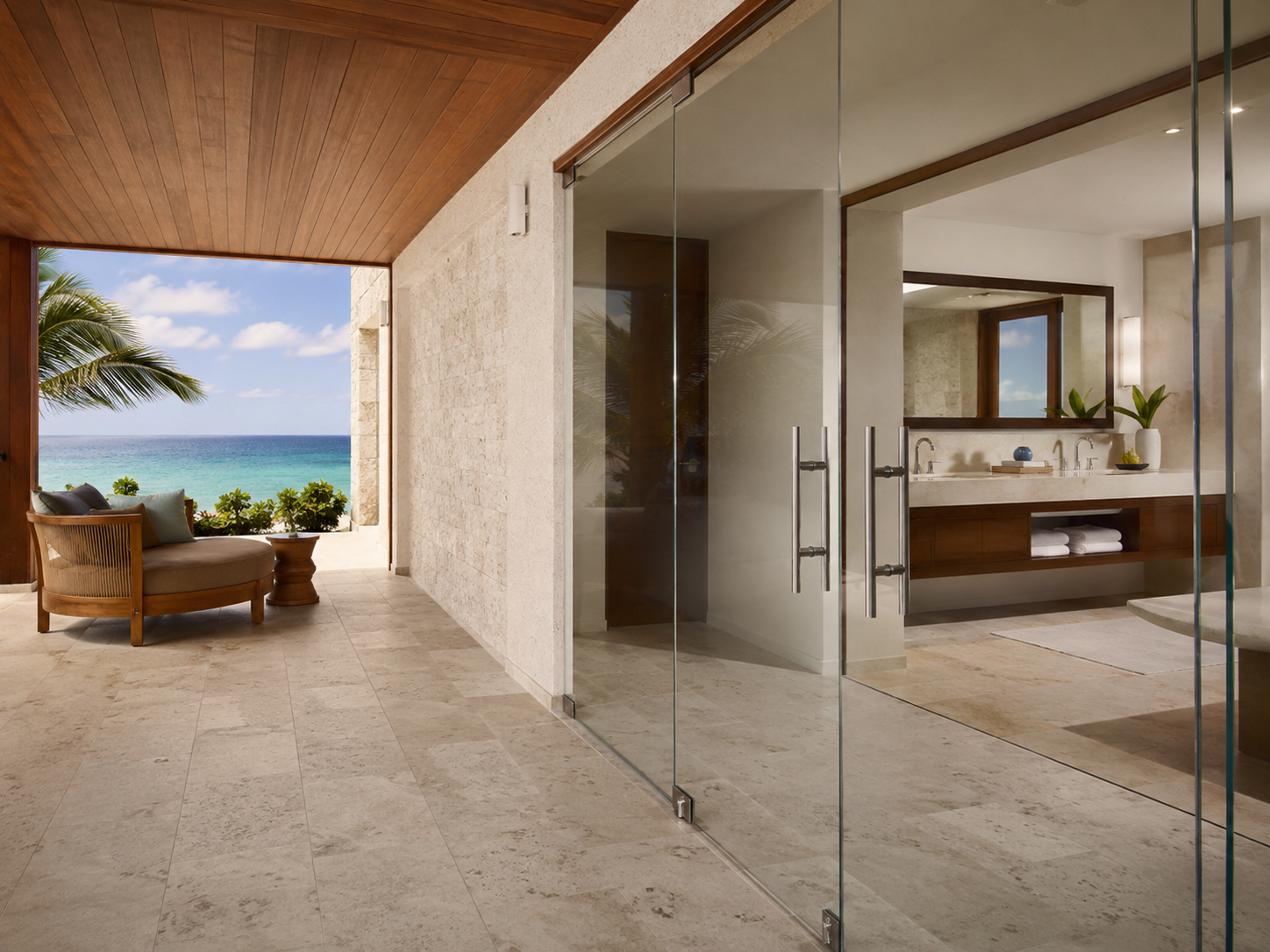
| Hotel lobby entrance | Medium | Guest traffic, appearance, door control and exposed handle finish |
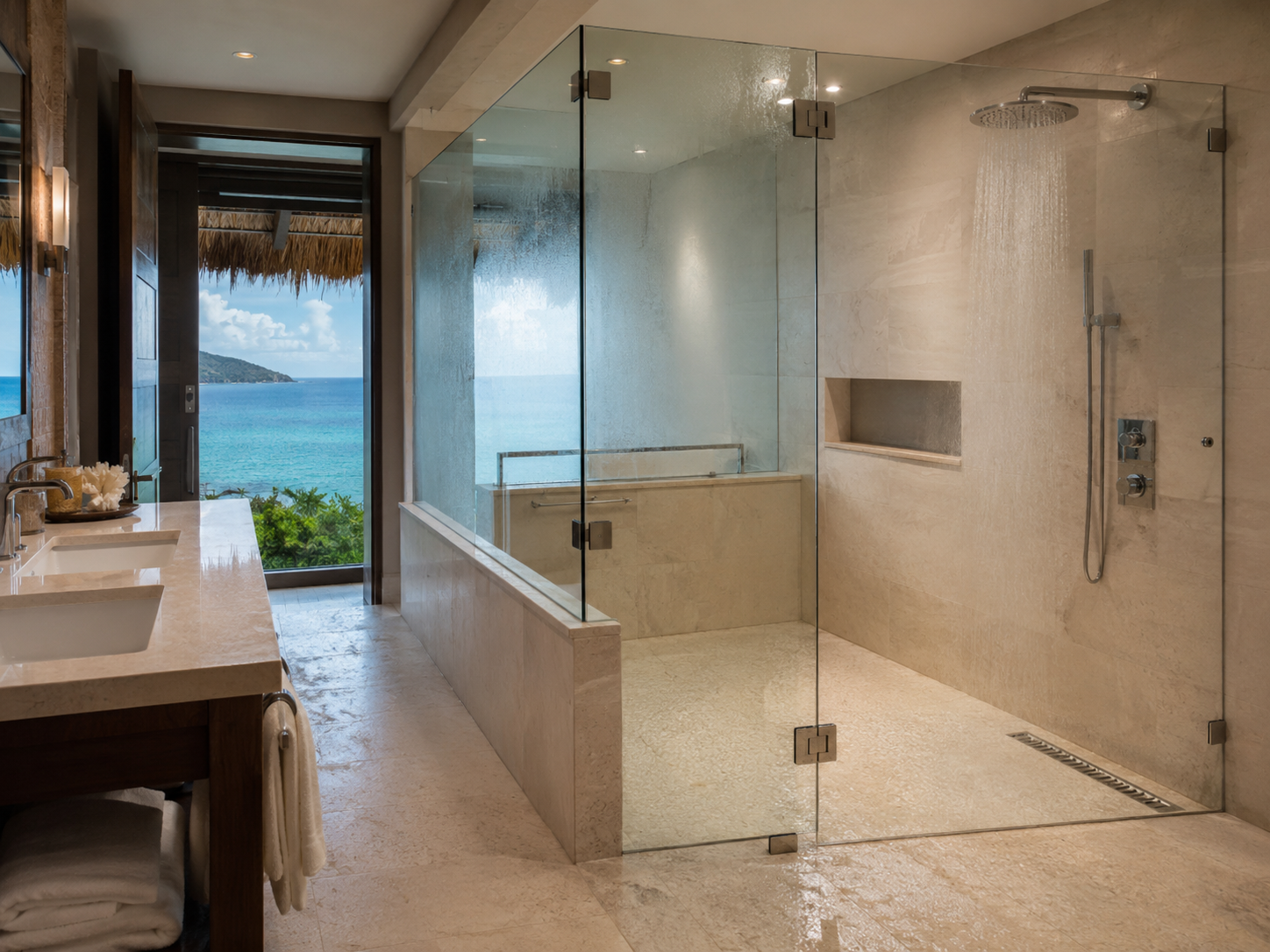
| Guest bathroom or shower room | Medium | Humidity, water stains, hinge movement and clamp corrosion |
| Interior corridors and guest rooms | Low to medium | Finish consistency, cleaning and long-term appearance |
The same stainless steel finish may perform differently depending on where it is installed. A brushed stainless handle inside a corridor and a railing spigot beside a pool are not facing the same risk.
The hardware schedule should match the real installation area, not just the overall project name.
Why Salt Air Damages Stainless Steel
Stainless steel resists rust because it forms a thin chromium oxide passive layer on the surface. In ordinary indoor environments, this layer protects the metal and helps it remain clean.
In coastal environments, chloride ions from salt air can attack this passive layer. When salt deposits remain on the surface, especially in small gaps or crevices, localized corrosion can begin. This may appear as tea staining, surface rust, pitting or discoloration around screws, washers, clamps, cover plates and joints.
This does not always mean the hardware has failed structurally, but it affects appearance and maintenance cost. In visible hotel areas, appearance is part of performance.
For technical comparison, engineers may use PREN, or Pitting Resistance Equivalent Number, to estimate resistance to pitting corrosion. In simple terms, higher alloy content, especially molybdenum and nitrogen, usually improves resistance in chloride-rich environments. For buyers, the practical takeaway is clear:
- SS304 is more suitable for protected indoor dry areas.
- SS316 is better for humid, semi-outdoor and coastal areas.
- Duplex 2205 may be considered for selected high-exposure zones.
The correct choice still depends on exposure, cleaning routine, budget and project specification.
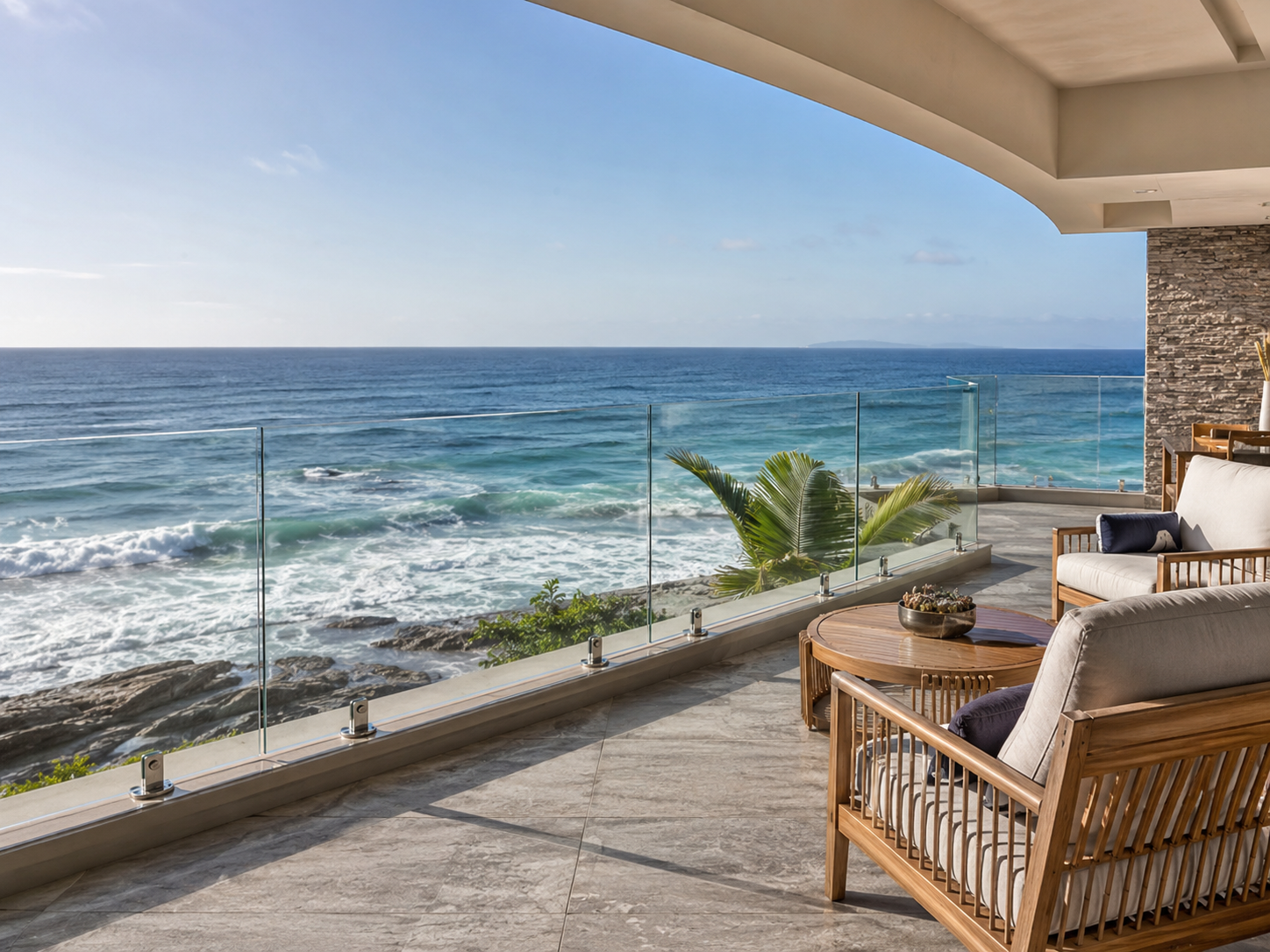
Material Selection: SS304, SS316 and Duplex 2205
Material selection should be based on where the hardware is installed.
SS304 is commonly used for indoor dry areas, such as guest room interiors, interior partitions, some corridor fittings and protected indoor door hardware. It is practical and cost-effective, but it is not the best choice for highly exposed seaside or poolside installations.
SS316 offers better corrosion resistance than SS304 because it contains molybdenum. It is often considered for humid areas, bathroom hardware, semi-outdoor spaces, balcony fittings and coastal hotel projects. However, SS316 is not maintenance-free. In salt-air environments, salt deposits should still be removed regularly.
Duplex 2205 may be considered for highly exposed applications where stronger pitting resistance is required. Examples may include sea-facing railing hardware, poolside glass barriers, beachfront terraces or aggressive salt-air locations. It is not necessary for every part of a hotel project, but it can be useful for selected high-risk zones.
A practical material approach is:
- SS304 for protected indoor dry areas
- SS316 for wet, humid or semi-outdoor zones
- Duplex 2205 for selected direct salt-air, poolside or high-exposure applications
This is more realistic than applying one material grade to the whole project without considering exposure level.
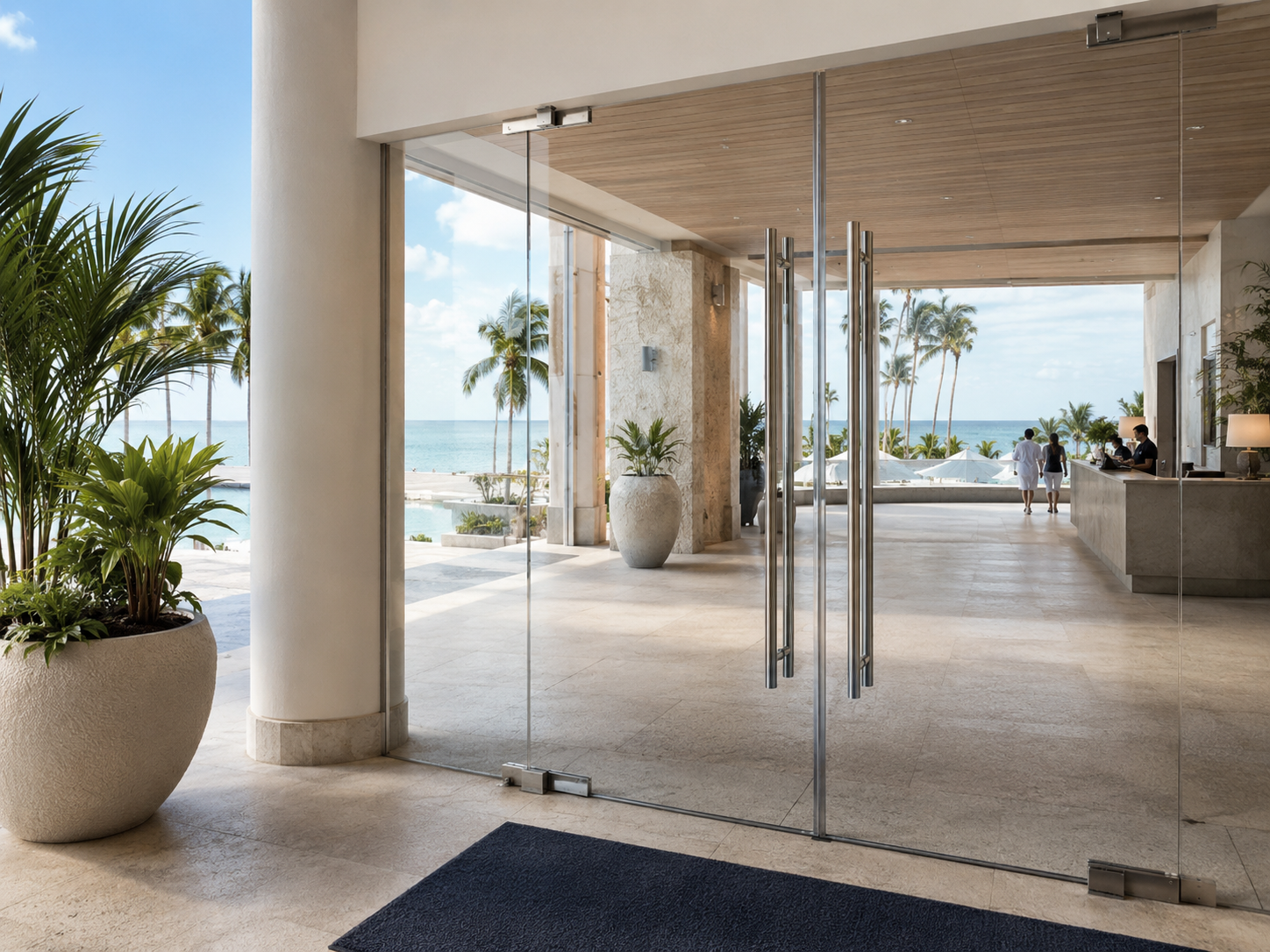
Glass Door Hardware for Coastal Hotel Entrances
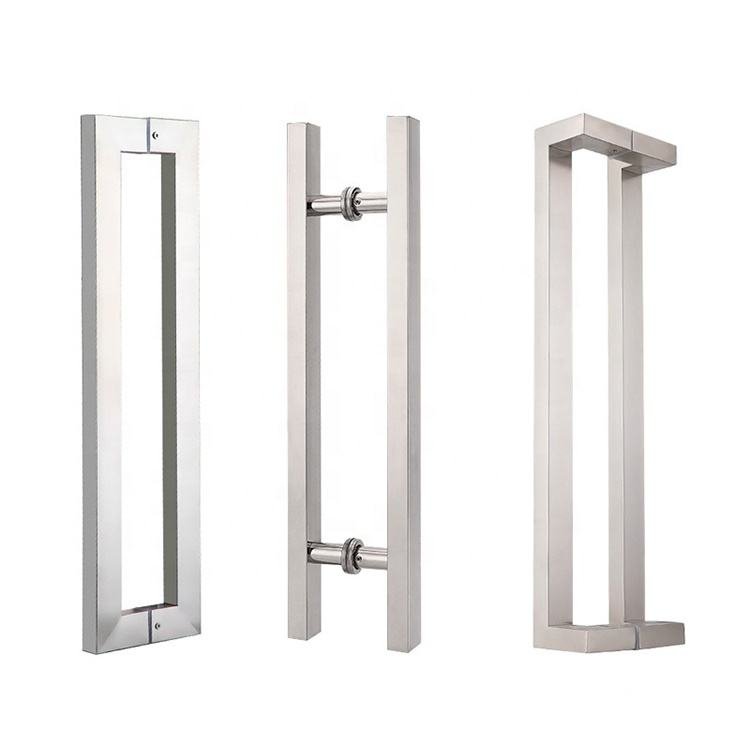
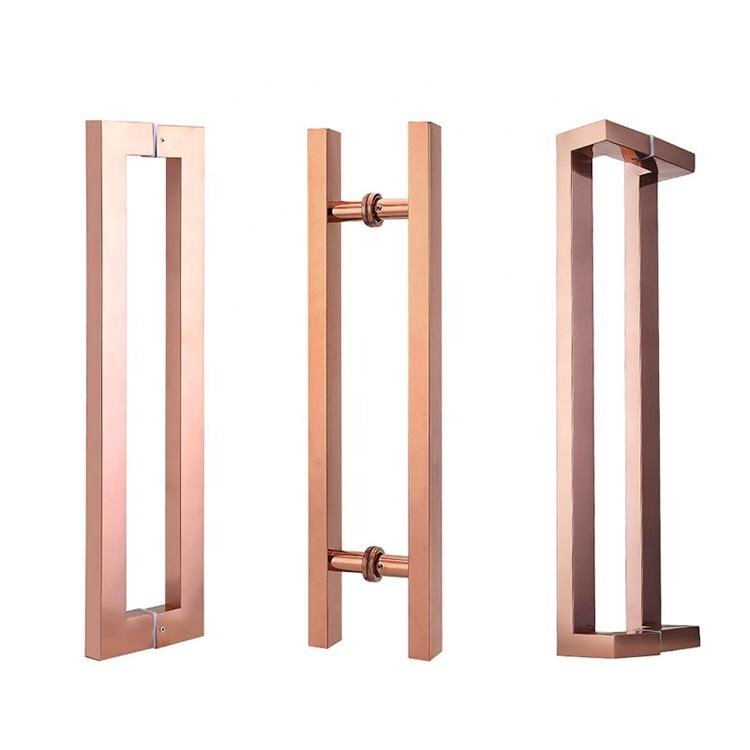
A coastal hotel entrance may look similar to a city hotel entrance, but the surface conditions are different. Guests may bring moisture, sand or salt from the beach. Wind-driven rain may reach covered entrance areas. Cleaning teams may wipe the hardware frequently. Pull handles, patch fittings, lock areas and floor spring cover plates are touched and exposed every day.
For glass entrance doors, the project should check:
- Door size and glass weight
- Floor spring or closer capacity
- Patch fitting material and finish
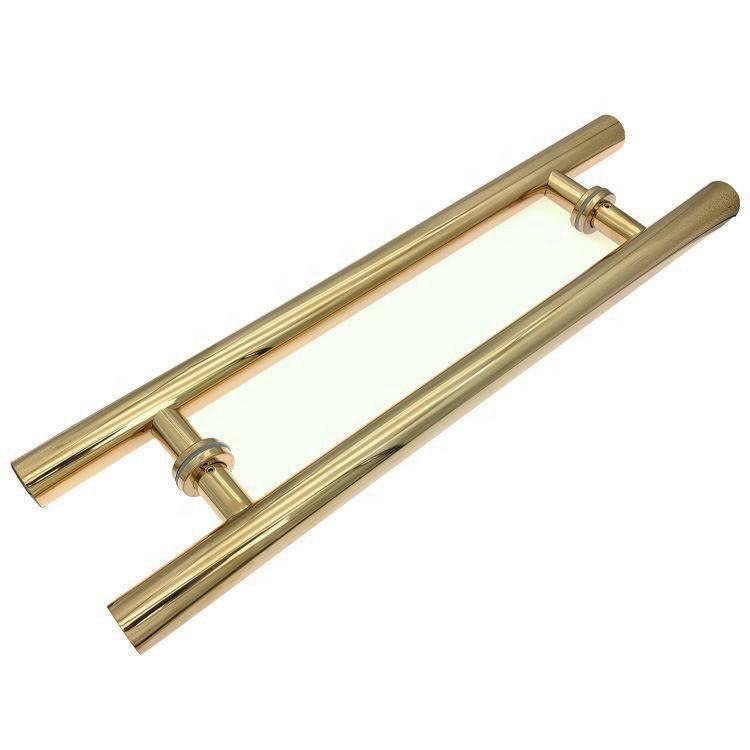
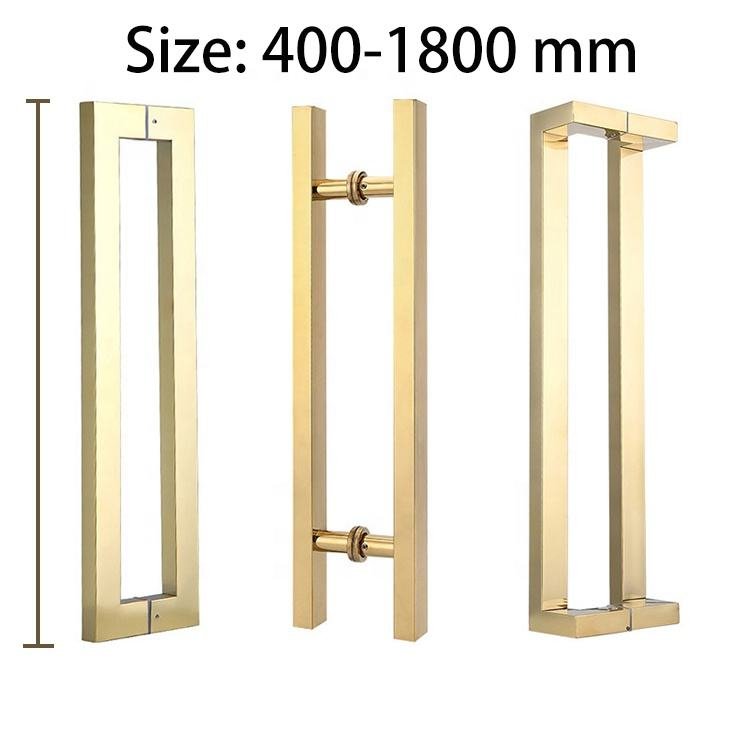
- Pull handle finish and grip surface
- Lock position and exposed metal areas
- Cleaning method and frequency
- Whether the entrance is fully indoor, covered outdoor or semi-exposed
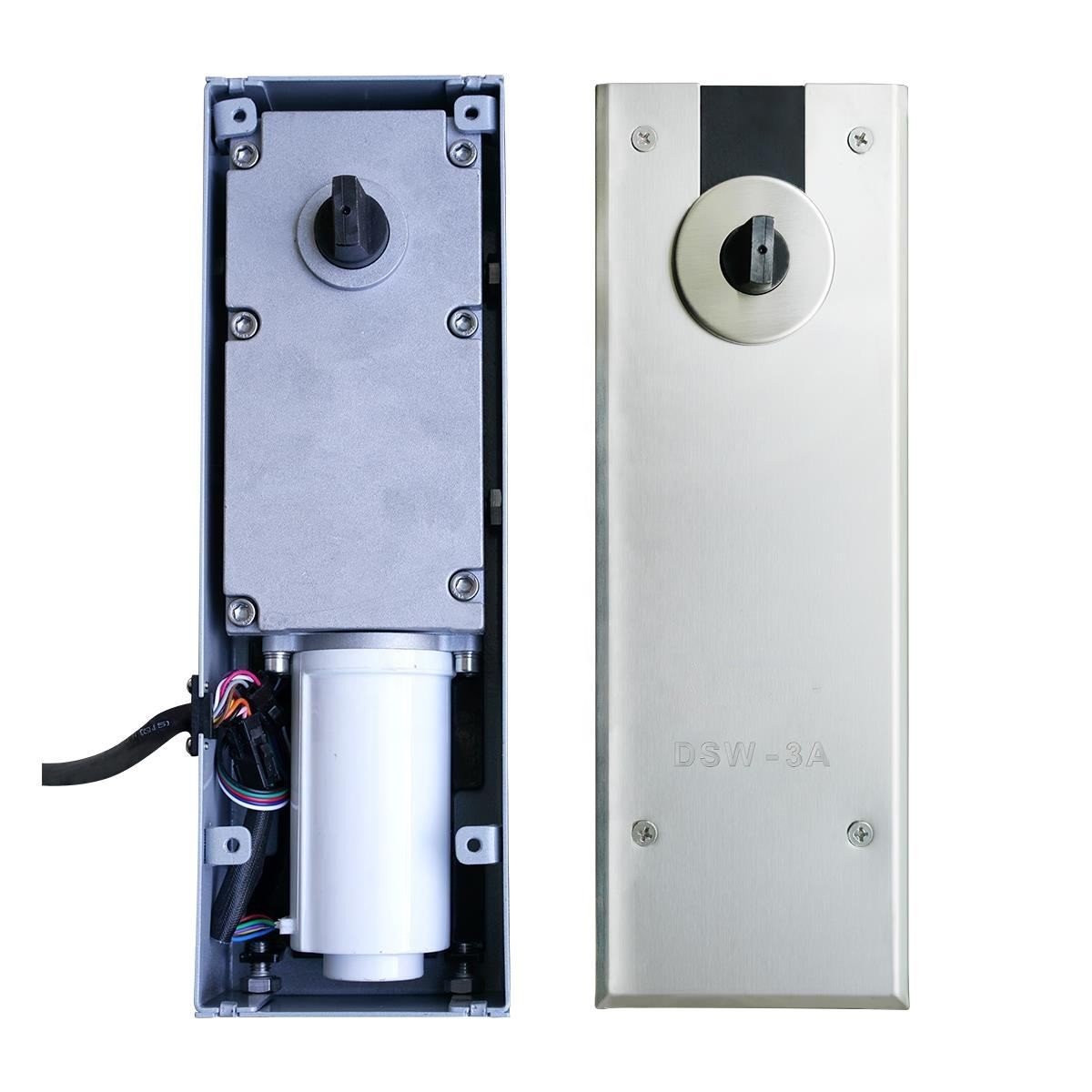
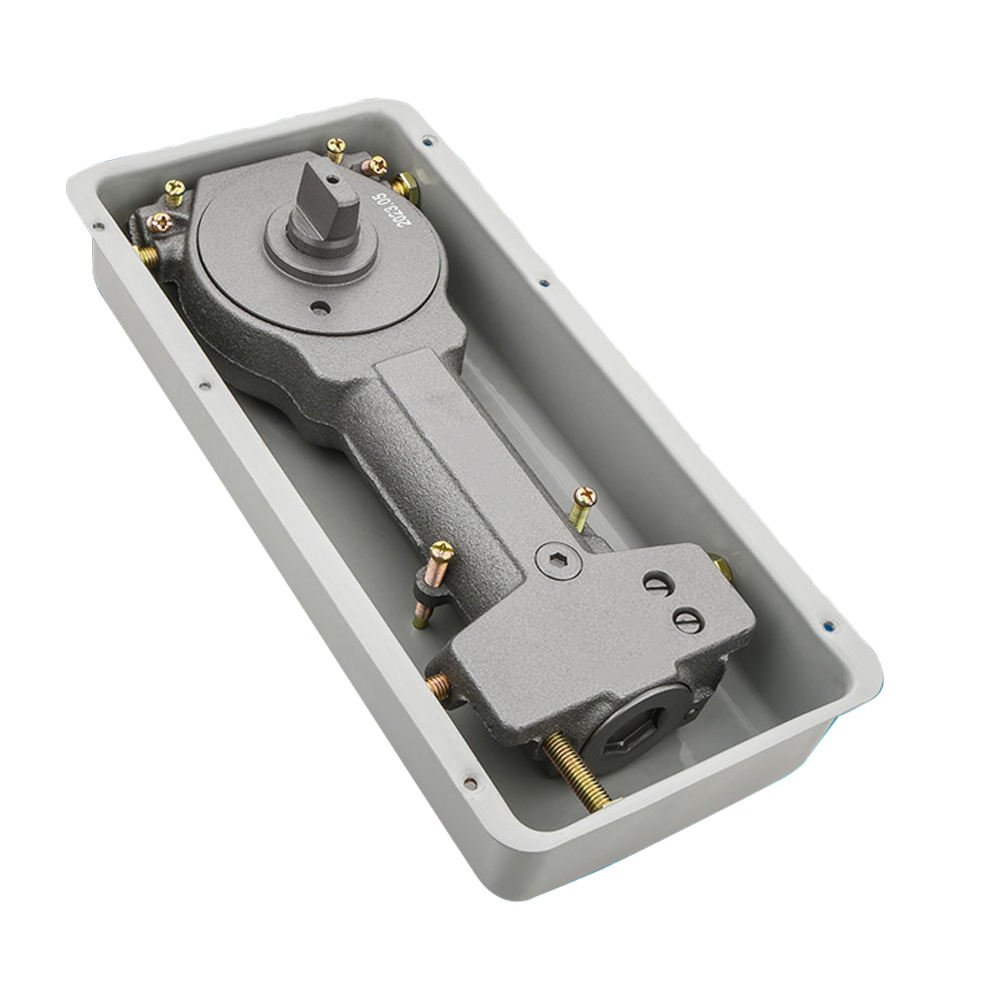
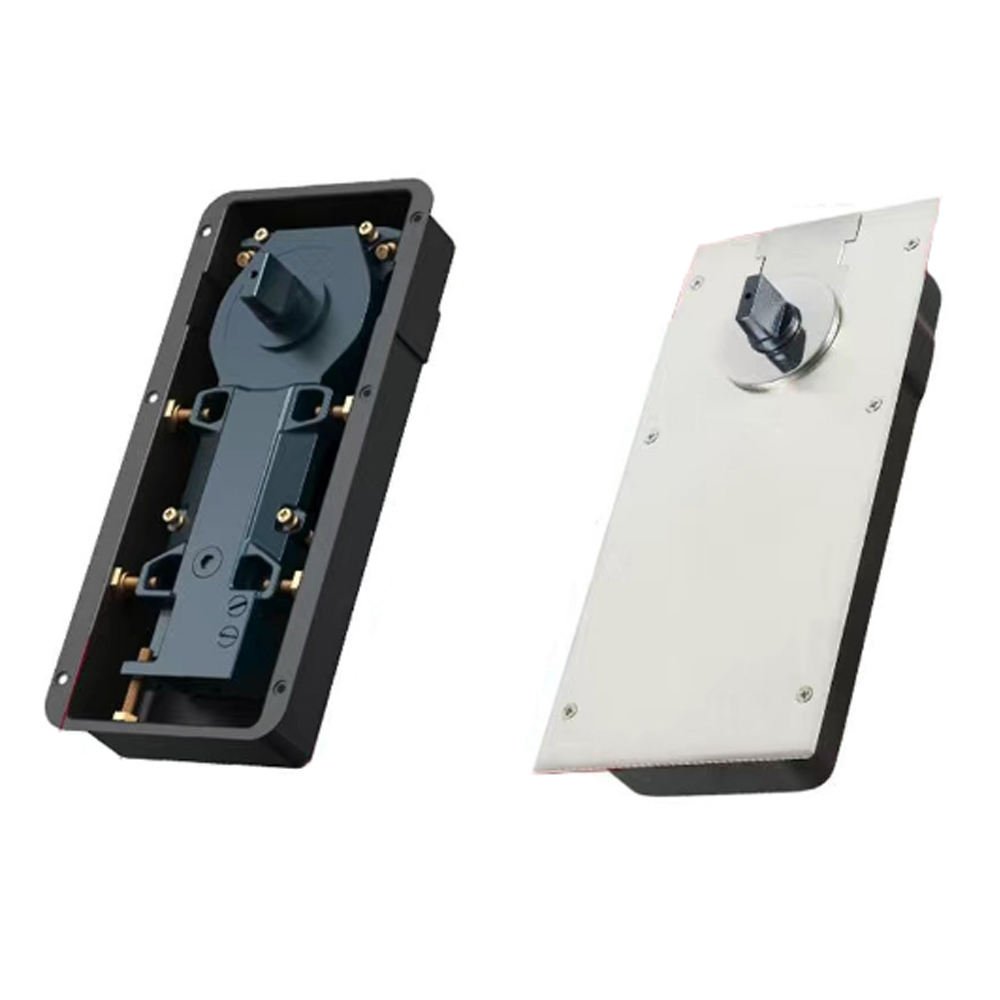
Recessed floor springs need special attention in coastal projects. The cement box area can become a water and salt trap if drainage, cover material and maintenance are not considered. In semi-exposed entrances, corrosion-resistant covers, better sealing and regular cleaning should be discussed before installation.
Hydraulic patch fittings may also be considered in selected projects where floor excavation is difficult or where standing water around a recessed floor spring is a concern. The final choice should depend on door size, glass weight, usage frequency, floor condition and project design.
For detailed entrance door selection, a project may refer to separate hotel lobby or commercial entrance hardware guides. For coastal hotel projects, the additional focus is material, finish and maintenance.
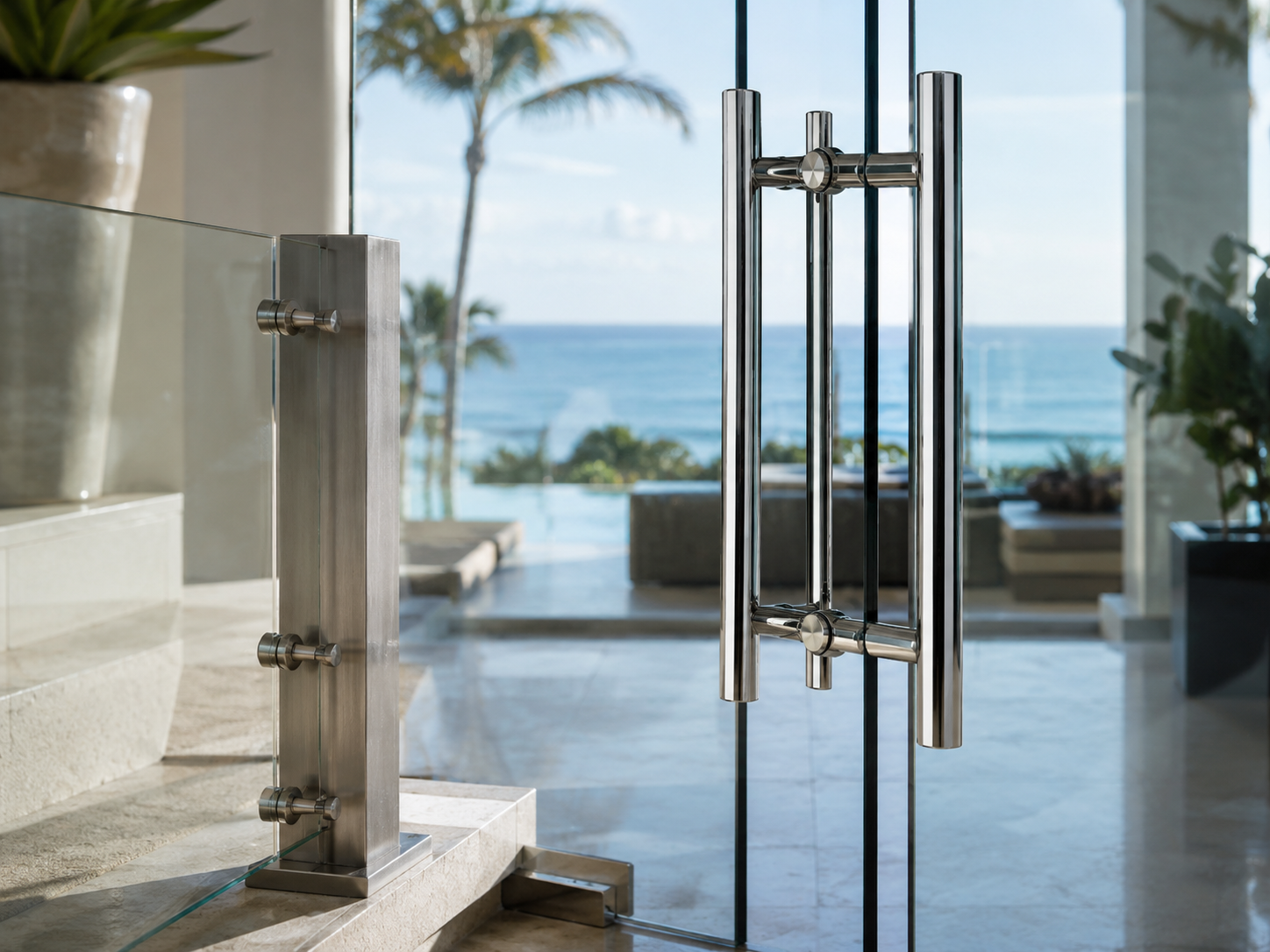
Balcony, Terrace and Railing Hardware in Salt-Air Areas
Balcony and terrace glass hardware is one of the highest-risk areas in coastal hotels and resorts. These areas may face direct salt wind, rain, cleaning water and guest contact at the same time.
Common hardware may include:
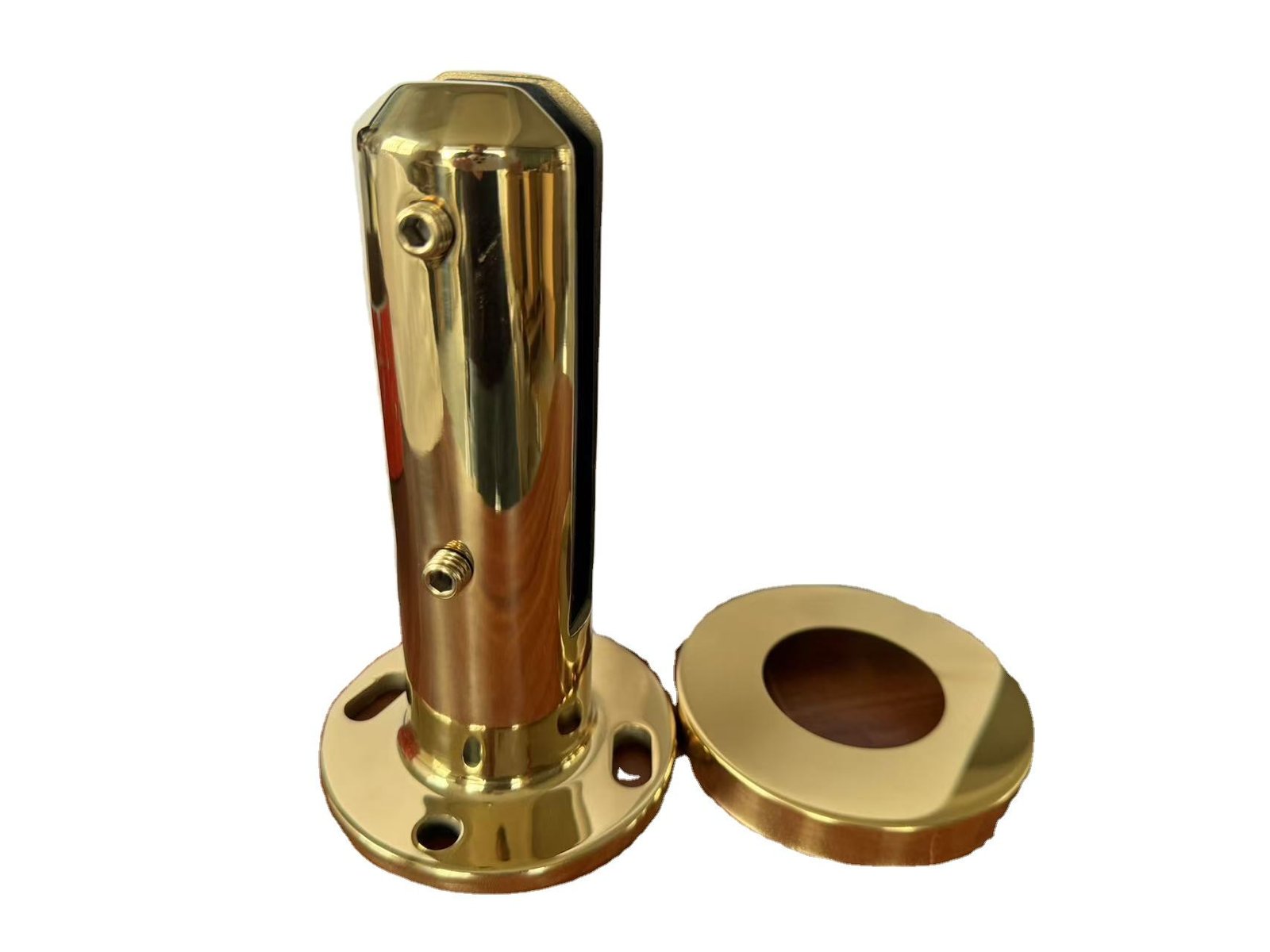
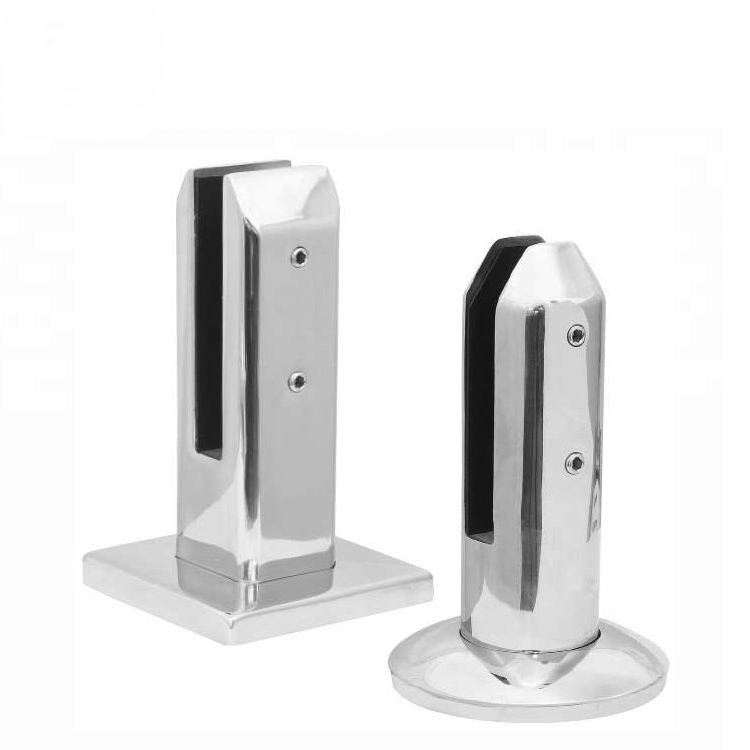
- Glass spigots
- Standoffs
- Base shoe systems
- Glass clamps
- Handrail connectors
- Railing brackets
- Balcony door handles and locks
A sea-facing balcony railing is not only a view feature. It is a safety system exposed to aggressive outdoor conditions. The hardware should be selected with both structural and corrosion considerations in mind.
For these areas, SS316 is often preferred over SS304. In highly exposed seaside or poolside areas, Duplex 2205 may be considered depending on project specification. However, final structural load, anchor design and code compliance should be confirmed by the project engineer.
The fixing substrate is also important. Salt air can affect exposed anchors, cover plates and interfaces between hardware and concrete or stone. If water remains around the base of spigots, standoffs or tracks, staining and corrosion risk increases.
Good material selection helps, but drainage, installation detail and cleaning routine still matter.
Poolside and Wet Areas Need More Than Stainless Steel
Poolside areas and guest bathrooms create different types of corrosion risk.
Pool areas may expose hardware to chlorine, water splash, sunscreen residue, cleaning chemicals and high humidity. Guest bathrooms and shower rooms expose hinges, clamps and handles to water, soap residue and poor ventilation.
In these areas, corrosion is usually a combination of water, chemicals, cleaning routine and ventilation — not only the base metal.
Common wet-area hardware may include:
- Shower hinges
- Glass clamps
- Door handles
- Pool fence spigots
- Gate hinges
- Glass latches
- Wall brackets
- U-channel or fixing profiles
For wet zones, hardware should be selected with material grade, finish type, moving function and cleaning access in mind. Hinges and moving parts should not only look good when installed; they should continue moving smoothly after repeated wet use.
SS316 may be a better choice for many wet and semi-outdoor areas. For poolside barriers or strong chlorine exposure, higher-grade options may be considered according to project requirements.
The important point is to set maintenance expectations early. Even corrosion-resistant stainless steel can develop surface staining if salt, chlorine or unsuitable cleaning chemicals remain on the surface for a long time.
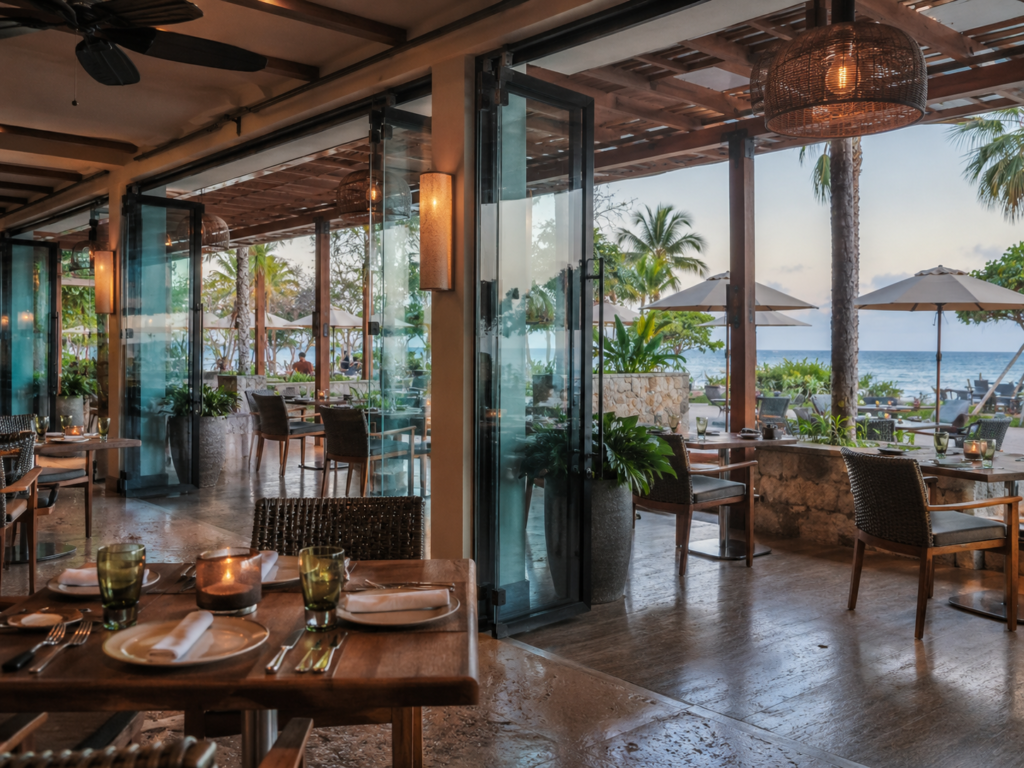
Semi-Outdoor Restaurant and Café Areas
Many coastal resorts have restaurants, cafés and bars that open toward a terrace, garden or sea view. These areas often use folding glass doors, sliding glass doors, fixed partitions or frameless frontage systems.
The challenge is that these areas sit between indoor and outdoor conditions.
During the day, glass systems may stay open for ventilation and customer flow. At night, they may close for security and weather protection. Floors may be cleaned with water. Guests frequently touch handles and glass panels. Salt air may enter from the open side.
For semi-outdoor dining areas, hardware selection should consider:
- Track cleaning
- Lower guide design
- Locking after business hours
- Fingerprints and cleaning marks
- Humidity exposure
- Finish durability
- Ease of staff operation
Black finish and PVD finishes are often requested for resort restaurants because they match modern interior design. They can work well, but cleaning method and scratch visibility should be discussed before large orders.
For full restaurant and café hardware selection, a separate restaurant and café glass door guide can provide more detail. In coastal resort projects, the additional issue is exposure and maintenance.
Finish Selection for Coastal Hotel Hardware
Finish selection is not only a design decision. In coastal hotels, it also affects maintenance and long-term appearance.
Brushed stainless steel is practical for many hotel areas because it hides small scratches and fingerprints better than mirror finish. It is commonly used for handles, clamps, patch fittings and visible stainless steel hardware.
Mirror polished stainless steel can look premium and has a smoother surface that may reduce salt deposit retention compared with rougher finishes. However, it also shows fingerprints, water marks and cleaning streaks more easily.
Black finish gives a modern architectural look. It is popular for resort restaurants, villas and contemporary hotel projects. In high-touch areas, buyers should consider scratch visibility and cleaning method.
PVD finish can be used for premium gold, champagne, black or other decorative finishes, depending on the product model. It can improve appearance, but the project should confirm suitable cleaning chemicals and avoid harsh agents that may affect the finish.
Powder coating or painted finishes may be used in selected systems, but outdoor and high-touch use should be checked carefully.
There is no single best finish for every coastal project. The choice should balance corrosion exposure, cleaning routine, appearance requirement and budget.
For multi-zone hotel projects, finish references should be controlled early. If a project orders hardware in several batches, slight finish differences can become visible across guest rooms, corridors, bathrooms, balconies and public areas.
Samples, finish codes and batch records help reduce this risk.
Salt Spray Testing, Passivation and Supplier Confirmation
For coastal projects, buyers may ask for salt spray test data, passivation information or material certificates. These can be useful, but they should be checked carefully.
If salt spray test data is required, buyers should confirm:
- Test standard
- Test hours
- Red-rust criteria
- Material grade
- Surface finish
- Whether the tested sample matches the ordered product
- Whether the test covers only the surface or the complete assembled hardware
Standards such as ASTM B117 or ISO 9227 may be used by some suppliers for neutral salt spray testing. However, test hours should not be compared without understanding the material, finish, sample preparation and acceptance criteria.
Post-production passivation can help remove free iron contamination from stainless steel surfaces and support the formation of a cleaner passive layer. For machined or cast stainless steel parts, this process may be important depending on product type and project requirement.
The key point is simple: do not rely only on a product name such as “marine grade.” Ask for material, finish, exposure use and test information when the project requires it.
Maintenance Expectations in Salt-Air Environments
One common mistake in coastal projects is assuming that corrosion-resistant hardware does not need maintenance.
Even SS316 hardware can show tea staining or surface discoloration if salt deposits stay on the surface for a long time. This does not always mean the base metal has failed, but it affects appearance and customer perception.
A practical maintenance routine may include:
- Regular freshwater cleaning
- Removing salt deposits from exposed hardware
- Avoiding harsh acidic or chlorine-based cleaners when not suitable
- Drying hardware after cleaning where possible
- Checking moving parts such as hinges, rollers and locks
- Inspecting poolside and sea-facing areas more often than indoor areas
Maintenance should be planned by exposure level. A guest room handle and a poolside spigot do not need the same maintenance frequency.
For coastal hotels, good hardware selection and good maintenance work together.
Practical Selection by Resort Area
Sea-facing balconies
Use hardware suitable for direct salt-air exposure. Check railing fixing, material grade, drainage, anchor detail and finish maintenance.
Poolside glass barriers
Consider water splash, chlorine, guest safety and maintenance access. Higher corrosion resistance may be needed for exposed fittings.
Guest bathrooms and shower rooms
Select hinges, clamps and handles with humidity, cleaning and ventilation in mind. Avoid treating bathroom fittings as dry indoor hardware.
Resort restaurant terraces
Check folding or sliding door hardware, track cleaning, locking, finish durability and staff operation. Semi-outdoor exposure should be considered.
Lobby and entrance doors
Focus on visible finish, guest contact, door control and exposed metal surfaces. Recessed floor springs, cover plates, pull handles and locks should be checked for moisture and salt exposure.
Interior guest rooms and corridors
Finish consistency, cleaning resistance and long-term appearance are usually more important than extreme corrosion resistance.
Common Mistakes in Coastal Hotel and Resort Projects
Using SS304 in highly exposed seaside areas
SS304 may work well indoors, but direct salt air, poolside splash and sea-facing exposure can be too aggressive.
Assuming SS316 means no maintenance
SS316 improves corrosion resistance, but it still needs regular cleaning in coastal environments.
Using one finish for every zone without considering exposure
A finish that works well in a dry interior may not be the best option for poolside, balcony or semi-outdoor use.
Ignoring cleaning chemicals
Harsh cleaners can damage finishes faster than normal guest use. Cleaning methods should be compatible with the selected finish.
Treating recessed floor spring boxes as dry areas
In semi-exposed entrances, floor spring boxes can collect water, salt and cleaning residue. Cover material, sealing and maintenance should be considered.
Mixing batches without finish control
Large hotel projects often purchase in phases. Without finish references, later hardware may not match earlier installed items.
Selecting railing hardware without checking exposure and substrate
Balcony and poolside railing hardware should be checked for both structural fixing and corrosion exposure.
Forgetting moving parts
Hinges, rollers, floor springs and locks may require more attention than fixed clamps because movement, moisture and cleaning residues affect performance.
How Metech Supports Coastal Hotel and Resort Projects
Metech Hardware supports coastal hotel and resort projects with architectural glass hardware for multiple project areas.
Our product range can include floor springs, patch fittings, pull handles, glass locks, shower hinges, glass clamps, spigots, standoffs, base shoe or U-channel options, sliding door kits, folding door hardware options and stainless steel accessories.
Material and finish options may include SS304, SS316 and selected higher-grade options depending on the product category and project requirement. Finish options can include brushed stainless steel, polished stainless steel, black and selected PVD finishes depending on the model and order quantity.
Before recommending hardware, we prefer to check the project location, installation area, exposure level, glass thickness, hardware type, finish requirement and estimated quantity.
For structural load, local code compliance and highly exposed marine environments, final specification should be confirmed with the project engineer or local consultant. Metech can help match hardware groups and prepare coordinated supply options for doors, railings, showers, partitions and semi-outdoor spaces.
For overseas buyers, contractors and distributors, Metech can also support mixed hardware orders, OEM packaging and export packing.
FAQ
Is SS316 enough for coastal hotel glass hardware?
SS316 is often a better choice than SS304 for humid or semi-outdoor coastal areas, but it is not maintenance-free. Regular cleaning is still needed to remove salt deposits and reduce surface staining.
When should Duplex 2205 be considered?
Duplex 2205 may be considered for highly exposed applications such as sea-facing railings, poolside barriers or aggressive salt-air environments where stronger pitting resistance is required. The final choice depends on project specification and budget.
Can SS304 be used in coastal hotel interiors?
Yes, SS304 may still be suitable for protected indoor dry areas such as guest rooms, corridors or interior partitions. It should not be used automatically for highly exposed coastal or poolside zones.
What finish is better for seaside resort projects?
There is no single best finish for every area. Brushed stainless steel hides small scratches better. Polished finishes may reduce salt retention but show marks more easily. Black and PVD finishes should be selected with cleaning method and scratch visibility in mind.
Should buyers ask for salt spray test reports?
For highly exposed coastal projects, salt spray test information can be useful. Buyers should confirm the test standard, test hours, material grade, finish and whether the tested sample matches the ordered product.
How should hotel glass hardware be maintained near the sea?
Exposed hardware should be cleaned regularly with fresh water and suitable cleaning methods. Salt deposits, pool chemicals and harsh cleaners should not remain on the surface for long periods.
Can Metech supply mixed hardware for doors, railings, showers and partitions?
Yes. Metech can support mixed orders for glass door hardware, railing fittings, shower hardware, sliding or folding door hardware and related stainless steel fittings for coastal hotel and resort projects.
Need Glass Hardware for a Coastal Hotel or Resort Project?
Send us your project location, installation area, exposure level, glass thickness, hardware type, finish requirement and estimated quantity. Metech Hardware can help recommend suitable glass door, railing, shower and partition hardware for coastal hotel and resort projects.