Home » Insights » Standard vs Heavy-Duty Glass Patch Fittings: Which One Should You Choose?
Standard vs Heavy-Duty Glass Patch Fittings: Which One Should You Choose?
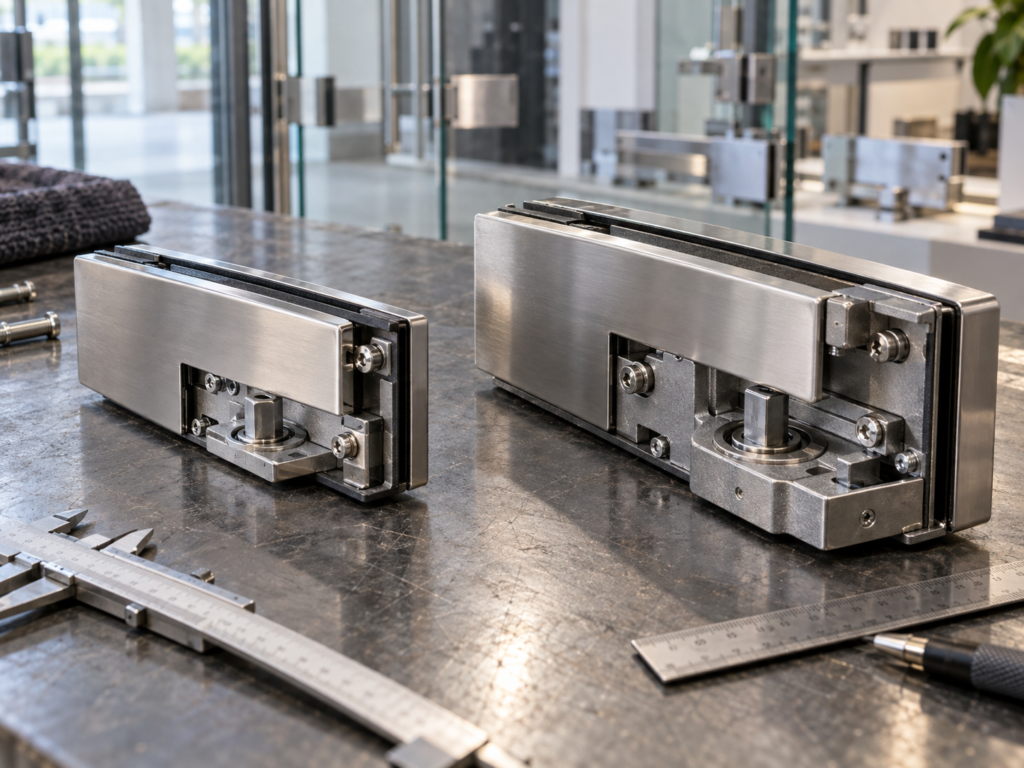
Two glass patch fittings can look almost identical from the outside while being intended for very different door conditions.
Both may use a similar brushed stainless-steel cover and the same general rectangular appearance. Yet the internal fitting, spindle insert, clamping system and approved application range can be very different.
This creates a common purchasing problem.
A contractor may assume that a larger or heavier-looking fitting is automatically “heavy duty,” while another buyer may choose the lowest-priced standard model because both products look similar once installed.
Neither approach is reliable.
The correct question is:
Which patch fitting is suitable for the actual door load, geometry and complete pivot system?
Heavy-duty selection is not simply about choosing a thicker cover plate. Door width, glass weight, traffic, wind exposure, floor spring capacity, spindle compatibility and glass preparation all need to work together.
1. What Does “Heavy-Duty Patch Fitting” Actually Mean?
There is no universal industry point at which every standard patch fitting suddenly becomes “heavy duty.”
The definition varies by manufacturer and product series.
A heavy-duty model may be designed for:
larger glass doors;
wider door panels;
higher operating loads;
more demanding traffic conditions;
reinforced internal components;
different spindle interfaces;
different glass preparation;
use with higher-capacity floor spring systems.
However, these features are model-specific.
A larger fitting is not automatically stronger, and a compact fitting is not automatically unsuitable for commercial use.
The technical specification matters more than the marketing label.
The correct selection should begin with the door and project conditions.
2. Standard vs Heavy-Duty Patch Fittings: Quick Comparison
Factor
Standard Patch Fitting
Heavy-Duty Patch Fitting
Typical Application
Normal commercial glass doors
Larger or more demanding entrances
Door Load
Standard model range
Higher model-specific range
Internal Design
Standard pivot / insert system
Reinforced design where applicable
Glass Preparation
Model-specific
May require different cutout
Floor Spring
Standard compatible models
Often coordinated with higher-capacity systems
Overall Size
Usually more compact
May be larger or heavier
Cost
Generally lower
Generally higher
Selection Basis
Normal door conditions
Load, geometry and usage conditions
This comparison is only a general guide.
The final decision should always follow the technical data for the exact model being specified.
3. Door Weight Alone Is Not Enough
Maximum door weight is one of the first values buyers usually check.
It is important, but it should not be the only one.
Imagine two glass doors with approximately the same total weight.
One is relatively narrow.
The other is much wider.
The wider door places the center of mass farther from the pivot axis, creating a more demanding operating condition even when the total weight is similar.
Patch fitting selection should therefore consider:
door width;
door height;
glass thickness;
total door weight;
pull handles and locks;
traffic level;
wind exposure where applicable;
pivot geometry.
A wider door can create a more demanding pivot condition even when total door weight is similar.
For this reason, a simple “100 kg” or “150 kg” description does not tell the complete story.
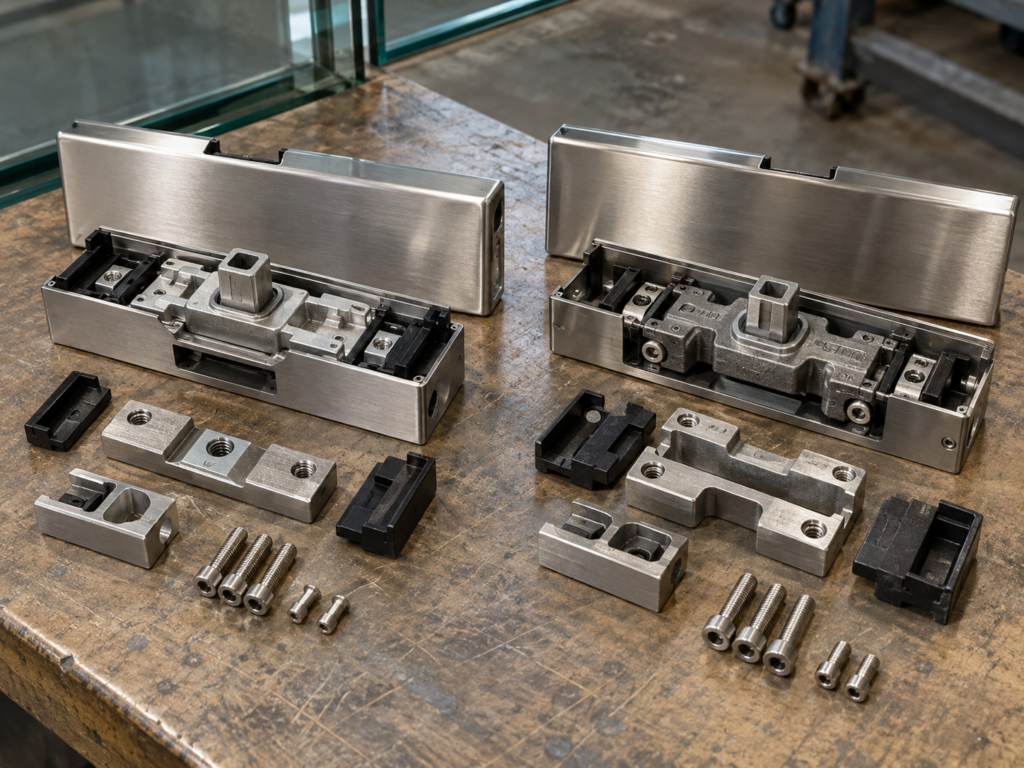
4. Internal Construction Matters More Than the Cover Plate
The visible stainless-steel cover is mainly an architectural finish.
The critical load transfer occurs through the internal fitting, spindle insert, clamping system and pivot connection.
Different patch fitting models may use different:
internal body materials;
spindle insert materials;
clamping plates;
fasteners;
manufacturing processes;
gasket and glass-contact systems.
This is why two fittings with similar external dimensions can have very different approved applications.
Buyers should compare the actual internal specification rather than assuming:
Standard = one material Heavy-duty = another material
There is no universal material rule that applies to every manufacturer.
For B2B purchasing, the more useful questions are:
What is the internal construction?
What application is the model rated for?
What spindle system does it use?
What glass configuration does it support?
What technical documentation is available?
The cover plate does not define the load-bearing capability of the fitting.
5. High Traffic and Wind Can Change the Selection
Static door weight is only one part of the application.
A commercial entrance may also experience repeated dynamic loading.
Examples include:
shopping malls;
universities;
office lobbies;
retail storefronts;
hotels;
exterior commercial entrances.
Frequent opening and closing creates repeated mechanical demand on the pivot system.
Exterior doors may also experience wind pressure, which can increase loads on the top and bottom pivot points.
This does not mean every high-traffic or exterior door automatically requires the largest heavy-duty fitting available.
It means the environmental conditions should be included in the hardware specification.
Dynamic operating conditions should be considered together with static door weight.
For demanding entrances, buyers should verify that the selected patch fitting, pivot and floor spring system are all suitable for the actual application.
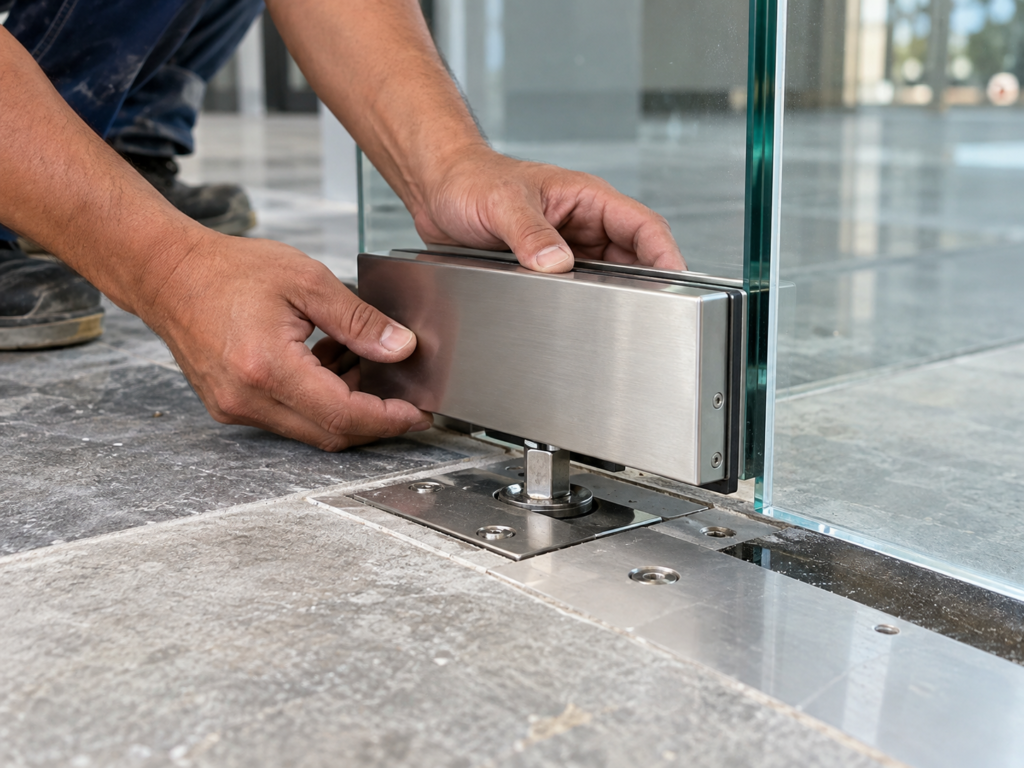
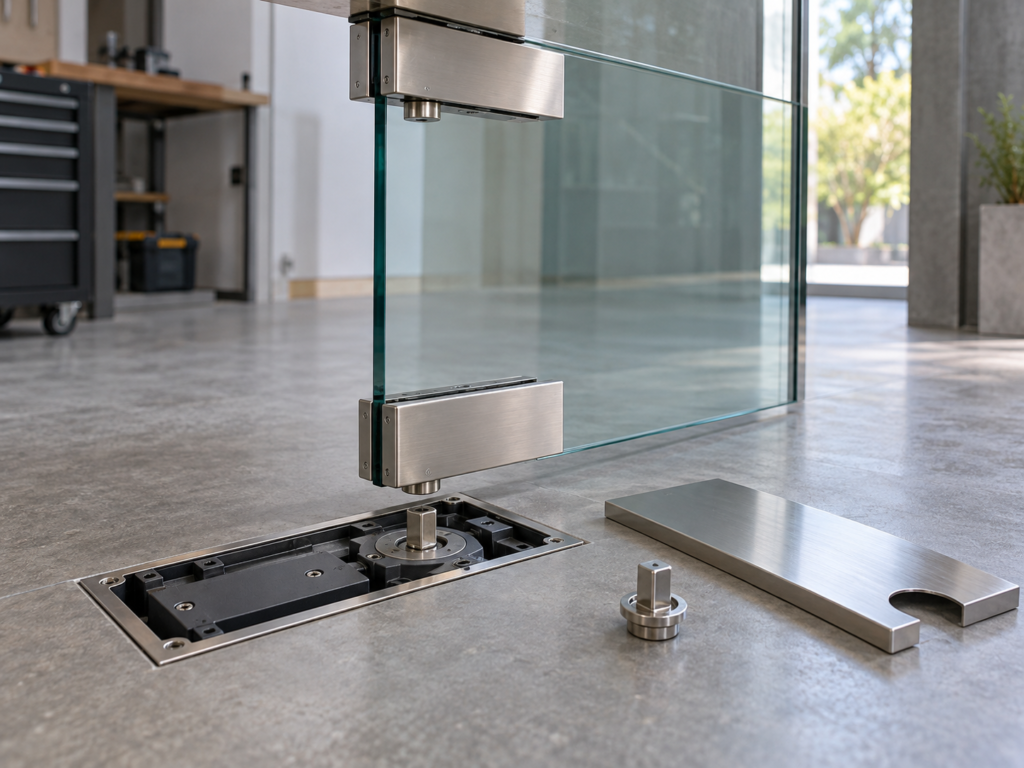
6. The Bottom Patch Fitting Is a Critical Pivot Connection
The bottom patch fitting performs an important structural role.
It creates the connection:
glass door → bottom patch insert → floor spring spindle
This means it is not simply a decorative clamp attached to the bottom of the glass.
When comparing standard and heavy-duty bottom patch fittings, review:
internal body construction;
spindle insert;
clamping arrangement;
glass contact area;
fasteners;
spindle interface;
approved application range.
A mismatch at this point can affect the entire door system.
For oversized or high-load doors, the bottom patch should therefore be evaluated together with the floor spring rather than selected independently.
7. A Heavy-Duty Floor Spring Does Not Define the Whole System
One of the most common specification mistakes is assuming that a high-capacity floor spring automatically makes the entire entrance heavy duty.
It does not.
The complete pivot system may include:
floor spring;
spindle;
bottom patch insert;
bottom patch fitting;
top patch fitting;
top pivot;
tempered glass;
locking hardware.
Each component has its own design and compatibility requirements.
A higher-capacity floor spring cannot compensate for an incompatible spindle or unsuitable patch fitting.
The usable capacity of the door system depends on compatible components, not on the floor spring rating alone.
This becomes increasingly important as door dimensions and operating demands increase.
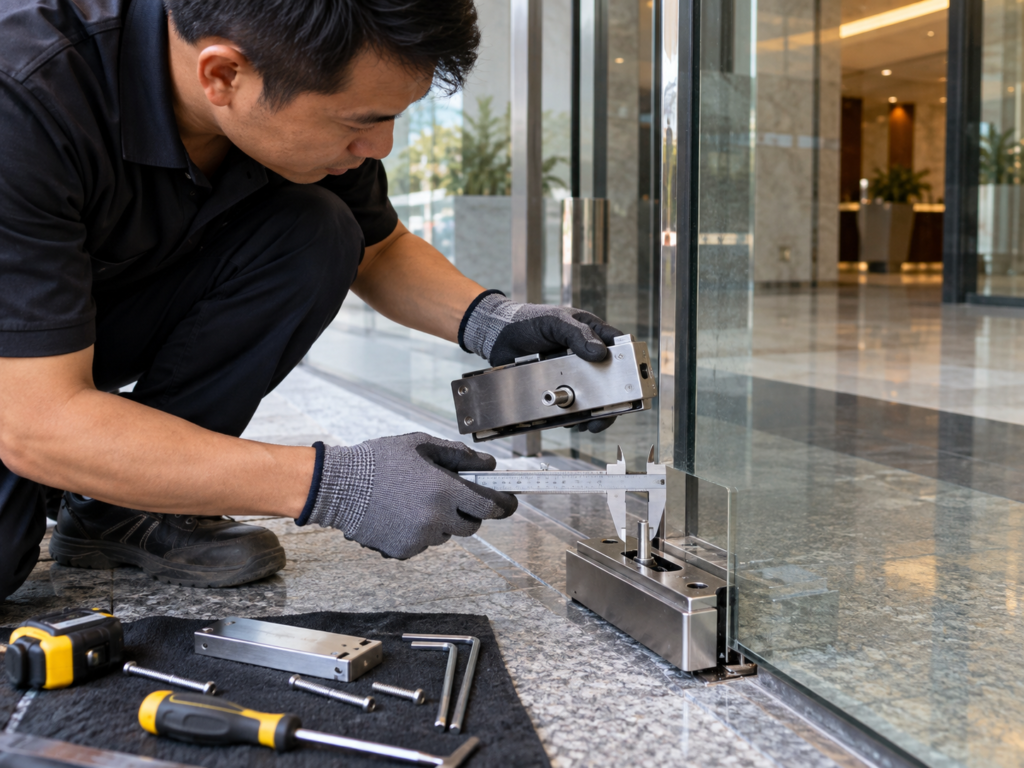
8. Check the Spindle and Insert Compatibility
The connection between the floor spring spindle and the bottom patch insert must be confirmed before ordering.
Different systems may use different:
spindle profiles;
spindle heights;
insert geometries;
pivot positions.
A patch fitting that looks similar externally may use a completely different internal insert.
Before approval, confirm:
spindle profile;
spindle height;
bottom patch insert;
pivot-center relationship;
floor spring compatibility.
Never assume a heavy-duty bottom patch will fit an existing floor spring only because the cover plate looks similar.
This is especially important for distributors serving replacement markets.
9. Glass Cutout and Glass Thickness Must Match the Exact Fitting
10. When Standard Patch Fittings Are Usually Enough
Heavy-duty hardware is not automatically better.
A standard commercial patch fitting may be fully appropriate when:
door dimensions are within the approved range;
door weight is within specification;
traffic is normal;
environmental loading is moderate;
the floor spring is correctly matched;
the glass configuration is standard;
all pivot components are compatible.
Using an unnecessarily oversized fitting may increase:
cost;
hardware size;
glass preparation complexity;
replacement difficulty.
The best patch fitting is the one correctly matched to the door—not the largest one available.
11. When Heavy-Duty Patch Fittings Should Be Considered
A heavy-duty model deserves consideration when the project becomes more demanding.
Typical examples include:
oversized glass entrance doors;
wider door panels;
heavier glass configurations;
high-traffic public entrances;
demanding exterior conditions;
larger floor spring systems;
applications approaching the limits of a standard fitting.
Even then, the final decision should be based on the exact model specification.
Do not select heavy-duty hardware only because:
“The door looks big.”
Review the complete system.
12. Replacement Projects Require Extra Care
Replacing a standard fitting with a heavy-duty model is not always a direct upgrade.
The existing tempered glass may already have permanent cutouts and holes.
The replacement fitting may use:
a different cutout;
different hole positions;
another spindle insert;
a different pivot center;
a different cover footprint.
Before replacement, confirm:
existing glass cutout;
glass thickness;
spindle profile;
spindle height;
floor spring model;
pivot position;
top pivot system.
Only then should the replacement fitting be selected.
The new hardware must adapt to the existing system unless the glass and floor hardware are also being replaced.
Standard vs Heavy-Duty Patch Fitting Selection Checklist
Check
Confirm
Door Width
Actual dimension
Door Height
Actual dimension
Glass Thickness
Confirmed
Door Weight
Estimated or confirmed
Traffic Level
Normal / high
Wind Exposure
Relevant where applicable
Floor Spring
Model and capacity
Bottom Patch
Compatible model
Spindle
Profile and height
Top Pivot
Compatible system
Glass Cutout
Approved drawing
Lock Hardware
Additional hardware considered
Replacement Project
Existing dimensions checked
Common Patch Fitting Selection Mistakes
Choosing by External Size
A larger fitting is not automatically a stronger system.
Selecting Only by Door Weight
Door width, pivot geometry and operating conditions also matter.
Using a Heavy-Duty Floor Spring With an Unverified Patch System
The complete pivot chain must be compatible.
Assuming All Bottom Patch Inserts Fit the Same Spindle
Different manufacturers and models can use different interfaces.
Changing Patch Fittings After Glass Tempering
The new model may require different glass preparation.
Assuming Heavy-Duty Is Always Better
Unnecessary heavy-duty hardware can increase cost and complexity without improving the project.
How Metech Supports Patch Fitting Selection
Metech Hardware works with selected production partners to support glass contractors, distributors, fabricators, importers and project buyers.
Depending on the project, we can help coordinate:
standard and heavy-duty patch fitting comparison;
door-condition review;
internal specification comparison;
floor spring matching;
spindle and insert compatibility;
glass cutout drawing coordination;
sample comparison;
finish options;
OEM requirements;
mixed commercial door hardware sourcing;
pre-shipment checking.
Our goal is to help buyers coordinate the patch fitting as part of the complete pivot system rather than selecting it as an isolated metal clamp.
FAQ
What Is the Main Difference Between Standard and Heavy-Duty Patch Fittings?
There is no single difference. Heavy-duty models are generally designed for more demanding applications and may use different internal structures, inserts, glass preparation or compatible pivot systems.
Is There a Universal Weight Limit for Standard Patch Fittings?
No. Load limits vary by manufacturer and model.
Do Heavy-Duty Patch Fittings Require Different Glass Cutouts?
Sometimes. Always compare the exact technical drawing before assuming compatibility.
Can I Use a Heavy-Duty Patch Fitting With My Existing Floor Spring?
Only if the spindle profile, spindle height, insert geometry and pivot relationship are compatible.
Does a 300 kg Floor Spring Automatically Require a Heavy-Duty Patch Fitting?
Not automatically. The complete pivot system should be reviewed together.
Should I Upgrade to Heavy-Duty During Replacement?
Only after checking the existing glass cutout, spindle, floor spring and pivot geometry.
Selecting Patch Fittings for a Commercial Glass Door?
Send us your door width, height, glass thickness, approximate weight, floor spring model and project application.
Metech Hardware can help compare standard and heavy-duty patch fitting options and confirm the key compatibility points before ordering.