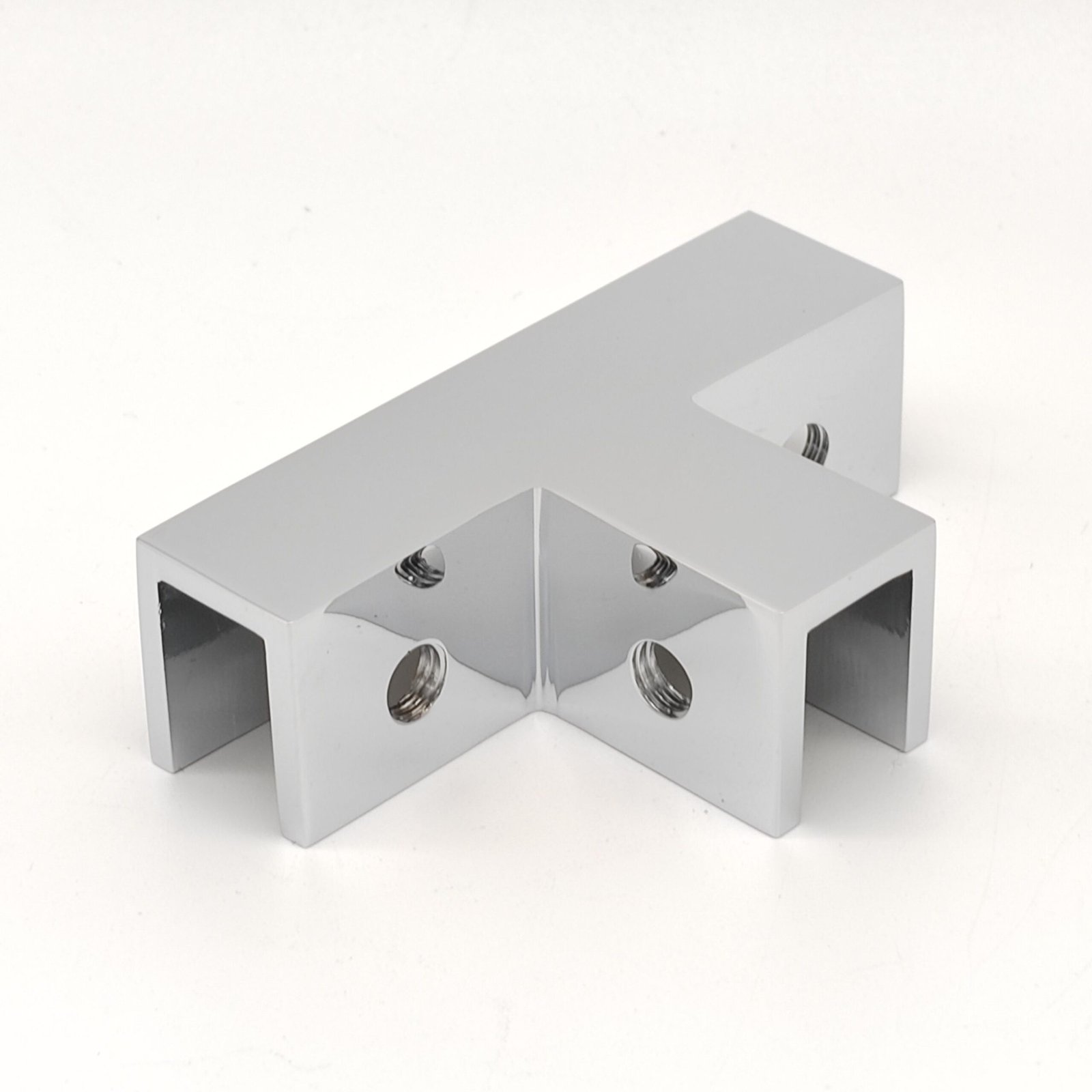
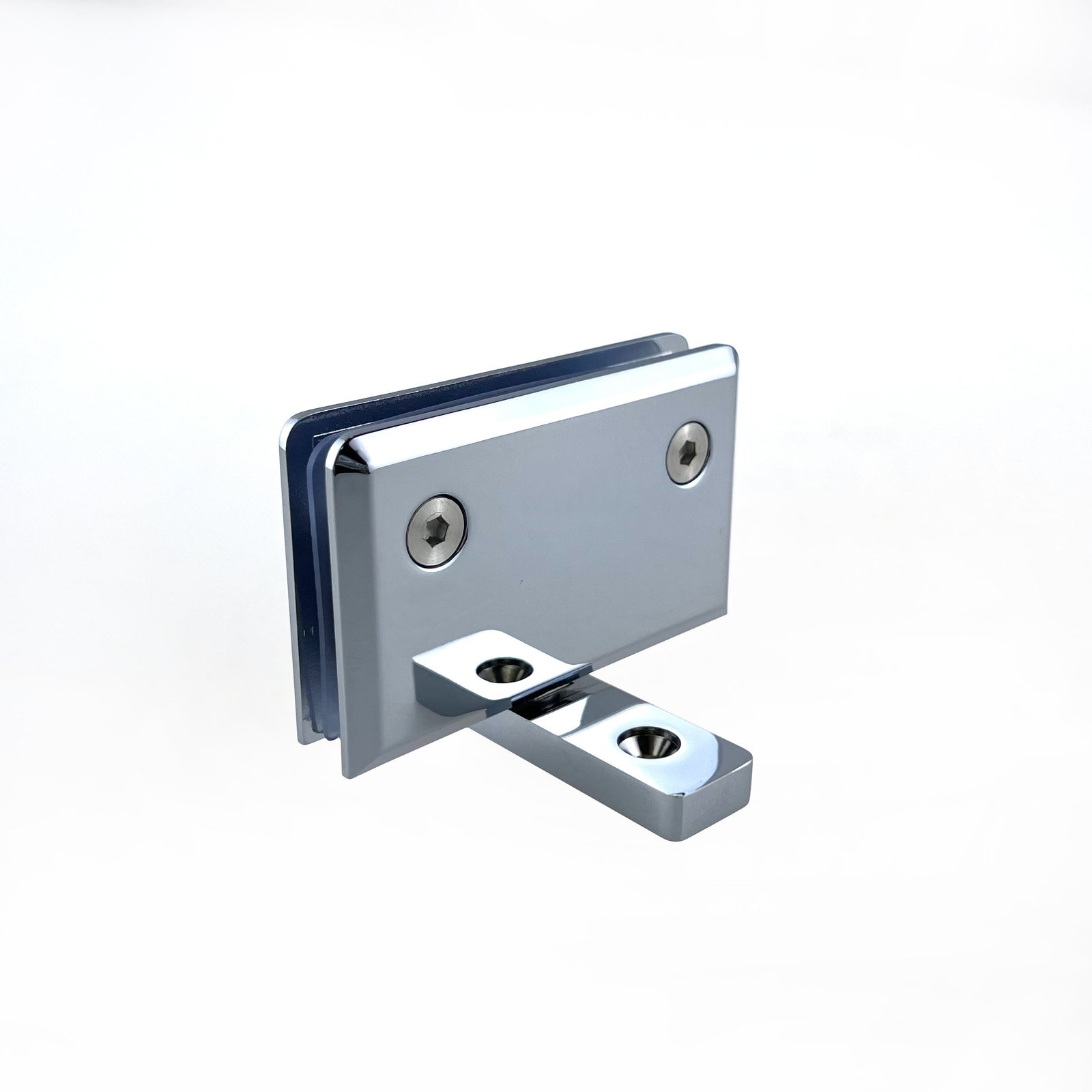
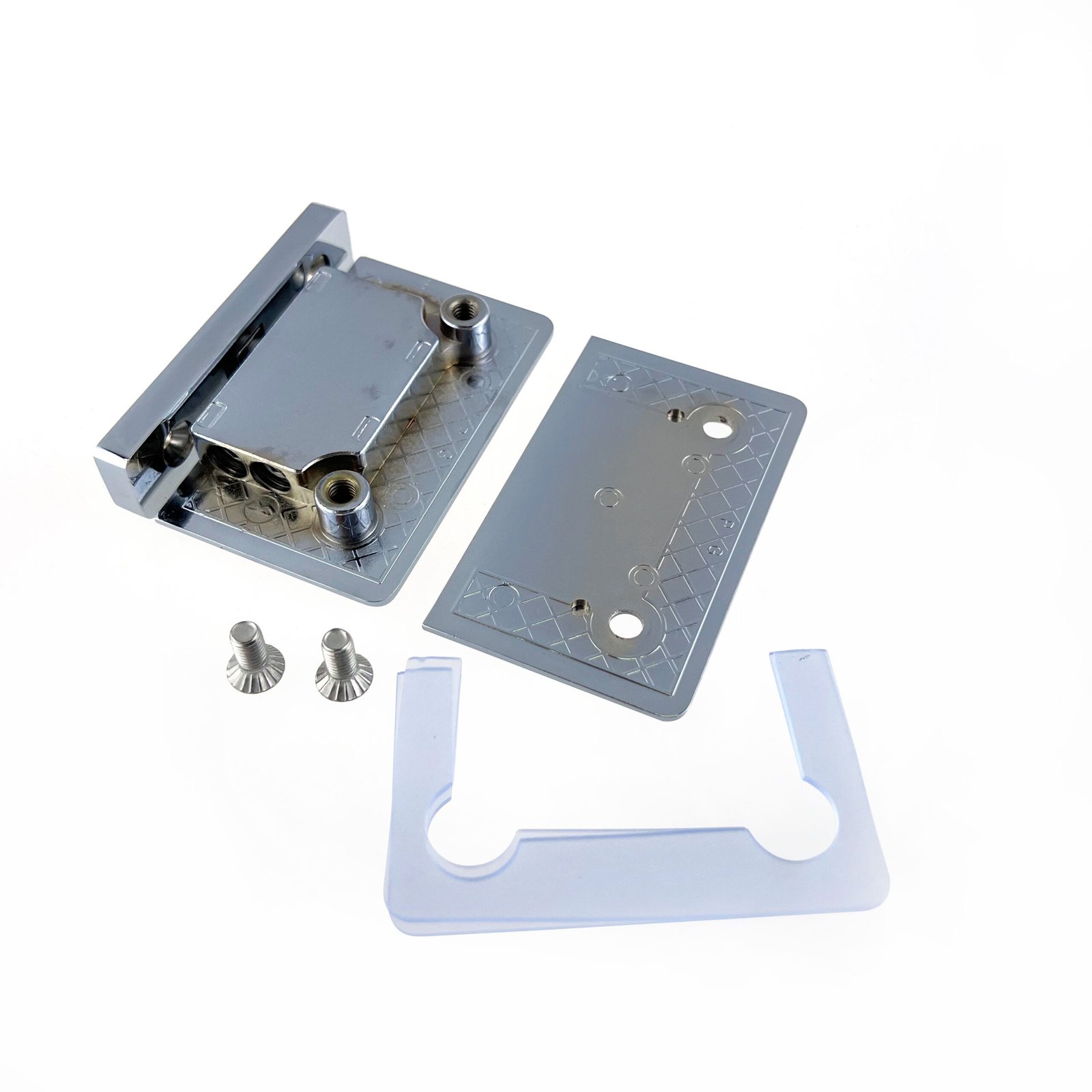
Replacing one worn shower hinge is a maintenance task.
Replacing shower hardware across 50, 100 or 300 hotel rooms is a renovation project.
For hotel operators, contractors and procurement teams, the objective is usually to improve reliability and appearance while keeping room downtime, glass replacement and construction waste under control.
When the existing tempered glass is still in good condition, it often makes sense to retain it and replace only the worn mechanical hardware. But this changes the replacement logic completely.
In a new shower enclosure, the glass can be prepared around the selected hinge.
In a renovation, the replacement hinge has to work with the glass that already exists.
That makes existing cutouts, hole positions, glass thickness, door dimensions and previous repair history the starting point for the entire project.
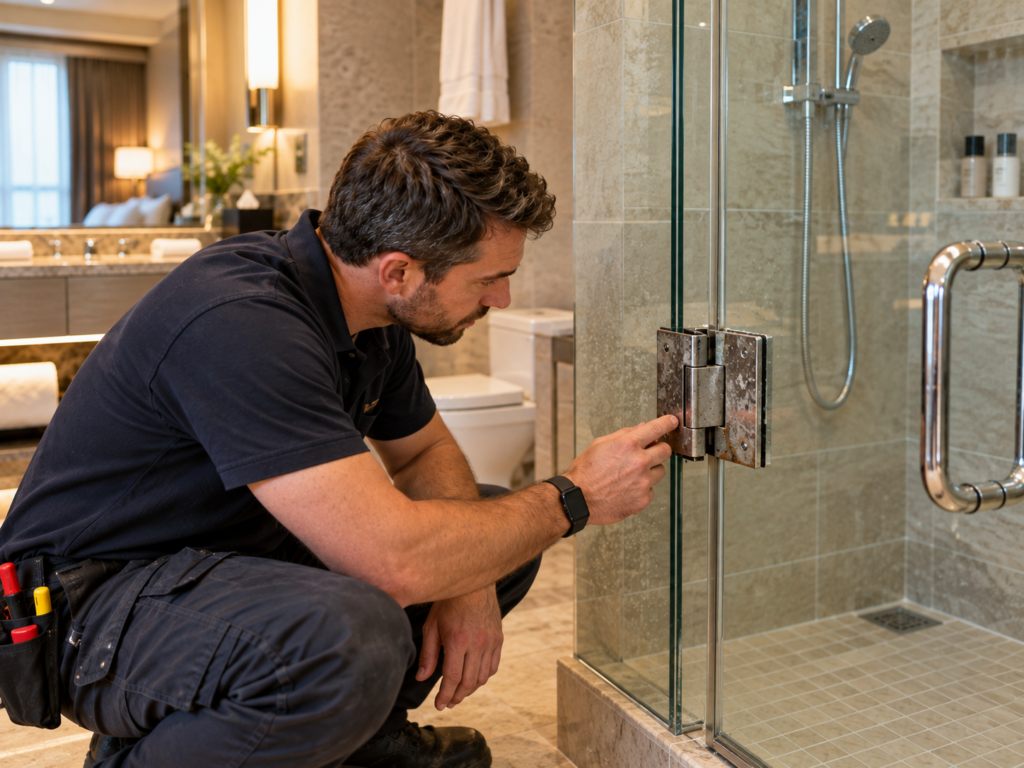
Decide the Renovation Scope Before Ordering Hardware
Not every bathroom needs the same level of replacement.
A room survey should first determine whether the project requires a hinge-only replacement, a partial hardware retrofit or a complete enclosure renewal.
| Existing Condition | Likely Renovation Approach |
|---|---|
| Glass remains serviceable, hinge worn | Hinge replacement |
| Glass is good, several fittings are aged | Partial hardware retrofit |
| Original hinge discontinued or incompatible | Replacement compatibility review |
| Glass damaged or layout no longer suitable | Consider full enclosure replacement |
Hinge-Only Replacement
If the glass, handle, clamps and seals remain in acceptable condition, replacing the hinge may be enough.
The key question is whether a suitable replacement can work with the existing glass preparation.
Partial Hardware Retrofit
In many hotel bathrooms, the hinge is not the only component showing age.
Handles may be scratched, seals hardened, clamps corroded or finishes visibly inconsistent.
Replacing several related items together can improve both performance and appearance.
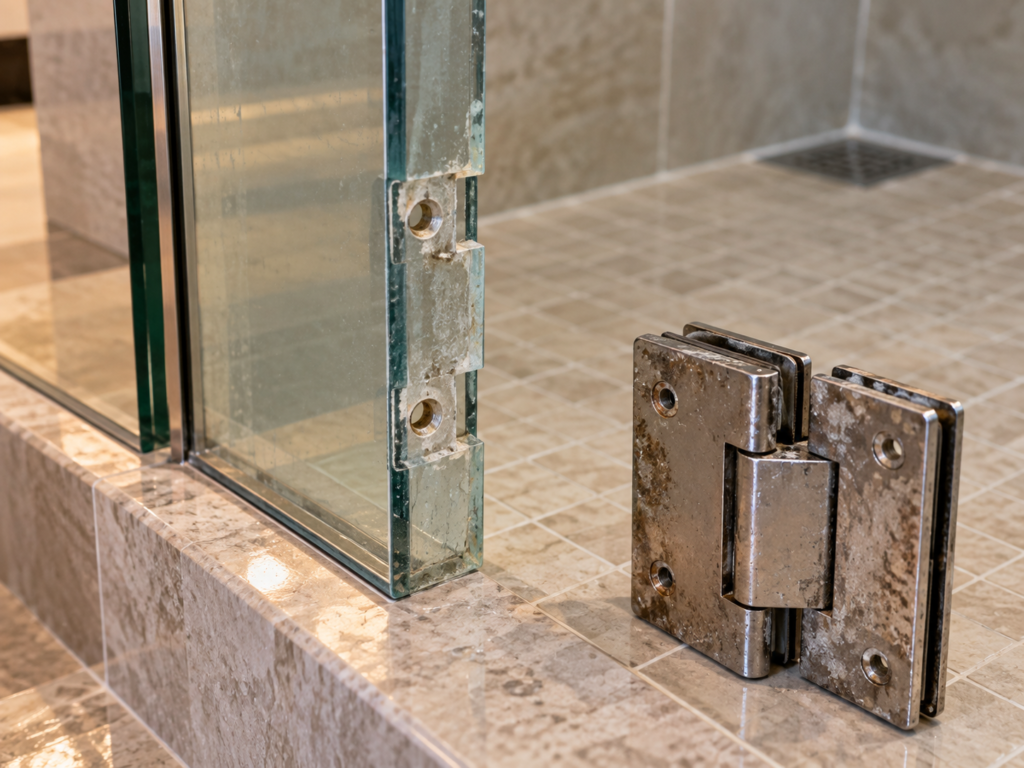
Full Enclosure Replacement
If the glass is damaged, the original cutout cannot accept a safe replacement, or the enclosure layout itself is outdated, replacing the complete shower system may be more practical than forcing new hardware into an unsuitable installation.
Legacy Glass Is the Main Constraint
In renovation work, the hardware has to adapt to the existing glass rather than the other way around.
Tempered glass requires its holes, notches and cutouts to be prepared before tempering. Once the panel is finished, it should not be treated like ordinary material that can simply be redrilled or reshaped on site.
This makes the existing glass preparation one of the most important parts of replacement matching.
Audit the Existing Cutout
Before a bulk order, record:
- cutout shape;
- hole positions;
- center-to-center distances;
- edge distances;
- hinge footprint;
- mounting orientation.
Different shower hinges may use visibly similar body shapes while still requiring different glass preparation.
A small dimensional mismatch can prevent installation or create unwanted metal-to-glass interference.
Confirm the Glass Thickness
The actual thickness should be measured rather than assumed.
Replacement hinges may support different glass ranges, and gasket configuration may also vary by model.
Check Door Size and Existing Loading
A hinge that physically fits the old cutout is not automatically the right replacement.
Door width, height, glass thickness and operating condition still affect whether the replacement is mechanically suitable.
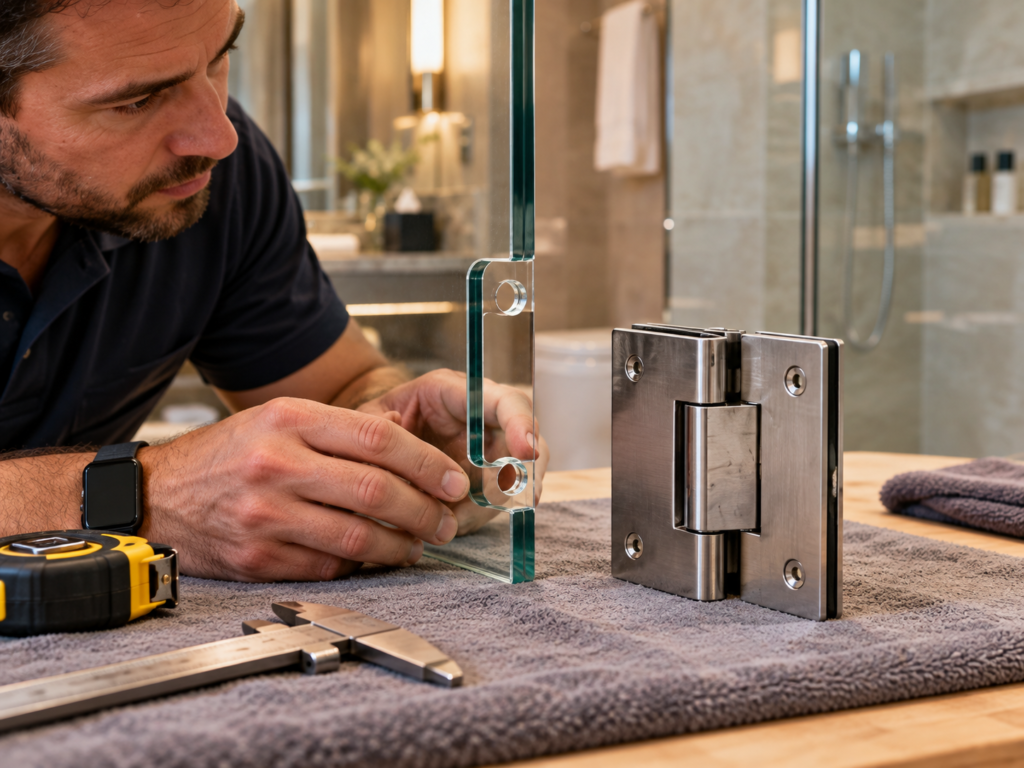
Survey the Hotel Before Making a Bulk Purchase
One of the biggest risks in multi-room renovation is assuming that every bathroom is identical.
A hotel may have started with one shower hardware specification, but years of maintenance can introduce several different replacement models.
Two rooms may look almost the same while using different hinges or glass cutouts.
A practical survey can record:
- room type;
- existing hinge type;
- glass thickness;
- door dimensions;
- cutout or hole pattern;
- finish;
- hinge condition;
- seal condition;
- handle and clamp condition;
- previous replacement hardware where identifiable.
The rooms can then be grouped into repeatable replacement categories.
This is much safer than removing one hinge from one room and ordering the same product for the entire building.
Build a Replacement Matrix by Room Type
Once the survey is complete, create a simple replacement matrix.
| Room Type | Existing Condition | Glass Preparation | Replacement Approach |
|---|---|---|---|
| Type A | Original hinges worn | Consistent cutout A | Direct compatible replacement |
| Type B | Original model discontinued | Cutout B | Alternative model review |
| Type C | Mixed repair history | Mixed preparation | Standardize during renovation |
This allows the purchasing team to calculate quantities according to the actual site condition.
It also prevents a single replacement model from being forced across incompatible bathrooms.
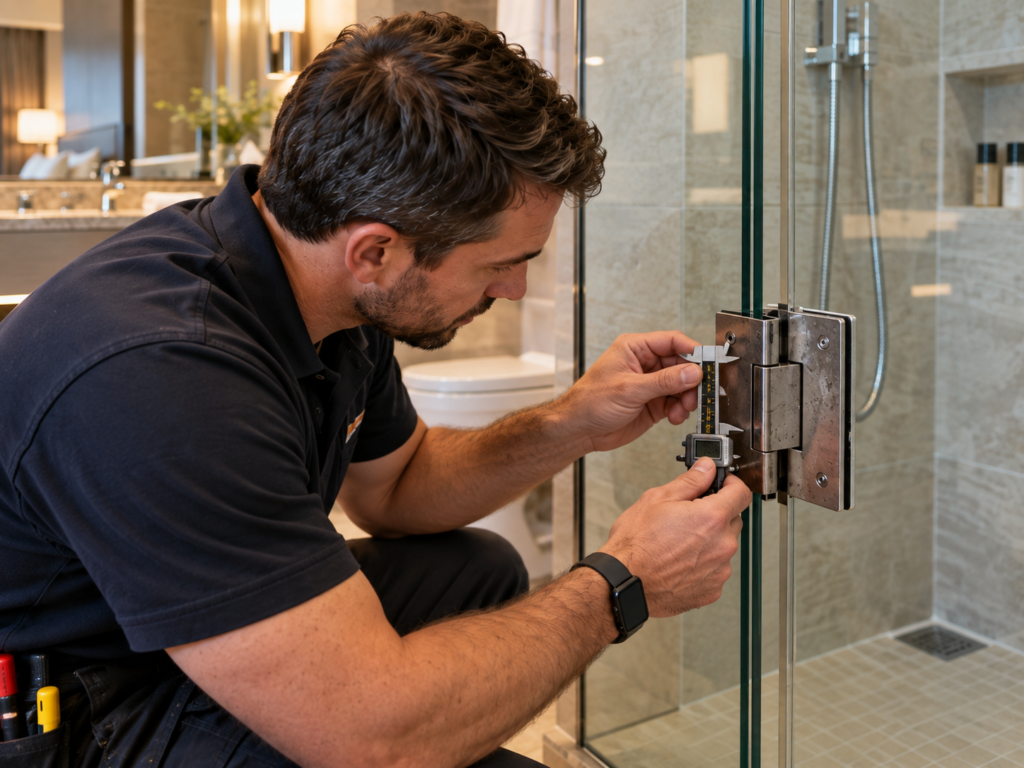
Match Geometry Before Appearance
A common replacement mistake is choosing a new hinge because it looks similar to the original.
Appearance helps with identification, but compatibility depends on more than shape and finish.
| Looks Similar | Still Needs to Match |
|---|---|
| Same square body | Existing cutout |
| Similar dimensions | Hole positions |
| Same finish | Glass thickness range |
| Same hinge angle | Closing behaviour |
| Same mounting style | Load suitability |
The project should review:
- cutout geometry;
- fixing position;
- plate coverage;
- gasket arrangement;
- compatible glass thickness;
- opening range;
- self-closing behaviour;
- door load.
The most suitable replacement is the model that works correctly with the existing enclosure, not simply the one that looks closest.
Review Hardware Durability During the Renovation
A renovation is also an opportunity to ask why the original hardware aged poorly.
Hotel shower hardware is exposed to moisture, frequent cleaning and repeated daily use. Coastal locations may introduce additional chloride exposure, while mineral deposits and cleaning chemicals create different maintenance challenges.
The original specification should therefore not automatically be copied.
Depending on the project, buyers may review alternatives such as brass, stainless steel or other suitable base materials together with the required surface finish.
For more demanding environments, SS316 may be considered where chloride resistance is important, while other projects may prioritize finish quality, mechanical strength or compatibility with the existing glass.
The correct choice depends on the actual environment and product design.
Review Cycle Performance and Closing Behaviour
Hotel shower doors may experience much higher use than a private residential enclosure.
If the old hinge has weak return action or inconsistent closing, the replacement evaluation should include more than external dimensions.
Where relevant, review:
- cycle-test information;
- spring or cam mechanism;
- closing and return behaviour;
- door load suitability;
- replacement gasket configuration.
Do not assume that every hinge with the same cutout will provide the same long-term operating performance.
For high-use projects, mechanical reliability should be part of the replacement specification.

What If the Original Hinge Is Discontinued?
This is common in older hotels.
The original supplier may no longer produce the model, or the design may have changed.
Several options may be possible.
Direct Compatible Replacement
This is the simplest solution when another model matches the existing glass preparation and provides suitable performance.
Alternative Model With Similar Glass Preparation
Another hinge may be usable, but cutout geometry, fixing holes, plate coverage and load conditions need to be checked.
Alternative Fixing Solution
Depending on the existing glass and hardware arrangement, another replacement approach may be possible.
This should be evaluated case by case.
Replace the Glass
If no safe and practical compatible hinge can be identified, replacing the glass may be more reliable than forcing an unsuitable hardware solution.
The objective is not to retain the existing glass at any cost.
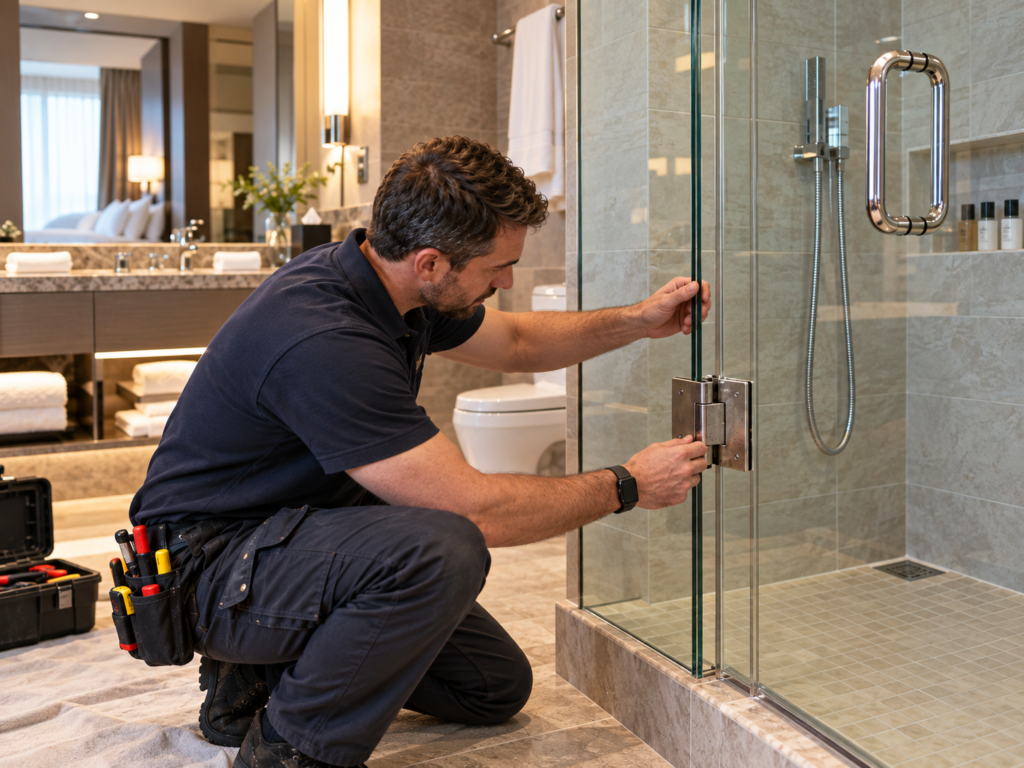
Use the Renovation to Reduce Old Hardware Variations
Hotel bathrooms often accumulate hardware variations after years of repairs.
One floor may use the original hinge, another may use a local replacement, and several rooms may already have different handles or seal profiles.
A larger renovation provides an opportunity to create a cleaner future standard.
Where practical, the project can:
- reduce the number of approved hinge families;
- standardize visible finishes;
- document replacement models by room type;
- unify seal references;
- retain approved samples and drawings;
- create clearer spare-part records.
Renovation should not simply reproduce every historical variation.
Plan Finish Upgrades Realistically
Some renovation projects want to keep the existing finish. Others use the bathroom upgrade to move from polished chrome to matte black, brushed metal, brass or another design direction.
For localized repairs, the goal may be to match the existing finish as closely as practical.
For larger renovation programs, replacing visible fittings as a coordinated set can provide a more consistent result.
This may include:
- shower hinges;
- pull handles;
- glass clamps;
- support hardware.
Existing finishes change over time, so a new component cannot always be expected to match aged hardware perfectly.
For decorative finishes, the coating system, base material, cleaning environment and approved sample should be reviewed together rather than selecting by colour name alone.
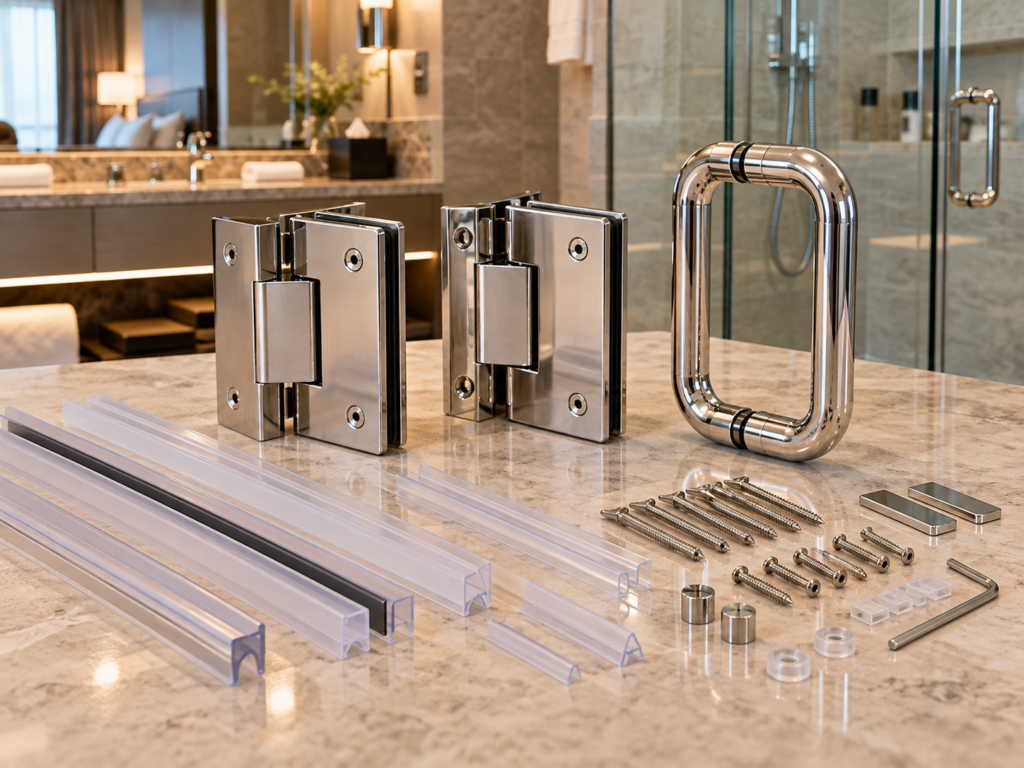
Review Seal Strips at the Same Time
Seal strips are easy to ignore during a hinge renovation.
However, years of use may leave them:
- hardened;
- discoloured;
- cracked;
- loose;
- less effective at controlling water.
Hinge replacement may also slightly change door alignment or the final gap.
For this reason, seals should be inspected as part of the same renovation survey and replaced where their condition or the new door geometry makes continued use impractical.
The required magnetic, side or bottom seal should match the actual glass thickness and gap condition rather than being selected as a generic replacement.
Test Sample Rooms Before Bulk Rollout
Before approving a large replacement order, select one or two representative rooms.
The sample replacement should verify:
- fit with the existing glass cutout;
- hole alignment;
- hinge-to-glass contact;
- door movement;
- closing behaviour;
- glass alignment;
- door gap;
- seal contact;
- finish appearance.
The first successful replacement room becomes the reference for the wider renovation.
This is especially important when using an alternative hinge for a discontinued original model.
Reduce Room Downtime With Pre-Planned Hardware Sets
Hospital renovation has an additional operational constraint: guest rooms need to return to service.
Before work begins, the contractor can prepare the correct hardware set for each room type.
This may include:
- replacement hinges;
- correct gaskets;
- screws and small fittings;
- seal strips where required;
- related replacement parts.
Different room types should be separated clearly.
Keeping a small quantity of approved spares can also help when unexpected site conditions appear.
Better preparation does not replace careful installation, but it reduces delays caused by missing or incorrect parts.
Common Mistakes in Multi-Room Shower Hinge Replacement
1. Ordering by Appearance Only
A visually similar hinge may not match the existing cutout.
2. Measuring One Room and Assuming the Entire Hotel Is the Same
Previous repairs may have introduced several different hardware configurations.
3. Ignoring the Existing Glass Preparation
The cutout is often the main constraint in replacement selection.
4. Replacing the Hinge Without Checking Door Alignment
Poor closing may involve more than hinge wear.
5. Automatically Repeating the Original Material Specification
Renovation is a good time to review whether durability should be improved.
6. Expecting New Finishes to Match Aged Hardware Perfectly
Existing surfaces may have changed after years of use and cleaning.
7. Ordering the Full Quantity Before Testing a Sample Room
A small compatibility problem can become a large project problem when repeated across many rooms.
What Buyers Should Provide for Replacement Matching
Useful information includes:
- clear photos of the existing hinge;
- hinge dimensions;
- glass thickness;
- cutout photo or drawing;
- hole positions;
- door width and height;
- existing finish;
- room quantity;
- number of different enclosure layouts;
- original model or brand if known.
Where practical, a safely removed physical hinge sample can also help with comparison.
How Metech Supports Hotel Shower Hardware Renovation
Metech Hardware works with selected production partners to support hotel operators, renovation contractors, glass companies and project buyers with replacement shower hardware.
Depending on the project, we can help review:
- replacement hinge options;
- existing dimensions and cutout compatibility;
- alternative material options;
- finish coordination;
- sample matching;
- gasket and seal requirements;
- mixed replacement hardware orders;
- hardware-set preparation;
- pre-shipment checking;
- export order coordination.
For multi-room renovation, we recommend surveying representative rooms and confirming replacement samples before bulk ordering.
Compatibility depends on the existing glass preparation, door condition and original hardware design.
The objective is to identify a practical replacement solution rather than assume that every old hinge can be replaced without changing the glass.
FAQ
Can Old Shower Hinges Be Replaced Without Replacing the Glass?
Sometimes. Compatibility depends on the glass thickness, cutout, hole positions, door size and replacement hinge geometry.
Can a Standard Shower Hinge Be Upgraded to a Soft-Close or Hydraulic Hinge?
Possibly, but the new hinge must be checked against the existing glass preparation, door load, hinge footprint and operating clearance. Cutout similarity alone is not enough.
What If the Original Shower Hinge Is Discontinued?
A compatible alternative may be available. If no safe replacement matches the existing glass preparation, glass replacement may need to be considered.
Should Hotels Replace All Shower Hinges at the Same Time?
Not necessarily. Replacement can be organized by condition, floor, room type or renovation phase.
Does the Glass Door Need to Be Removed During Hinge Replacement?
In many installations, the glass needs to be safely supported or removed so the hinge can be unloaded and replaced correctly. The exact procedure depends on the hinge design and should be handled by qualified installers.
What Information Is Needed to Find a Replacement Hinge?
Photos, dimensions, glass thickness, cutout details, hole positions, door size, finish and quantity are useful. The original model or physical sample can also help.
Planning a Multi-Room Shower Hardware Renovation?
Send us photos of the existing shower hinges, glass thickness, door dimensions, cutout details, finish requirements and room quantities.
Metech Hardware can help review replacement options and coordinate sample matching before bulk renovation orders.