In commercial architectural projects, installing a frameless glass door is not a simple linear process. It is a coordinated mechanical system involving the site contractor, glass fabricator, installer and hardware supplier.
The timeline is strict.
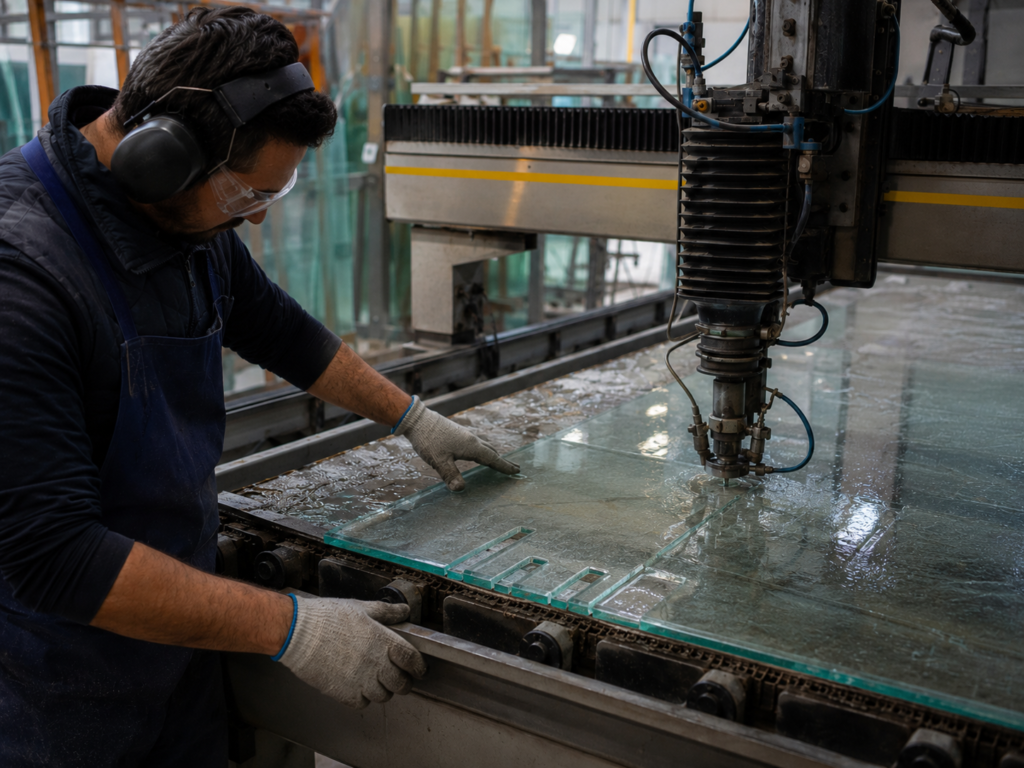
Before the glass enters the tempering furnace, all drilling, notching, CNC cutting and edge processing must already be completed. Once tempered, the glass panel cannot be safely drilled, enlarged, cut or reshaped on site.
This means a hardware decision made too late can become a serious project problem. If the patch fitting cutout does not match, if the lock holes are missing, if the floor spring spindle does not align with the bottom patch fitting, or if the glass thickness does not match the gasket package, the project may face delays, extra cost or replacement glass.
For glass fabricators, glazing contractors, fit-out contractors and hardware distributors, profitable project delivery depends on early frameless glass door hardware coordination.
The goal is simple:
confirm the hardware system before glass processing, not after the glass has already been tempered.
1. Why Hardware Coordination Must Happen Before Tempering
A frameless glass door is different from a framed door. There is no full metal frame to hide small dimensional mistakes. The hardware connects directly to the glass, so every hole, notch, cutout, gap and clearance matters.
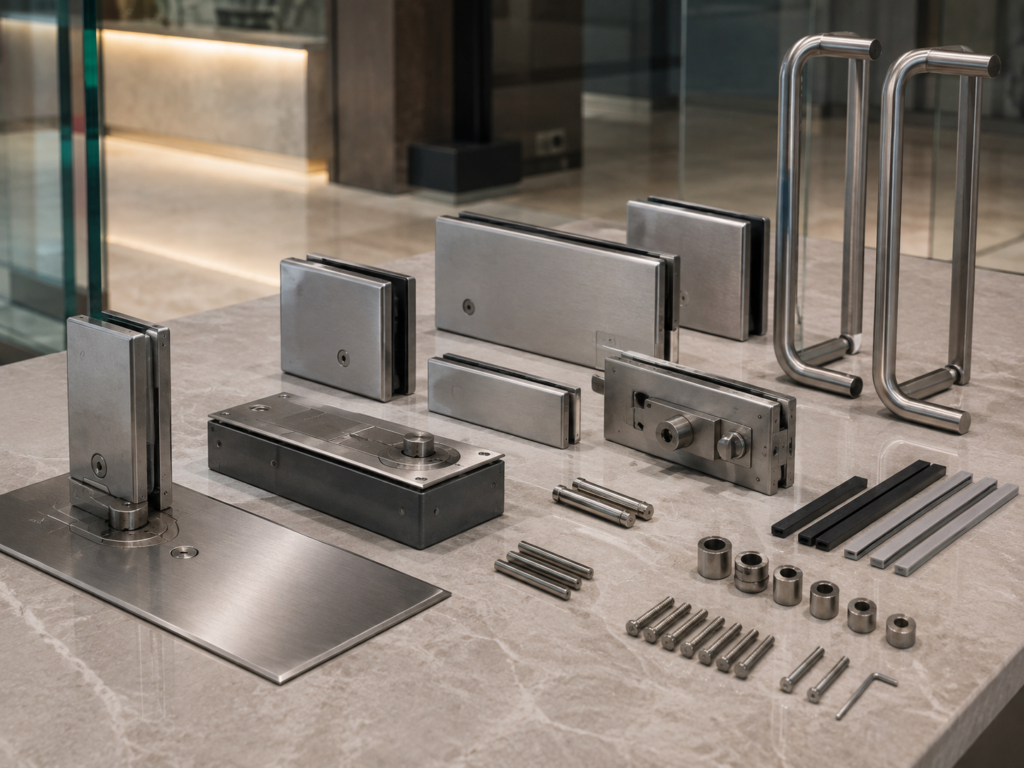
Patch fittings may require corner cutouts and circular holes. Patch locks or bottom locks may need additional glass preparation. Pull handles require accurate hole spacing. Floor springs define the pivot center. Top pivots and overpanel fittings must align with the moving door. Electric drop bolts or access control locks may require special receiver positions.
If these details are not confirmed before tempering, the installer may arrive on site with hardware that cannot be fitted to the glass.
The safer workflow is:
confirm hardware model → confirm drawings and dimensions → process glass → temper glass → install hardware.
This process helps reduce mismatch risk between the glass factory, the contractor and the hardware supplier.
In frameless glass door projects, many expensive mistakes happen before installation day. Good coordination moves those decisions earlier, before the glass is produced.
2. The Project Workflow: Contractor, Fabricator, Installer and Hardware Supplier
A successful frameless glass door project usually involves several parties.
The site contractor or glazing contractor confirms opening dimensions, finished floor level, site structure, installation sequence and project requirements.
The glass fabricator cuts, drills, CNC-processes, edges and tempers the glass. The fabricator needs accurate hardware information before processing.
The installer handles final hardware assembly, patch fitting tightening, door gap adjustment, pivot alignment and lock testing.
The hardware supplier provides selected hardware models, dimensional references, cutout drawings, load suggestions and compatibility checks for floor springs, patch fittings, locks, handles and related accessories.
The project becomes risky when each party works from different assumptions.
For example, the contractor may assume a 65mm pivot center, while the selected bottom patch fitting works with another spindle position. The fabricator may prepare a cutout based on a similar-looking patch fitting, while the delivered hardware uses a different internal block. The installer may discover that the lock requires a door gap that was not planned.
Frameless glass door coordination means all teams work from the same hardware schedule before glass production begins.
3. The Geometry Rule: Coordinating Cutouts, Holes and Notches
The most frequent problem in frameless glass door projects is a mismatch between the glass preparation and the actual hardware.
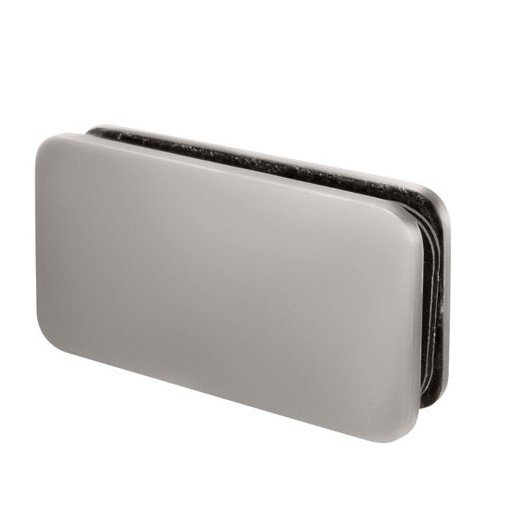
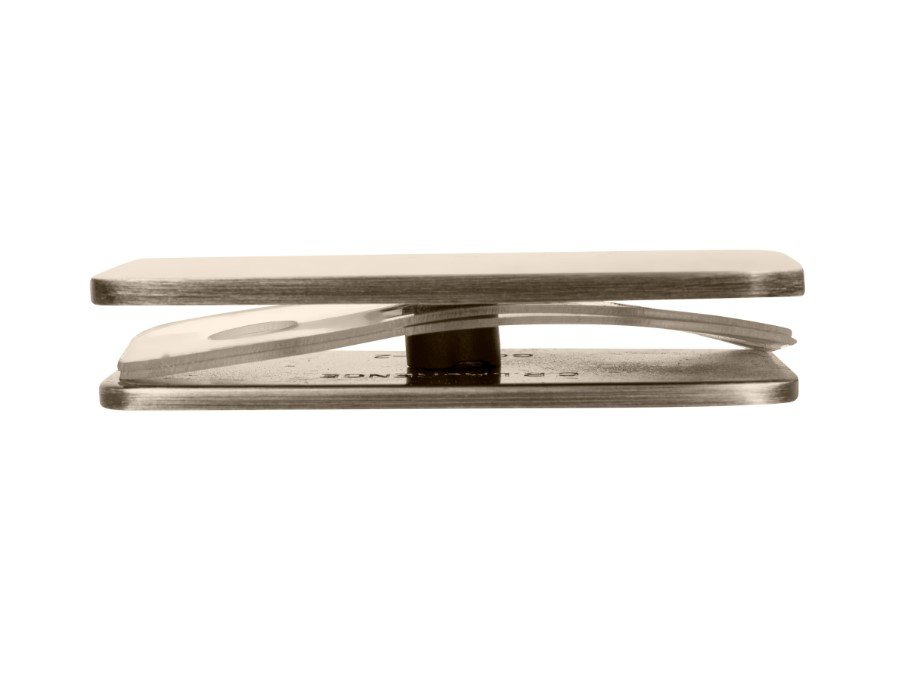
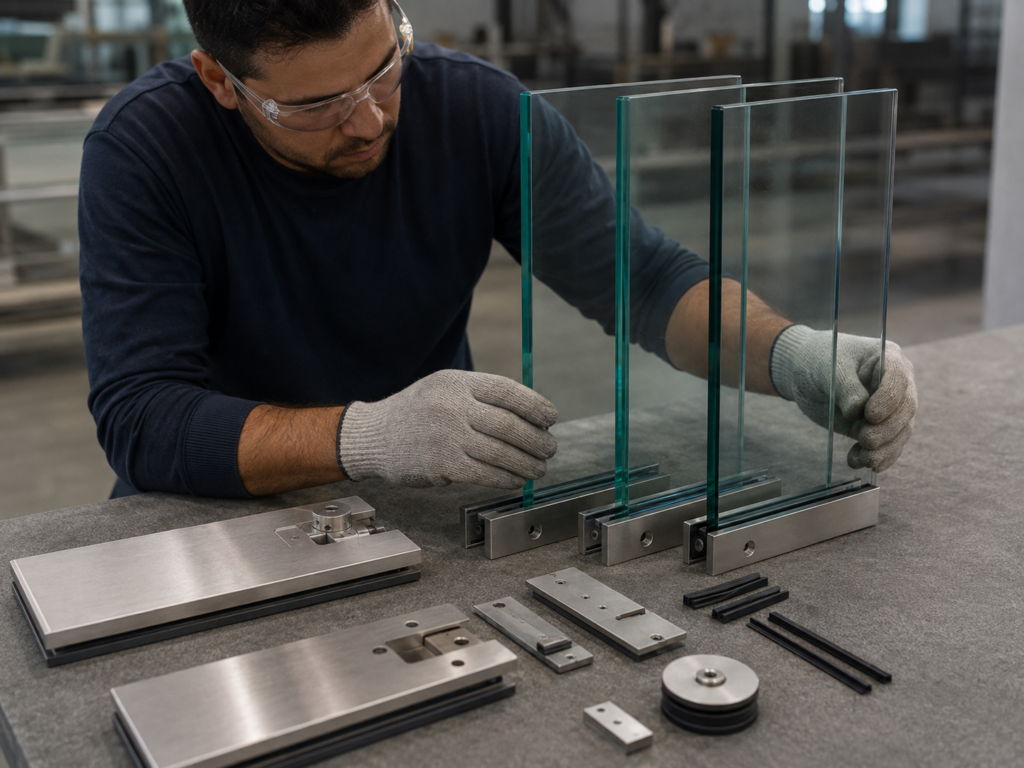
Patch fittings, central locks, bottom locks and heavy-duty hinges do not always clamp only on the flat surface of the glass. Many products use internal blocks, bolts, sleeves or fixing points that must pass through physical holes and notches in the glass.
There is no single universal cutout standard for every frameless glass door fitting. Different manufacturers, product series and regional hardware styles may use different hole spacing, notch shapes, pivot offsets and internal clamping structures.
This is why contractors should not rely only on external cover plate size.
Two patch fittings may look similar from the outside, but the internal cutout can be different. A cover plate with a similar length and width does not guarantee that the glass notch, bolt hole position or corner cutout will match.
For new glass production, the hardware schedule should be locked first. Contractors should obtain the correct PDF drawing, CAD reference or dimensional template for the selected patch fitting, lock, hinge or handle, and pass it to the glass fabricator before CNC processing.
For replacement projects, the existing glass holes and cutouts should be measured and photographed before ordering new hardware.
A few millimeters of error can decide whether the hardware fits or fails.
4. Load Transfer: Matching Glass Weight, Floor Spring and Patch Fitting
Glass fabricators often know the exact size and thickness of each panel, but the hardware selection must also consider how that glass weight is transferred into the floor spring, patch fitting and pivot system.
A practical glass weight formula is:
Glass weight = 2.5kg per square meter per 1mm glass thickness
For example:
12mm glass weighs about 30kg/m².
A standard commercial glass door measuring 1.0m × 2.4m × 12mm weighs approximately:
1.0 × 2.4 × 30 = 72kg
For oversized entrances, the weight increases quickly. A large door measuring 1.5m × 3.0m × 15mm weighs approximately:
1.5 × 3.0 × 37.5 = 168.75kg
The floor spring should not be selected only according to static glass weight. Door width, traffic frequency, wind pressure, user impact, pull handle size and installation condition also affect the working load.
For oversized, wide or high-traffic doors, contractors should avoid selecting a floor spring too close to the calculated door weight. A practical working margin is often required. In some cases, a higher-capacity floor spring series, such as a 300kg model, may be considered for doors approaching 150kg or more, depending on the actual door width and project condition.
The bottom patch fitting must also match the floor spring. The insert inside the bottom patch must fit the spindle profile of the floor spring, such as flat-tapered, square or other supplier-specific spindle types.
If the insert and spindle do not match, the door may have loose play, poor centering, wobbling movement or abnormal stress on the patch fitting.
Load coordination is not only about one product. The glass, floor spring, bottom patch, top pivot and installer’s alignment must work together.
5. Pivot Axis and Spindle Insert Compatibility
The pivot axis is one of the most important details in a frameless glass door system.
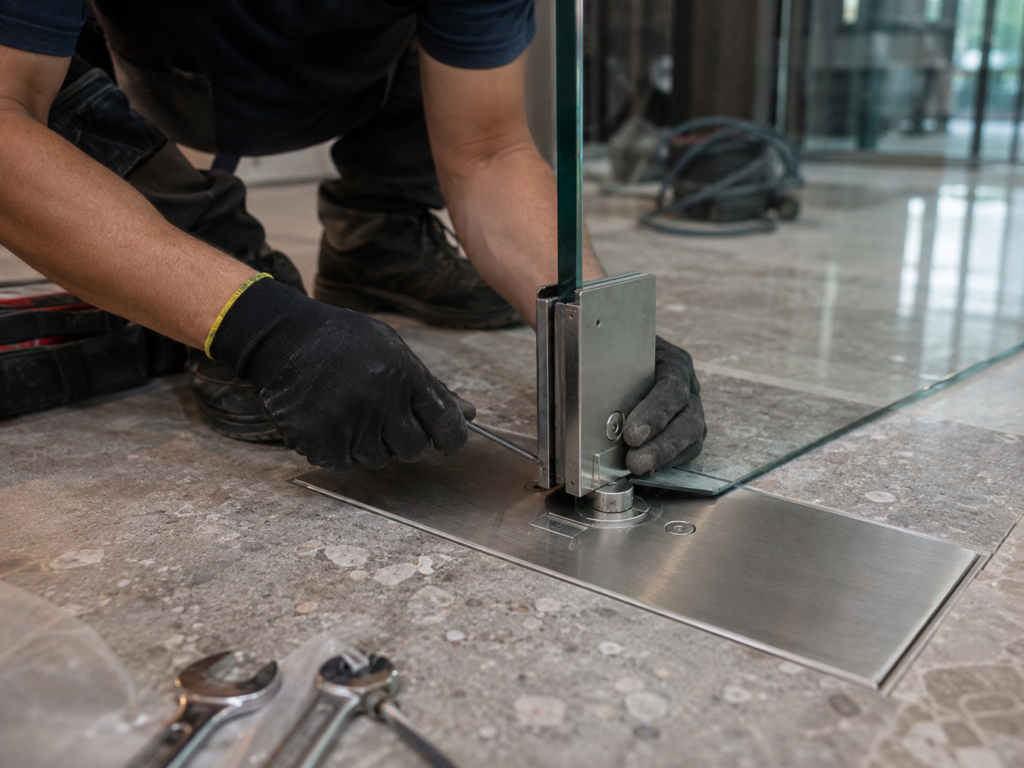
In a floor spring door, the floor spring spindle connects to the bottom patch fitting. The top pivot supports the upper part of the door. Together, they form the vertical rotation axis of the moving glass panel.
Common pivot center references may include 55mm or 65mm, depending on the selected hardware model. These values should never be guessed from appearance. They should be confirmed from the actual floor spring, bottom patch fitting and top pivot combination.
Even a 2mm to 3mm pivot alignment error can create visible problems:
- the door may not return to center;
- the bottom edge may scrape the floor;
- the door gap may become uneven;
- the central lock may not align;
- the floor socket may miss the lock bolt;
- the patch fitting may carry abnormal stress;
- the floor spring may wear faster.
For double glass doors, pivot alignment becomes more important because both leaves must meet correctly at the center line. If one door is slightly off axis, the meeting gap, central lock position and floor socket alignment may all be affected.
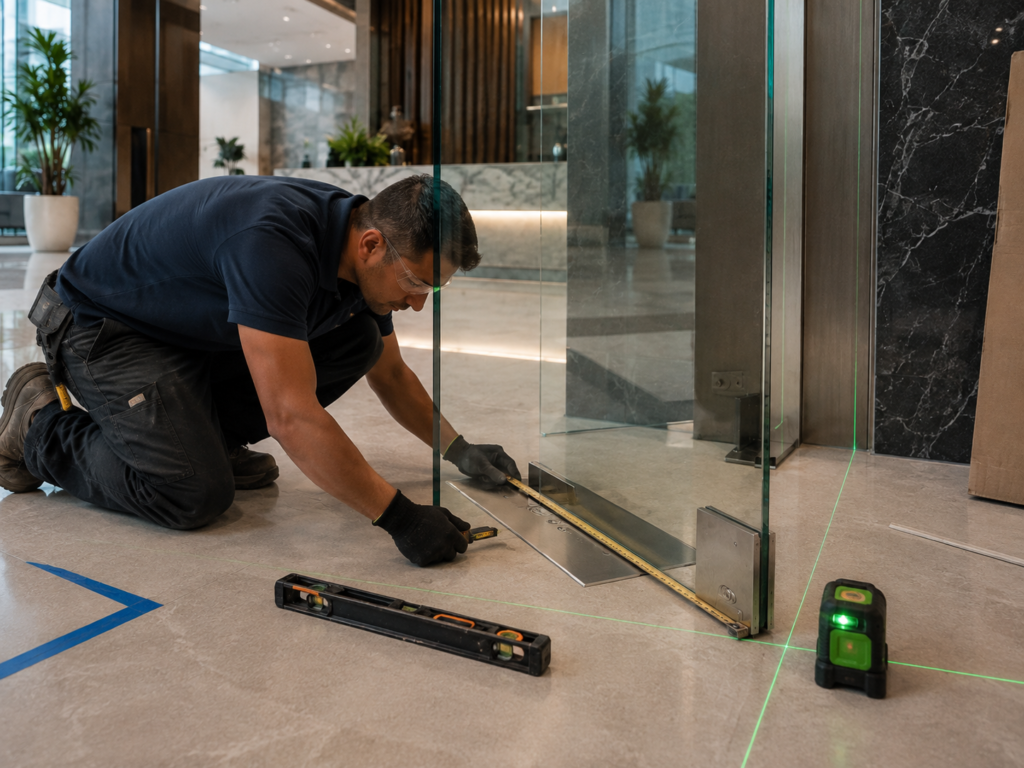
Before glass production, the contractor should confirm the floor spring position, spindle center, top pivot position, bottom patch fitting, door width, finished floor level and required bottom clearance.
6. Clearances, Locks and Door Gap Planning
Door gaps are not only visual. They affect movement, locking, sealing and user safety.
A frameless glass door requires planned clearance at the floor, side jamb, top area and meeting edge. The correct gap depends on hardware type, glass thickness, door size, lock type, floor condition and project requirement.
For many central glass-to-glass patch lock applications, the meeting gap is often kept around 3mm to 5mm, depending on the lock model. If the gap is too small, metal lock covers or glass edges may interfere when the doors move. If the gap is too large, the bolt or keeper engagement may become unreliable.
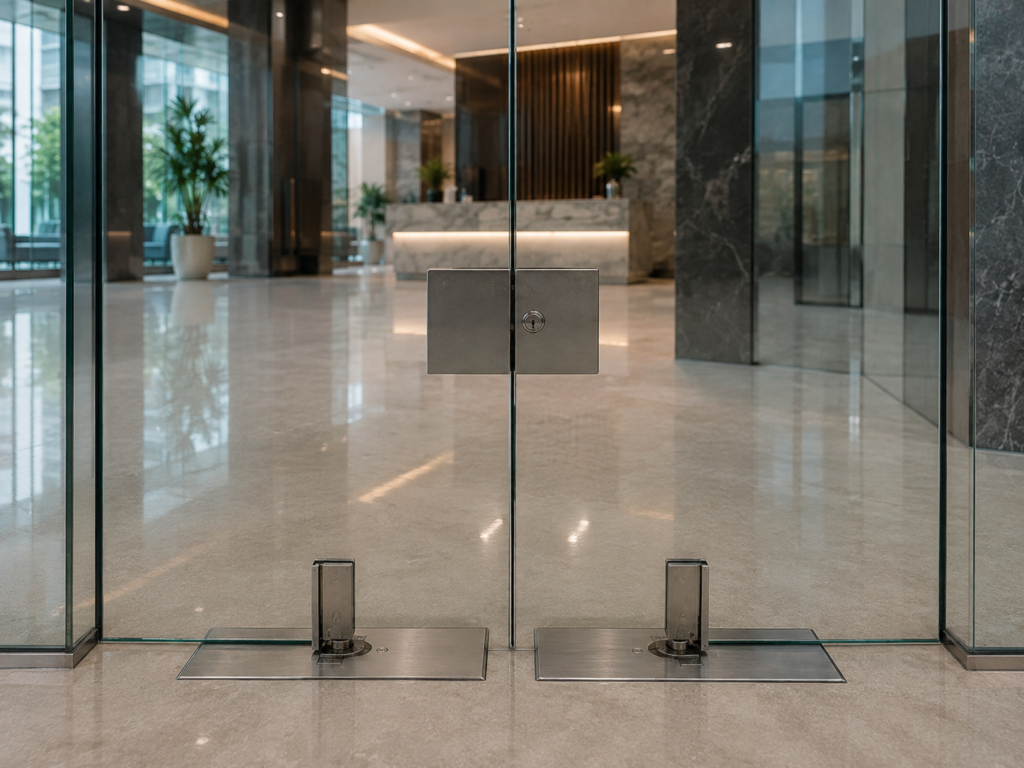
Locking hardware should be confirmed before glass processing. Common options include:
- patch lock;
- bottom patch lock;
- central glass lock;
- sliding glass lock;
- floor socket;
- keeper;
- inactive leaf floor bolt;
- electric drop bolt;
- smart lock or access control hardware.
Each lock type may affect the glass holes, door gap, floor preparation and hardware position.
For example, a bottom patch lock must align with a dust-proof floor socket. A central patch lock must match the meeting gap. An electric drop bolt must return to the receiver accurately, which depends on door centering and floor spring quality.
Pull handles also require early coordination. Hole spacing, handle length, glass thickness and installation height should be confirmed before drilling.
Locks and handles are not final decorative additions. They are part of the glass processing plan.
7. Glass Thickness and Gasket Package Coordination
Hardware coordination also includes glass thickness.
Common commercial frameless glass door thicknesses include 10mm, 12mm and 15mm. Some patch fittings and locks are designed to support more than one glass thickness by using different spacer gaskets, clamping blocks or screw lengths.
However, the correct gasket package must be supplied with the hardware.
If a fitting intended for 12mm glass is installed on 10mm glass without the correct spacer gaskets, the cover plates may bottom out before enough clamping pressure is applied. Over time, the glass may slip downward or the fitting may become loose.
If standard hardware is used on thicker glass, such as 15mm, the fitting may not close properly around the glass edge unless the model supports that thickness. In some cases, thinner gaskets, different internal blocks or longer fixing bolts may be required, depending on the product design.
This is why contractors should specify the exact glass thickness when ordering hardware.
The glass fabricator, contractor and hardware supplier should confirm:
- glass thickness;
- gasket package;
- screw length;
- clamping method;
- sleeve or isolation parts;
- cover plate fit;
- load capacity for the selected glass thickness.
A correct gasket package helps protect the glass and maintain stable clamping pressure during long-term use.

8. Finish Coordination Across Visible Hardware
In commercial fit-out projects, hardware coordination is not only mechanical. It is also visual.
A frameless glass entrance may include patch fittings, pull handles, glass locks, floor spring cover plates, door closers, glass clamps and other visible metal parts. If these items are purchased from many different suppliers, the finish may not match.
One supplier’s brushed stainless steel may have a different grain direction from another supplier’s brushed finish. Matte black may be powder coated, painted or PVD-coated depending on the supplier. Gold finishes may vary in tone. Polished chrome and brushed nickel may also differ between product series.
For hotels, retail stores, office lobbies and premium commercial interiors, finish consistency affects the final appearance of the whole entrance.
Unified procurement helps improve consistency across visible hardware. It also simplifies communication because the contractor can confirm finish, quantity and project hardware schedule with one supplier instead of coordinating many small orders separately.
Finish samples, product photos or confirmed surface codes are useful before bulk ordering.
9. Common Coordination Mistakes in Frameless Glass Door Projects
The first mistake is ordering glass before confirming the hardware model. This creates risk because the glass cutouts, holes and clearances may not match the final fittings.
The second mistake is using similar-looking patch fittings without checking drawings. Similar cover plates do not guarantee the same internal block, pivot offset or hole pattern.
The third mistake is ignoring floor spring and spindle compatibility. If the bottom patch insert does not match the floor spring spindle, the door may wobble or fail to return cleanly.
The fourth mistake is forgetting lock and handle holes. The door may be prepared correctly for patch fittings but still miss the holes required for locks or pull handles.
The fifth mistake is changing hardware brands after glass tempering. This may be possible only when the new hardware matches the existing glass thickness, cutout shape and hole pattern.
The sixth mistake is using the wrong gasket package for the glass thickness. This can reduce clamping pressure or prevent the fitting from closing correctly.
The seventh mistake is ignoring finished floor level and bottom clearance. A small difference in floor height can cause rubbing, uneven gaps or lock misalignment.
The eighth mistake is mixing visible hardware finishes from too many suppliers without samples or finish confirmation.
These mistakes are common because different teams focus on different parts of the project. Good coordination helps discover the mismatch before production, not during installation.
10. What to Confirm Before Glass Production
Before glass production, the project team should confirm both the site information and the hardware information.
Useful details include:
- project type;
- opening width and height;
- glass thickness;
- door width and height;
- single or double door layout;
- estimated glass weight;
- floor spring model;
- bottom patch fitting model;
- top patch fitting and top pivot requirement;
- overpanel or side panel layout;
- pivot center;
- lock type;
- handle hole spacing;
- fixed glass layout;
- finished floor condition;
- bottom clearance;
- gasket package;
- finish requirement;
- quantity;
- replacement or new project;
- drawings or site photos.
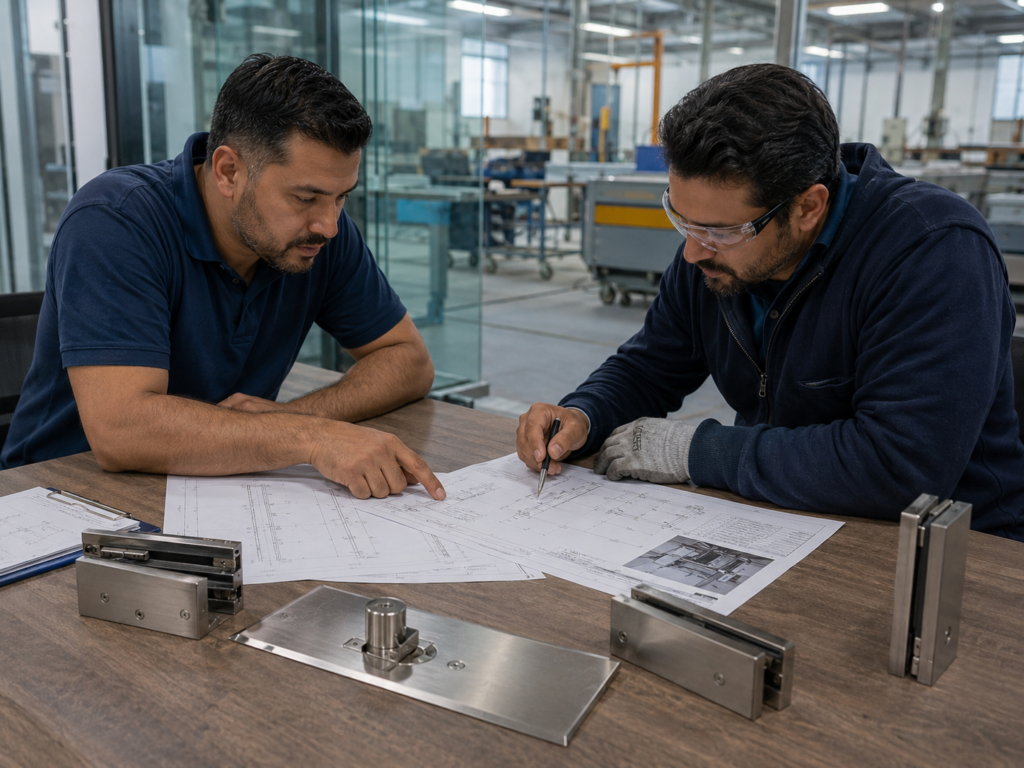
For commercial projects, drawings should be reviewed by the contractor, fabricator and hardware supplier before glass processing begins. If the hardware is already available, a physical sample can also help confirm hole spacing, cutout shape and fitting depth.
The purpose of this checklist is not to slow the project down. It is to prevent producing glass that cannot accept the selected hardware.
11. How Metech Supports Fabricators and Contractors
Metech Hardware supplies frameless glass door hardware for commercial glass door projects, including floor springs, patch fittings, top pivots, patch locks, bottom locks, pull handles, glass clamps and related architectural glass hardware.
For glass fabricators, contractors and project buyers, Metech can help review hardware combinations before glass processing. We can support project discussions around glass thickness, estimated door weight, floor spring selection, pivot center, patch fitting type, spindle insert compatibility, lock position, handle hole spacing, finish and quantity.
For selected hardware models, Metech can provide product drawings, cutout references or dimensional information to help customers coordinate with glass fabricators before tempering. For distributors and contractors, Metech can also support mixed hardware orders for glass doors, glass partitions, shower enclosures, glass railings and commercial entrance projects.
Before quotation, buyers can send door schedules, glass sizes, site photos, hardware requirements and current project problems. Metech can help reduce mismatch risk by checking whether the selected hardware set fits the project direction before glass production.
Final glass processing dimensions should always be confirmed according to the selected product drawing and approved project documents.
FAQ
Can a glass factory modify a cutout after tempering?
No. Once architectural glass has been tempered, it cannot be safely drilled, cut, enlarged or ground on site. Any drilling, grinding or cutting after tempering is unsafe and may cause glass breakage.
Do you provide CAD or cutout drawings for patch fittings?
For selected hardware models, Metech can provide product drawings, cutout references or dimensional information. These should be checked with the final product model and project approval documents before glass processing.
Can similar patch fittings use different glass cutouts?
Yes. Similar exterior cover plates may use different internal blocks, bolt positions, pivot offsets or notch shapes. The actual cutout drawing should be checked before glass processing.
What happens if 12mm hardware is used on 10mm glass without correct gaskets?
The fitting may not clamp the glass correctly. The cover plates may bottom out before enough pressure is applied, which can lead to looseness or glass slipping over time.
Can I mix a bottom patch fitting from one brand with a floor spring from another?
It may be possible, but the spindle profile, insert shape, pivot center and load requirement must match. If the bottom patch insert and floor spring spindle are incompatible, the door may wobble or fail to return correctly.
Why is pivot alignment important for glass doors?
The top pivot, bottom patch fitting and floor spring spindle must align on the same vertical axis. Poor alignment can cause rubbing, poor centering, uneven gaps, lock misalignment and extra stress on the hardware.
Should locks and handles be confirmed before glass processing?
Yes. Patch locks, bottom locks, central locks, electric drop bolts, smart locks and pull handles may all require specific hole positions or affect door gaps.
What should I send to Metech before ordering?
Send opening dimensions, glass thickness, door size, door type, estimated glass weight, hardware requirements, lock type, handle hole spacing, site photos, drawings, finish, quantity and whether it is a new project or replacement project.