shower door hinge troubleshooting, frameless shower door hinge, shower hinge replacement, glass shower door hinge, shower door sagging, shower door not closing properly, self closing shower hinge, shower hinge cutout, shower hinge mouse-ear cutout, shower hinge hole pattern, shower hinge gasket compression, shower hinge zero position, heavy duty shower door hinge, shower hinge replacement for existing glass, shower hinge for 8mm 10mm 12mm glass
In a frameless glass shower enclosure, the hinge is one of the main structural components that supports the moving glass door. It carries the vertical dead weight of the glass, controls the swing movement, helps the door return to position, and keeps the glass aligned with seals, fixed panels and shower openings.
A shower hinge works in a difficult environment. It is exposed to hot water, steam, hard water minerals, cleaning chemicals and repeated daily movement. In hotels, gyms, spas and clubhouse shower rooms, the same hinge may be used many times every day.
When a frameless shower door begins to sag, fails to close tightly, leaks water near the hinge side, hits the fixed glass, or makes a sharp clicking sound, many buyers assume the glass panel has warped.
But tempered glass normally does not warp like wood or plastic. When a frameless shower door moves out of position, the cause is usually mechanical.
The problem may come from the hinge body, but it may also come from glass weight, hinge quantity, gasket compression, wall alignment, seal strip interference, wrong hinge angle or poor replacement matching.
The key question is:
Is the problem caused by the hinge itself, or by the glass door layout around it?
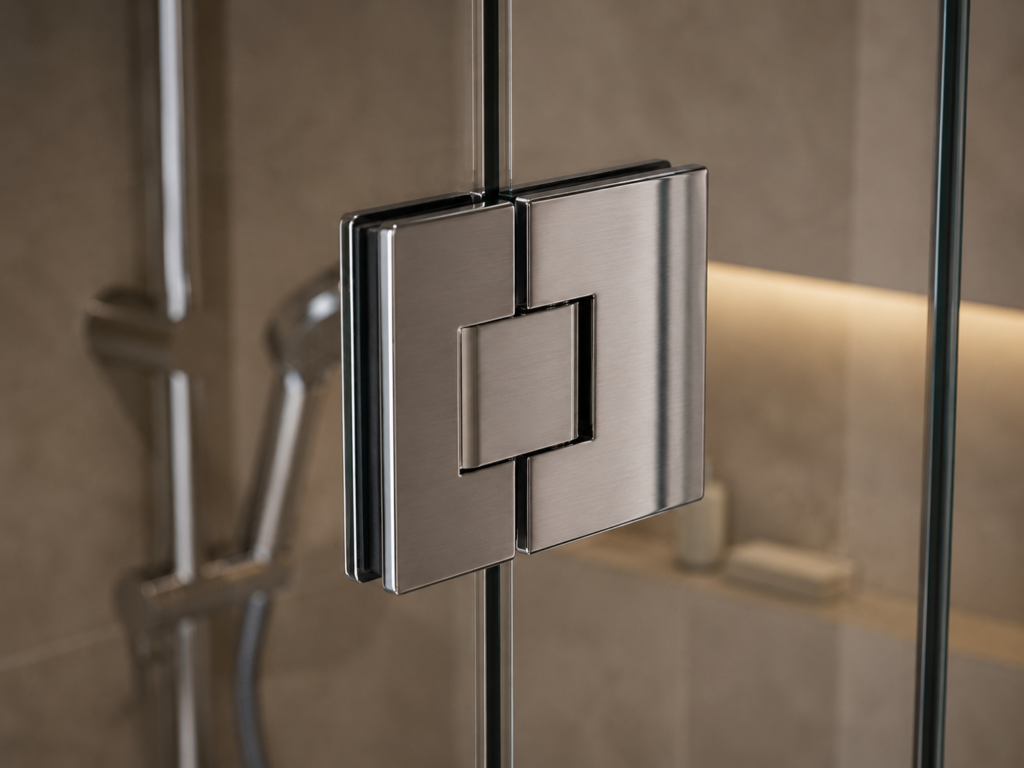
1. Why Shower Hinge Problems Are Often Misdiagnosed
A frameless shower door does not have a full metal frame to support the glass. The hinges, fixed panel, wall fixing points, gaskets, seals and glass clearances must all work together.
If one part is wrong, the hinge may be blamed even when the real problem is elsewhere.
A door may sag because the hinge body is overloaded, but it may also sag because the internal gaskets have compressed and the glass has slipped downward. A self-closing door may fail to return because the internal spring is worn, but it may also be stopped by magnetic seal friction or incorrect hinge angle. Water leakage near the hinge side may look like a hinge problem, but the real cause may be poor bottom seal contact, floor slope or glass misalignment.
Common causes include:
- glass door weight exceeding hinge capacity;
- too few hinges for the door size;
- gasket compression and loss of clamping friction;
- loose hinge screws;
- wall not plumb;
- fixed glass panel movement;
- incorrect 90°, 135° or 180° hinge angle;
- seal strip interference;
- wrong glass clearance;
- internal spring or cam fatigue;
- unsuitable material or finish for wet areas;
- replacement hinge not matching the original glass holes.
Before replacing a shower hinge, buyers should diagnose the glass weight, hinge angle, hole pattern, gasket condition, wall alignment and seal system.
2. How a Frameless Shower Door Hinge Supports the Glass
A frameless shower door hinge is not the same as a small furniture hinge. It must hold a heavy tempered glass panel without a full frame.
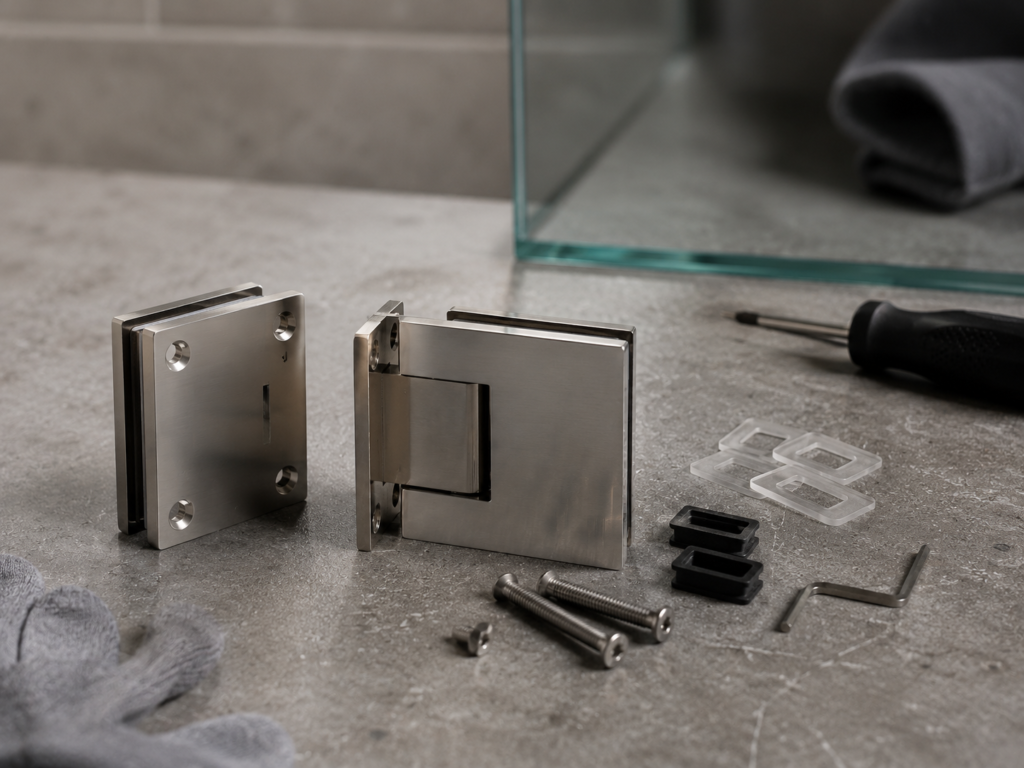
The hinge uses clamping plates, screws and high-density gaskets to grip the glass. The gasket protects the glass from direct metal contact and distributes clamping pressure. The hinge body and pivot mechanism control the swing movement. In self-closing hinges, an internal spring or cam mechanism helps return the door toward the closed position.
Common shower glass thicknesses include 8mm, 10mm and 12mm. The hinge must match the glass thickness, gasket thickness and screw length. A hinge designed for 8mm glass should not be forced onto 10mm or 12mm glass without the correct gasket package.
Glass weight should also be calculated before choosing hinges. A practical formula is:
Glass weight = 2.5kg per square meter per 1mm glass thickness
This means:
10mm glass weighs about 25kg/m².
For example, a shower door measuring 0.8m × 2.0m × 10mm weighs approximately:
0.8 × 2.0 × 25 = 40kg
A larger door measuring 0.9m × 2.1m × 10mm weighs approximately:
0.9 × 2.1 × 25 = 47.25kg
If the calculated door weight is around 45kg, buyers should not choose a hinge pair rated only around 35kg. A heavier-duty hinge pair rated around 50kg, or a suitable three-hinge layout, may be considered depending on door size, hinge design and use frequency.
Wall-to-glass hinges and glass-to-glass hinges also work differently. A wall-to-glass hinge transfers load into the wall. A glass-to-glass hinge transfers part of the load into a fixed glass panel. If the fixed panel is unstable, the moving door may sag even when the hinge itself is not defective.
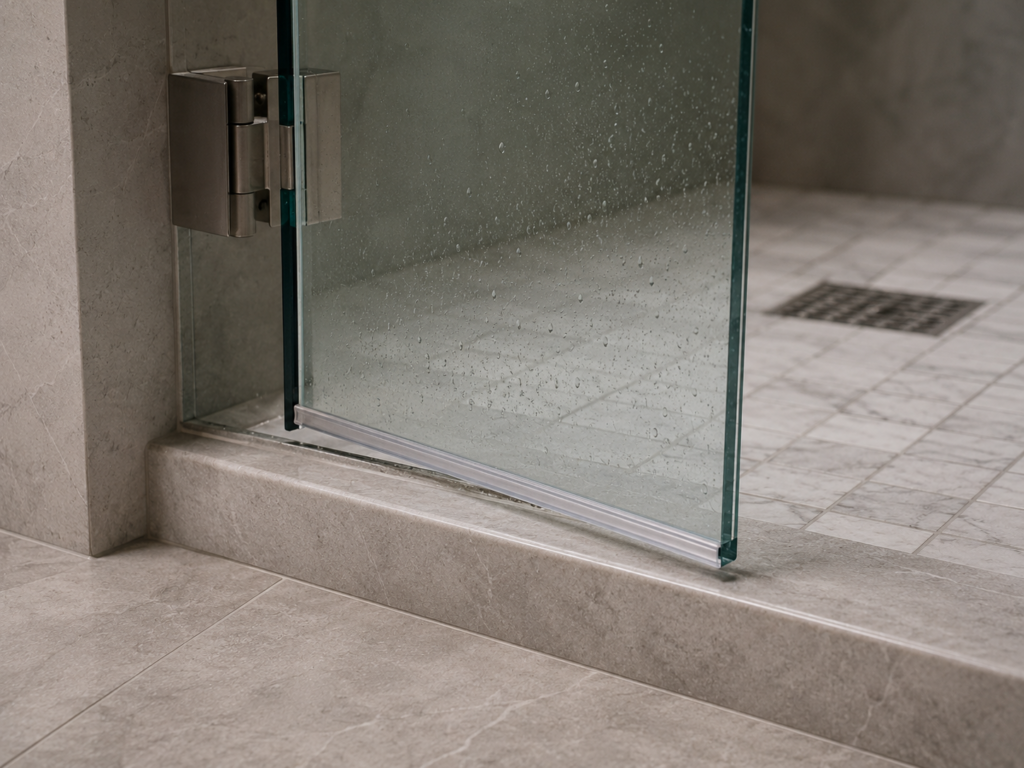
3. Problem 1: Door Sagging and Loss of Clamping Friction
Door sagging is one of the most common frameless shower door problems.
The bottom edge of the moving glass door may drag against the floor curb, shower tray or bottom sweep seal. The magnetic seal may no longer meet correctly. The hinge-side gap may become uneven. In some cases, the moving glass may start touching the fixed glass panel.
A sagging shower door is usually a load and clamping problem, not only a seal strip problem.
In many cases, the hinge loses clamping friction. Over time, internal gaskets may compress and flatten. Screws may loosen under repeated movement. If the hinge is under-rated for the glass weight, the glass may slowly slip downward millimeter by millimeter inside the hinge body.
Even a 2mm to 3mm drop can affect a frameless shower door. The bottom seal may drag. The magnetic strip may misalign. The door may stop returning smoothly.
For diagnosis, the installer should safely support the glass door, check the hinge screws, inspect whether the glass has slipped inside the hinge, and confirm whether the gaskets are still holding pressure. In some cases, the door can be repositioned and the screws re-torqued. If the door sags again after a short period, the gaskets may be permanently compressed, or the hinge may be structurally under-specified.
For heavier shower doors, hotel bathrooms, gyms and high-frequency wet areas, hinge load capacity should be reviewed carefully before replacing with the same model.
4. Problem 2: Poor Self-Closing or Loss of Zero-Point
A self-closing shower hinge is designed to help the door return toward the closed position. In a good installation, the door should stop cleanly at the intended 0° closed position.
If the door swings freely but fails to return to zero, leaves a visible gap, or stops slightly open, water leakage and seal misalignment may follow.
Many self-closing shower hinges begin to pull the door closed around 25°, depending on model design. Some hinges have a different self-closing range, and some are free-swing hinges with no self-closing function.
Poor self-closing may be caused by:
- internal spring or cam fatigue;
- incorrect hinge angle;
- hinge body installed out of alignment;
- glass door too heavy for the hinge;
- wall not plumb;
- fixed glass panel moving under load;
- magnetic seal or bottom seal creating friction;
- wrong 90°, 135° or 180° hinge selection.
A self-closing hinge cannot correct a wrong shower layout. A 90° hinge is used for a different configuration than a 135° hinge or 180° hinge. If the hinge angle does not match the glass-to-wall or glass-to-glass arrangement, the door may never return naturally to the correct position.
If the internal return mechanism has lost tension, the hinge normally needs replacement. Most self-closing shower hinges are sealed assemblies and are not designed for on-site spring replacement.
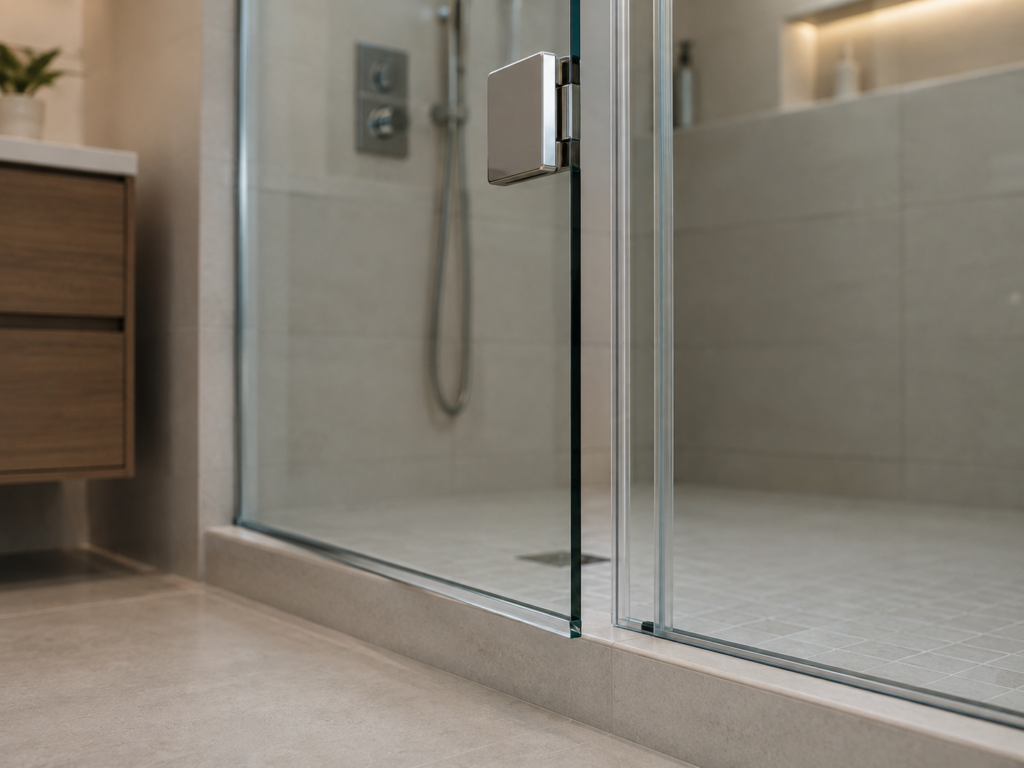
5. Problem 3: Popping, Clicking or Grinding Noise Around the Hinge
A sharp popping sound, clicking noise or grinding sensation should be checked carefully.
Some noise may come from loose screws, dry pivot movement, worn internal parts or gasket movement. But in more serious cases, the sound may indicate that the glass has shifted and metal parts inside the hinge are contacting the edge of the drilled glass holes.
This is important because tempered glass is sensitive around holes and edges. Direct metal-to-glass contact can create edge stress, scratches or micro-damage. It should be corrected before continued use.
A professional inspection should check:
- whether screws are loose;
- whether the gasket has slipped;
- whether isolating sleeves are present around bolts;
- whether the glass hole edge shows chips or stress marks;
- whether the internal hinge block fits the glass cutout correctly;
- whether the hinge body has moved under load.
If the hinge uses bolts through glass holes, the bolts should be isolated from the glass with suitable sleeves or gaskets. The metal should not press directly against the raw glass hole edge.
If a hinge makes repeated popping noises after re-tightening, replacement may be safer than continued use.
6. Problem 4: Glass-to-Glass Collision and Clearance Problems
A frameless shower door needs controlled clearance. The glass edges, seals, hinges and fixed panels must have enough space to move without hard contact.
Many frameless shower layouts work with only 2mm to 4mm of controlled clearance, depending on seal type, hinge design and glass layout. If the gap is too small, the moving door may hit the fixed panel, wall, shower curb or magnetic strip.
Common causes include:
- incorrect glass size;
- hinge axis misalignment;
- wall not plumb;
- fixed glass panel movement;
- hinge lateral slip;
- wrong hinge angle;
- compressed or oversized seals;
- bottom sweep interference;
- poor installation measurement.
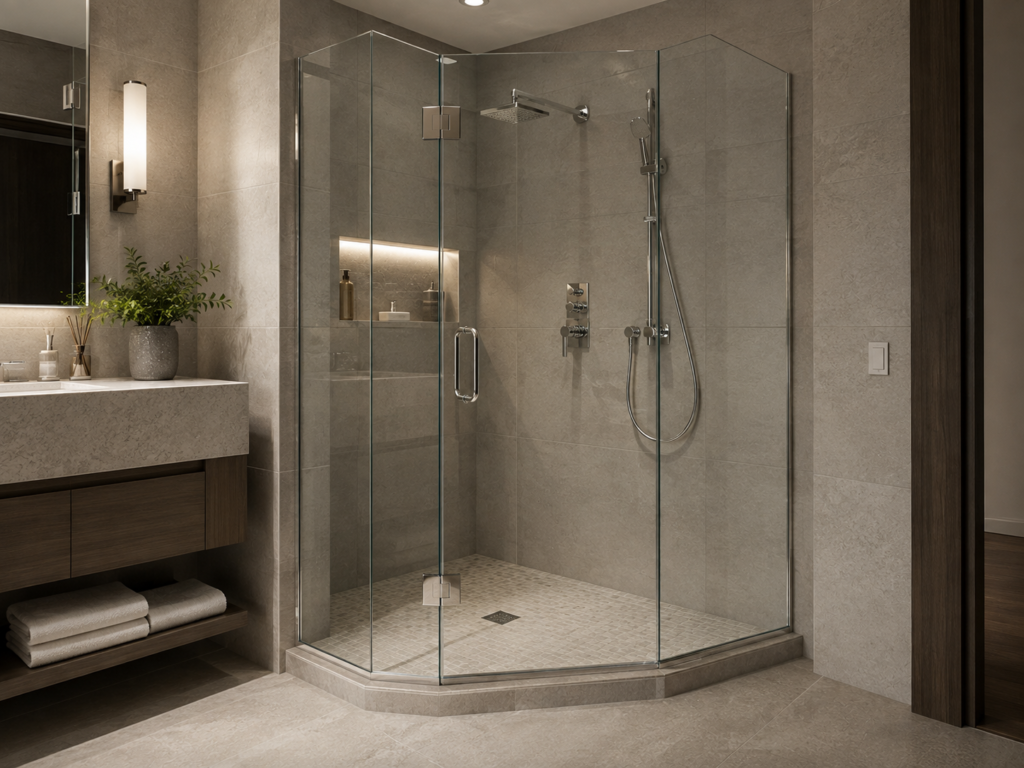
This is especially important in 135° neo-angle shower enclosures and 180° inline shower screens. A small angle error can change the door return position and cause the glass to collide with the fixed panel or seal.
Glass-to-glass contact should not be ignored. Repeated contact can damage seals, chip glass edges and affect user safety.
If collision happens after hinge replacement, the new hinge should be checked against the original hinge angle, hole pattern, offset and gasket thickness.
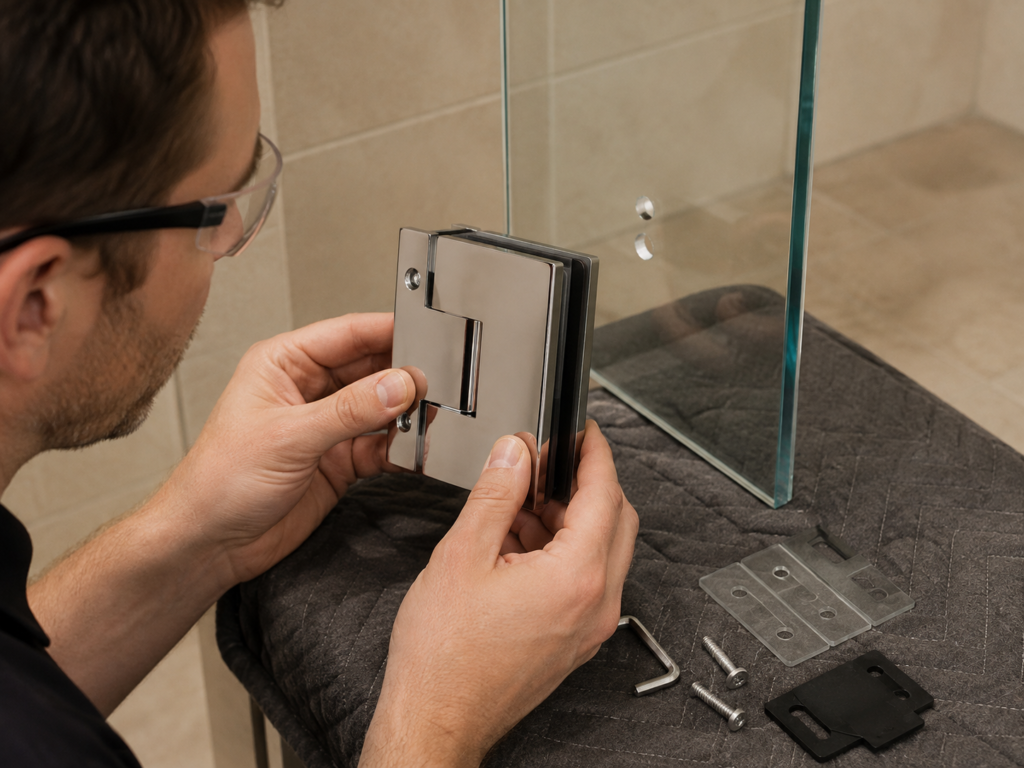
7. Problem 5: Water Leakage Near the Hinge Side
Water leakage around a frameless shower door is often blamed on the hinge, but the hinge is rarely the only waterproofing component.
A hinge can affect water control indirectly. If the door sags, the bottom seal may no longer touch the curb correctly. If the door does not return to zero, the magnetic strip may not meet. If the hinge-side gap is too large, water may escape near the wall or fixed panel.
However, leakage may also come from the seal system. The bottom sweep may be installed in the wrong direction. The magnetic strip may not match the door angle. The side seal may be the wrong size for 8mm, 10mm or 12mm glass. The shower curb or floor slope may also guide water toward the door gap.
A hinge can affect water control, but it should be checked together with seal strips, glass alignment, floor slope and door return position.
If water leakage appears only after the door has sagged, the hinge and glass position should be checked first. If the glass is aligned but leakage continues, the seal system may be the main issue.
8. Two Hinges or Three Hinges: When Load Capacity Is Not Enough
Not every frameless shower door should use the same number of hinges.
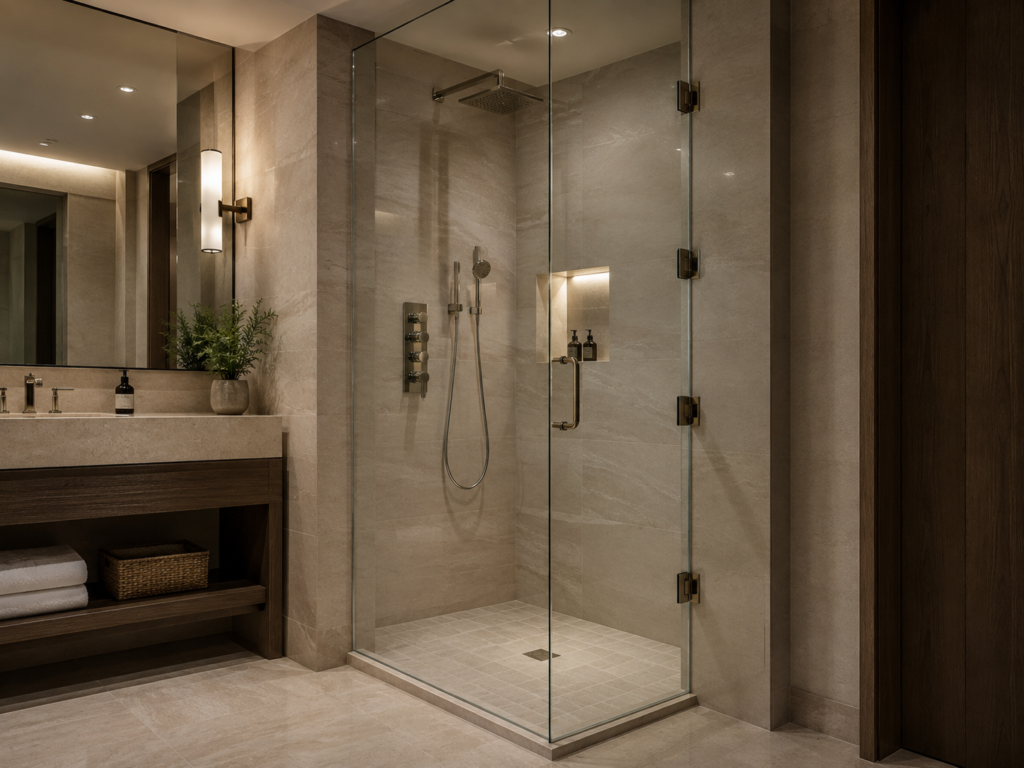
Many standard 8mm or 10mm residential shower doors use two hinges. But larger doors, 12mm glass doors, taller panels, wider doors and high-frequency hotel or gym shower rooms may need three hinges depending on door weight and project use.
Adding a third hinge can help distribute load, but only if all hinges are aligned correctly. If three hinges are not on the same vertical axis, one hinge may carry more load than the others. This can create binding, noise, poor self-closing or uneven glass movement.
For a door around 40kg, two properly rated hinges may be enough depending on design. For a door around 45kg–50kg, buyers should check whether the hinge pair rating is sufficient or whether a three-hinge layout is required.
A third hinge is useful only when the hinges are aligned and loaded correctly. If the wall is bowed or the hinge line is not plumb, adding another hinge may not solve the problem.
For replacement projects, buyers should not automatically copy the old hinge quantity if the original door already sagged. The old specification may have been insufficient.
9. Replacement Matching: Glass Thickness, Cutout Geometry and Hinge Angle
Replacing shower hinges is not only about finding a similar cover shape.
The new hinge must match the existing glass thickness, hole pattern, cutout geometry, hinge angle, opening direction and installation type. This is especially important because tempered glass cannot be safely drilled, enlarged or reshaped after production.
For replacement projects, the old hinge should be removed carefully and the bare glass hole pattern should be inspected. Common glass preparations may include:
- two simple circular holes;
- mouse-ear cutout;
- square or rectangular notch;
- special supplier-specific cutout geometry.
A hinge designed for a square notch may not fit a mouse-ear cutout. A hinge with an internal block only 2mm wider than the existing cutout may fail to install. Similar exterior cover plates do not guarantee the same internal clamping block.
Buyers should confirm:
- glass thickness: 8mm, 10mm or 12mm;
- hinge angle: 90°, 135° or 180°;
- wall-to-glass or glass-to-glass type;
- self-closing or free-swing function;
- existing hole pattern;
- cutout shape;
- screw spacing;
- gasket thickness;
- door width and height;
- estimated glass weight;
- left or right opening;
- finish and quantity.
For new projects, the hinge model should be confirmed before glass drilling and tempering. For replacement projects, photos, measurements and cutout shape are essential.
10. Adjust or Replace: How to Decide
Not every shower hinge problem requires replacement. Some issues can be improved by adjustment, tightening screws, replacing gaskets or correcting seal interference. Other symptoms suggest that replacement is more likely.
| Symptom | Try Adjustment First? | Replacement More Likely When |
|---|---|---|
| Door slightly misaligned | Yes | Glass holes or hinge body are worn |
| Door sagging | Limited | Gasket compression, hinge deformation or overloaded door |
| Self-closing weak | Yes | Internal spring or cam mechanism is fatigued |
| Clicking or popping noise | Inspect immediately | Metal-to-glass contact or internal wear is found |
| Glass hits fixed panel | Check clearance | Wrong hinge angle or glass sizing issue |
| Water leakage | Check seals first | Door sag or hinge misalignment affects seal contact |
| Rust or corrosion | Clean first | Material or finish is unsuitable for wet area |
| Loose screws | Tighten first | Thread, hinge body or glass hole support is damaged |
A good troubleshooting process starts with simple checks: hinge screws, gasket position, glass clearance, wall alignment, seal strip interference and door weight.
If the hinge body is deformed, the self-closing mechanism is weak, the pivot is worn, or the glass has slipped repeatedly, replacement is usually more practical.
11. Common Mistakes When Buying Replacement Shower Hinges
The first mistake is buying by appearance only. Two shower hinges may look similar, but the hole pattern, cutout shape, hinge angle, glass thickness range, self-closing function and load capacity may be different.
The second mistake is ignoring glass thickness. Hinges for 8mm, 10mm and 12mm glass may use different gaskets and clamping structures.
The third mistake is using two hinges for an oversized heavy door. If the door is too tall, too wide or too heavy, sagging may appear even when the hinge is not defective.
The fourth mistake is replacing hinges without checking seal strip interference. A self-closing hinge may fail because the magnetic strip or bottom seal creates too much friction.
The fifth mistake is mixing 90°, 135° and 180° hinges incorrectly. The hinge angle must match the shower layout.
The sixth mistake is ignoring wall alignment or fixed glass stability. A weak wall fixing or moving fixed panel can make the door sag again after replacement.
The seventh mistake is not checking the glass hole pattern before ordering. Tempered glass cannot be modified on site if the new hinge does not match the existing holes.
12. What to Confirm Before Ordering Shower Hinges
Before ordering shower hinges, buyers should prepare the basic shower door information.
For new projects, provide glass thickness, door width, door height, hinge angle, installation type, finish, self-closing requirement and whether the door uses two or three hinges.
For replacement projects, photos are very important. Send clear pictures of the existing hinge, glass holes, cutout shape, wall fixing, fixed glass panel, door gap, seal strip and current problem. If possible, measure the hole spacing, glass thickness, door size and cutout dimensions.
The supplier should also know whether the door is used in a residential bathroom, hotel, gym, spa, clubhouse or other high-frequency wet area. Commercial wet areas may require stronger hinge bodies, better material grade and more durable surface finish than light residential bathrooms.
Shower hinges should not be selected only by price or appearance. They must match the glass, hole pattern, layout and daily use condition.
13. How Metech Supports Shower Hinge Projects
Metech Hardware supplies shower hinges and related frameless shower hardware for residential, hotel, gym, spa and clubhouse projects.
We can support different hinge angles, including 90°, 135° and 180° configurations, as well as wall-to-glass and glass-to-glass designs. Material options may include brass, SS304, SS316 and selected aluminum options according to project requirement. Finish options may include polished chrome, brushed stainless, matte black, gold and other project finishes.
For project buyers, we can help review glass thickness, door size, hinge angle, hinge quantity, self-closing requirement, finish and replacement photos before quotation. Some project-grade self-closing hinges may be tested for 100,000 opening cycles, depending on model specification.
For distributors and contractors, Metech can support mixed orders that combine shower hinges with shower seal strips, glass clamps, handles, sliding shower kits and other architectural glass hardware.
To request a quotation, send the glass thickness, door size, hinge angle, installation type, finish, quantity, current problem and available photos or drawings.
FAQ
Why is my frameless shower door sagging?
A frameless shower door may sag because the glass is too heavy, the hinge quantity is insufficient, the gaskets are compressed, the screws are loose, the wall fixing is weak, the fixed glass panel moves, or the hinge body is overloaded.
Can I adjust a shower door hinge?
Some shower hinges allow limited adjustment, and minor alignment problems may be corrected by repositioning or tightening. However, if the glass has sagged repeatedly, the hinge body is worn, or the glass holes do not match, adjustment may be limited.
Why does my self-closing shower hinge not close?
The self-closing spring or cam mechanism may be fatigued, the hinge angle may be wrong, the glass door may be too heavy, the wall may not be plumb, or the seal strip may create too much friction.
Why does my shower hinge make a popping or clicking noise?
Clicking or popping may come from loose screws, worn pivot parts, gasket movement or metal-to-glass contact around the drilled holes. The hinge and glass holes should be inspected before continued use.
Can I replace shower hinges without changing the glass?
Yes, but only if the new hinge matches the existing glass holes, cutout shape, glass thickness, hinge angle, door weight and installation type. Tempered glass cannot be safely drilled or reshaped after production.
What is a mouse-ear cutout for shower hinges?
A mouse-ear cutout is a glass cutout shape with rounded indentations used by some shower hinge designs. It is not interchangeable with every square notch or simple two-hole pattern. The hinge drawing must match the existing glass.
When should I use three shower hinges?
Three hinges may be considered for taller, wider, heavier or high-frequency shower doors. However, the hinges must be aligned correctly. A third hinge only helps when load is distributed evenly.
Are brass or stainless steel shower hinges better?
It depends on project requirements. Brass is widely used in premium shower hinges because of its machining stability and finish options. SS304 and SS316 are also used for different corrosion resistance requirements, with SS316 generally preferred for more humid or corrosive environments.
Why is my shower door leaking near the hinge side?
Leakage near the hinge side may be caused by door sagging, excessive hinge-side gap, incorrect side seal, poor floor slope, wrong glass return position or seal strip mismatch. The hinge and seal system should be checked together.
Do I have to remove the glass door to replace the hinges?
In most replacement cases, yes. The glass door should be safely supported and removed by trained installers using proper lifting tools. It is not usually a one-person maintenance task.
What information should I send before ordering replacement hinges?
Send the glass thickness, door width and height, existing hinge photos, hole spacing, cutout shape, hinge angle, installation type, finish, quantity and current problem description.