A sliding glass door looks like a simple track and a panel of glass. The hardware behind it is doing more work than that.
The track and roller system carries the full weight of the glass panel through every opening and closing cycle. It keeps the panel aligned, controls movement, reduces noise and helps the door stay stable after months of daily use. If the track, roller, guide and stopper are not matched correctly, the door may still slide during the first test, but it will not feel good for long.
This is different from a swing glass door, which usually relies on a floor spring, patch fitting or pivot system. It is also different from a motorized automatic entrance door, which uses an operator, sensors and power control. A manual sliding glass door kit is its own category, with its own selection logic.
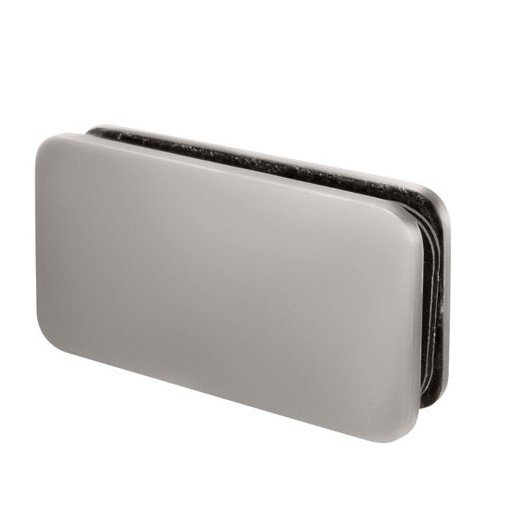
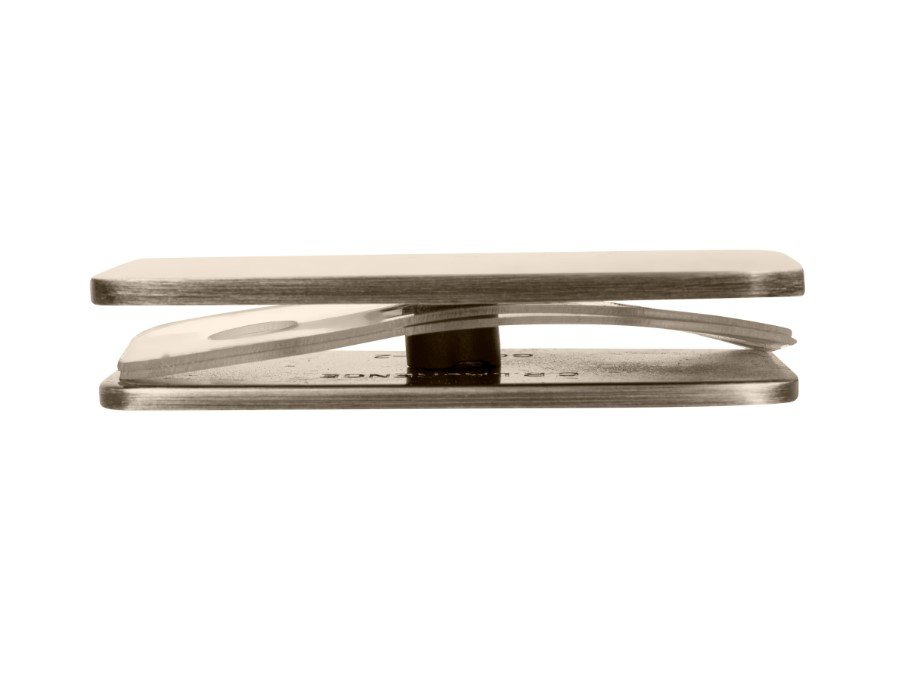
For offices, showrooms, hotels and residential interiors, sliding glass door hardware should be selected as a complete system. Track, rollers, glass clamps, hangers, floor guides, stoppers, soft-close dampers, handles and locks all affect the final performance.
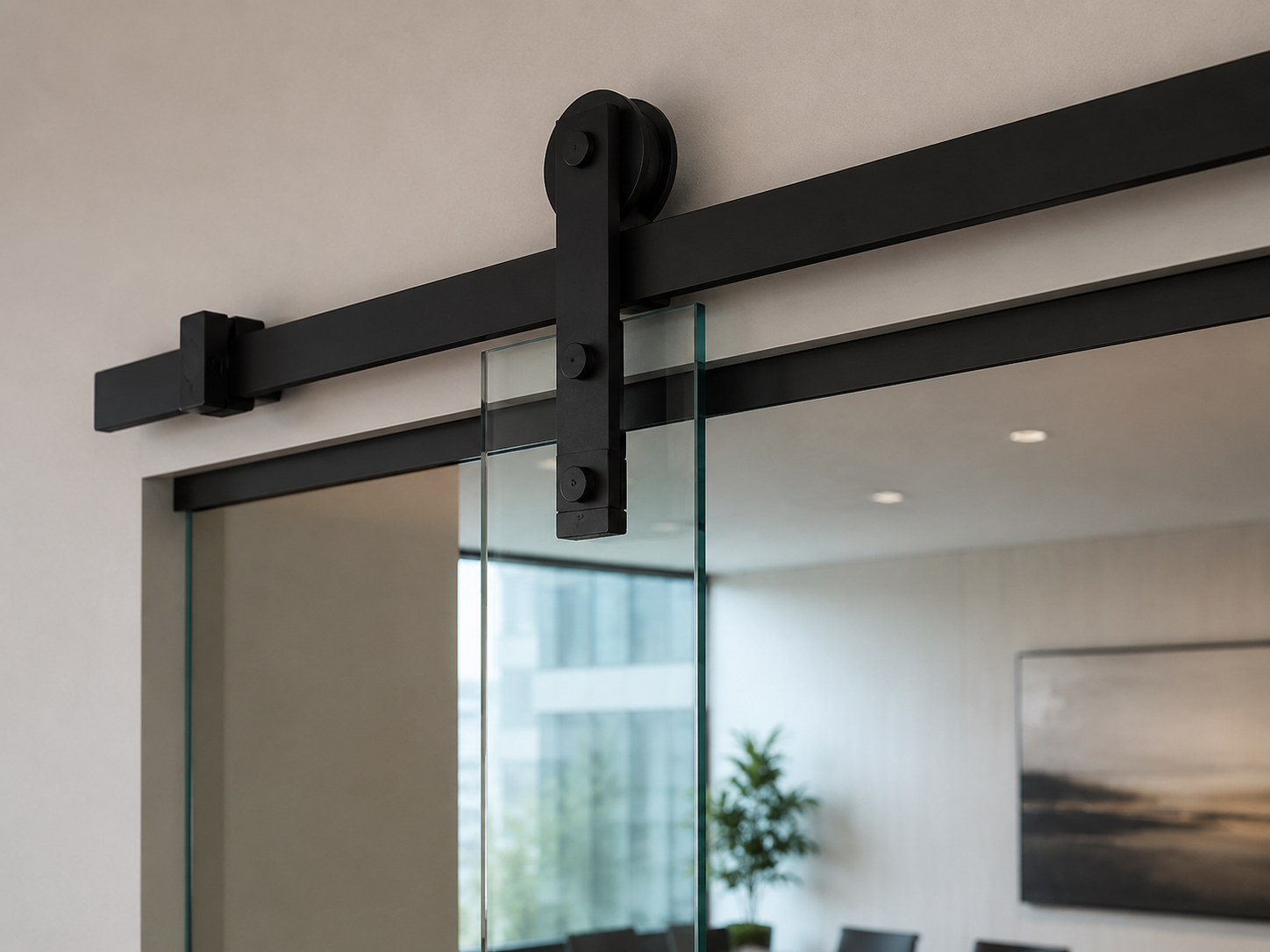
Where Manual Sliding Glass Doors Are Used
This article focuses on manual interior sliding glass doors, not automatic storefront entrance doors and not shower sliding doors.
Common applications include:
- Office meeting rooms
- Glass partition doors
- Open-plan office dividers
- Showroom display partitions
- Retail interior display areas
- Residential room dividers
- Study room and kitchen partitions
- Walk-in closet and wardrobe doors
- Hotel interior partitions
- Barn-door style feature walls
A showroom sliding wall and an office meeting room door may use similar hardware, but the selection details are not the same. A showroom panel may be wider for display purposes. An office meeting room door may be opened many times per day and needs to stay quiet near people working. A residential closet door may carry less weight, but it still needs smooth movement and soft closing for daily use.
The first question should not be only “Can it slide?”
The better question is: Can the system stay smooth, quiet and aligned under the actual door weight and usage frequency?
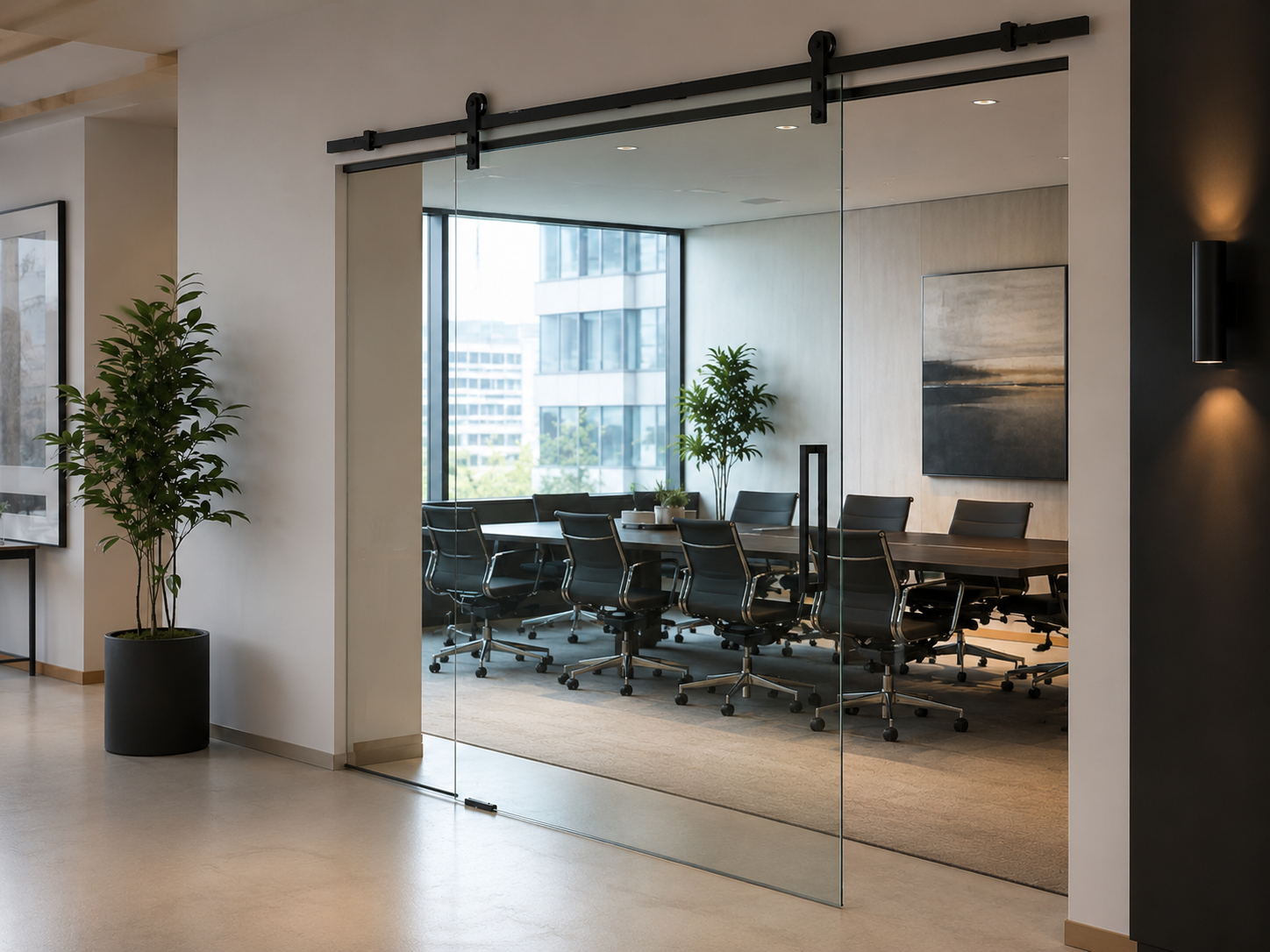
Sliding Door Configuration Comes First
Before choosing the track and roller hardware, the sliding configuration should be confirmed. The configuration affects track length, number of carriers, panel overlap, wall space and installation cost.
Single sliding panel is the simplest layout. One glass panel slides along one track. It is common for small rooms, closets, office partitions and simple interior dividers.
Bi-parting sliding doors use two panels that slide apart from the center. This is useful when the project needs a wider opening but does not have enough wall space on one side for a single large panel.
Telescoping sliding doors use two or more panels that slide in the same direction and stack together when open. This can help showrooms, offices or wide partitions create a larger clear opening when side parking space is limited.
Barn-door style sliding systems mount the track on the wall surface above the opening. The glass panel slides across the wall instead of into a concealed pocket. This style is often used in residential interiors, studios and feature walls because it is easier to install and keeps the hardware visible as part of the design.
The configuration should be decided before ordering. If the wall space, panel parking area or track length is not checked early, the hardware may need to change after the opening has already been built.
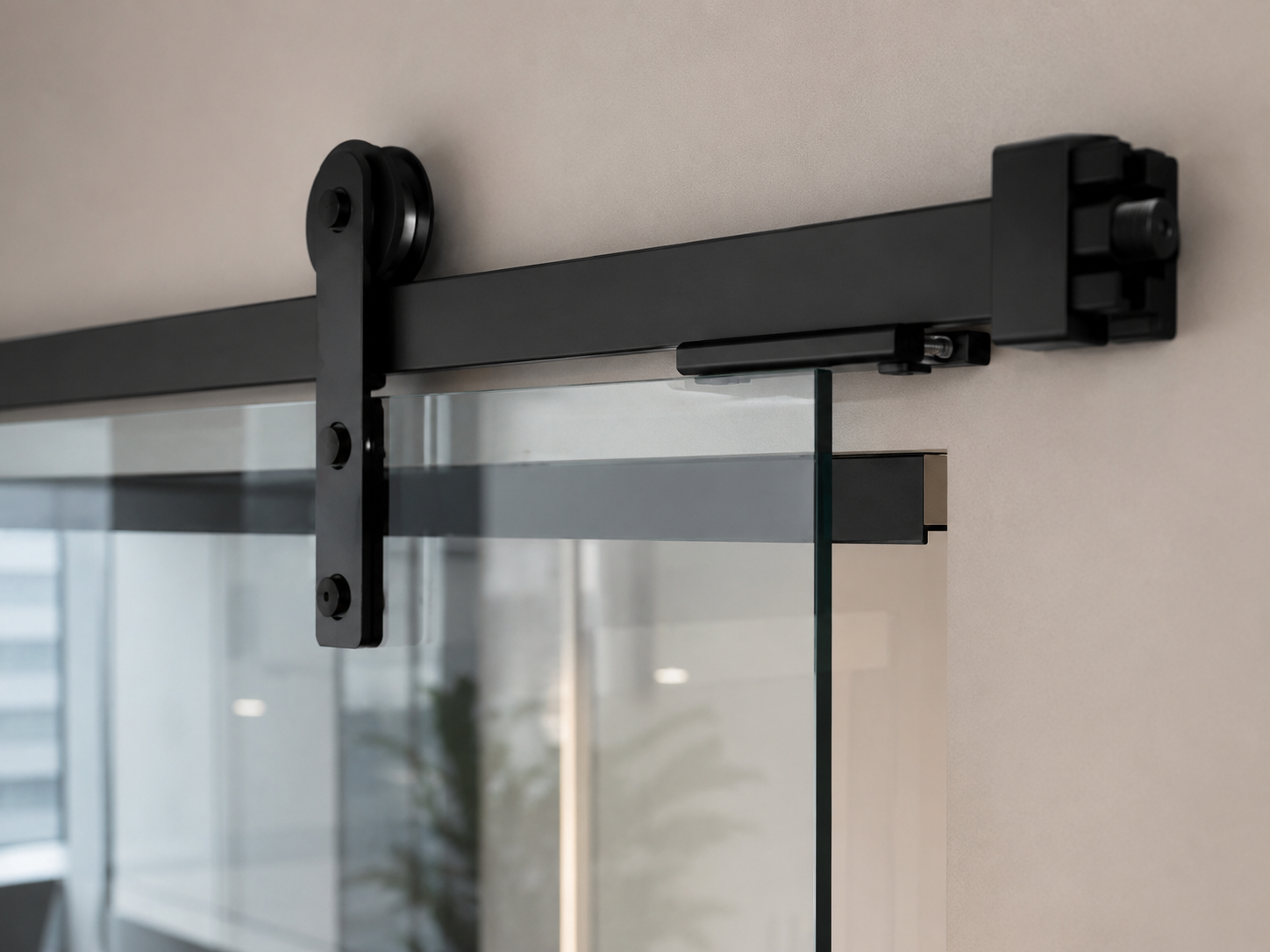
Main Hardware in a Sliding Glass Door System
A sliding glass door kit should not be selected by roller price alone. Each part of the system has a job.
| Hardware component | What it affects |
|---|---|
| Sliding track | Load path, alignment and long-term movement |
| Roller / pulley | Smooth movement, noise and load capacity |
| Glass clamp / hanger | Connection between glass and roller |
| Floor guide | Prevents bottom panel swing |
| End stopper | Controls open and closed position |
| Soft-close damper / buffer | Reduces closing impact and noise |
| Handle / pull | Daily operation and user comfort |
| Sliding lock | Privacy or security requirement |
| Anti-jump device | Helps prevent the panel from lifting out of the track |
A strong roller cannot solve a weak track. A soft-close damper cannot correct a badly aligned panel. A good sliding lock will still feel poor if the panel does not stop in the same position every time.
This is why sliding glass door hardware should be selected as one system, not as loose individual parts.
Door Weight and Glass Thickness Should Be Checked First
Glass weight is the first number to check.
As a rough reference, tempered glass weighs about 2.5kg per square meter for each 1mm of glass thickness.
| Glass thickness | Approximate weight |
| 8mm tempered glass | About 20kg/m² |
| 10mm tempered glass | About 25kg/m² |
| 12mm tempered glass | About 30kg/m² |
For example, a 1.0m × 2.3m sliding glass panel made from 10mm tempered glass weighs about 57.5kg before adding handles, locks or clamps. The same size panel in 12mm glass weighs about 69kg. If laminated safety glass is used, the weight can increase further.
Sliding systems are usually selected by rated panel weight. Buyers should confirm whether the kit is rated for 60kg, 80kg, 100kg or heavier panels, depending on the actual model. For office or commercial doors used frequently, the track and roller should not be selected exactly at the maximum rated load. A reasonable safety margin is better for long-term movement and lower maintenance risk.
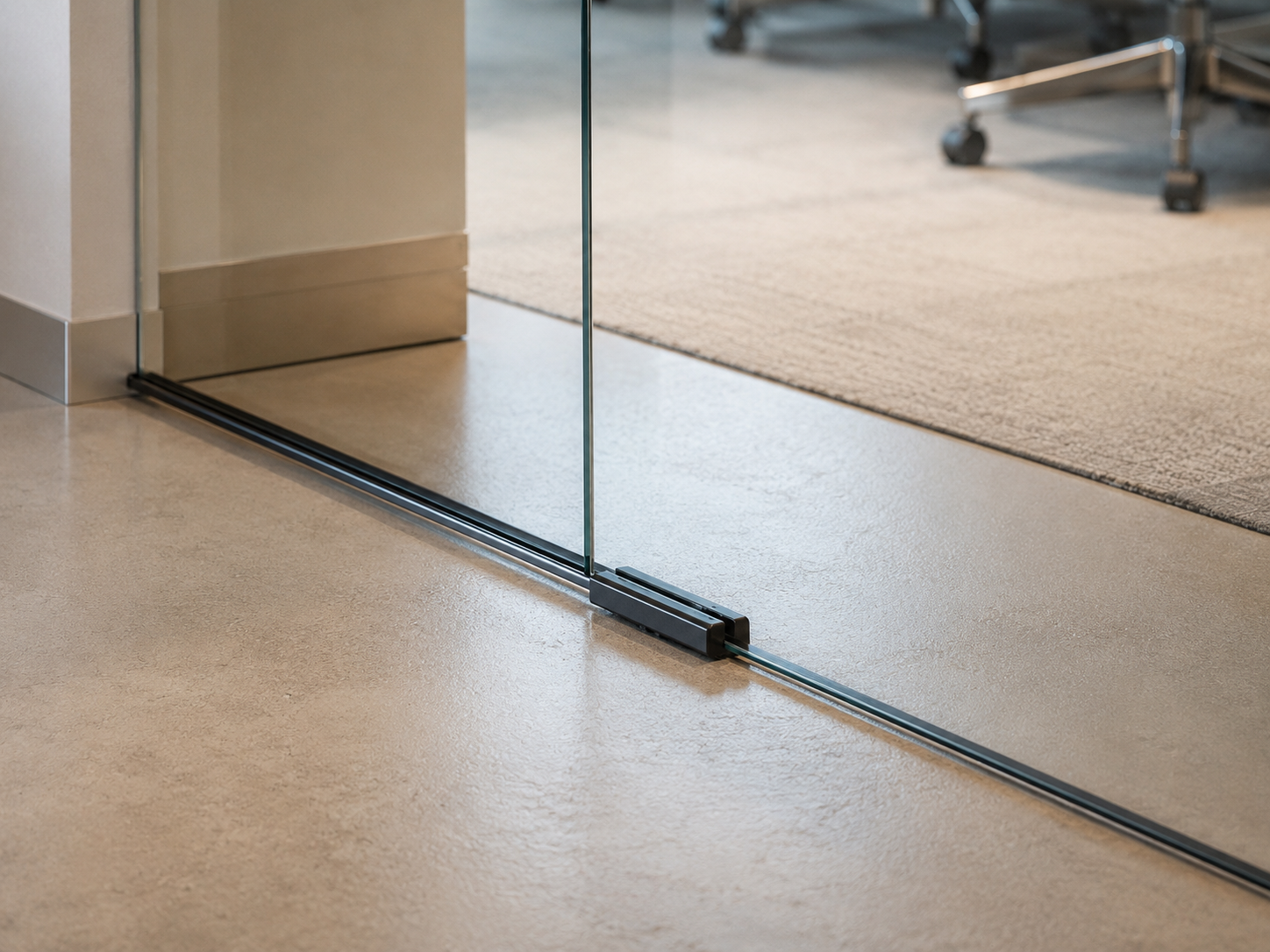
Door height also matters. A tall glass panel is easier to swing at the bottom if the floor guide is weak or missing. For large panels, the floor guide is not a small accessory. It is part of the stability system.
Track and Roller Quality Affect Noise
For interior glass doors, smooth movement is not only about load capacity. Noise and wear are just as important.
Basic plastic rollers may work at first, but they can wear faster and develop play after repeated use. For better interior systems, POM wheels with precision bearings are often preferred because they can reduce noise and provide smoother movement compared with low-grade plastic rollers.
The track also matters. If the track is not straight, not firmly fixed, or not matched with the roller design, the door may become noisy even when the roller itself is good.
For office partitions and meeting rooms, quiet operation is especially important. The door is often used near people working, talking or having meetings. A rough sliding sound may not be a safety problem, but it reduces the quality of the space.
Top-Hung or Bottom-Rolling?
Many interior glass sliding systems use top-hung hardware because it keeps the floor cleaner and avoids a floor track collecting dust. In a top-hung system, the track carries the door weight from above, and the floor guide only keeps the panel stable at the bottom.
This works well for offices, showrooms and residential interiors when the wall, ceiling or beam structure is strong enough.
However, bottom-rolling systems are still used in some projects. They carry more load through a floor-mounted track and reduce stress on the upper structure. The trade-off is that the lower track can collect dust, affect cleaning and interrupt the floor line.
The choice should not be made by appearance only.
If the ceiling or wall structure cannot carry the door weight, a top-hung system may look clean but create installation risk. If the floor track is placed in a dusty or high-traffic area, a bottom-rolling system may need more cleaning and maintenance.
A detailed comparison between top-hung and bottom-rolling systems can be developed as a separate Insight article. For this Application page, the practical point is simple: confirm where the load will go before choosing the system.
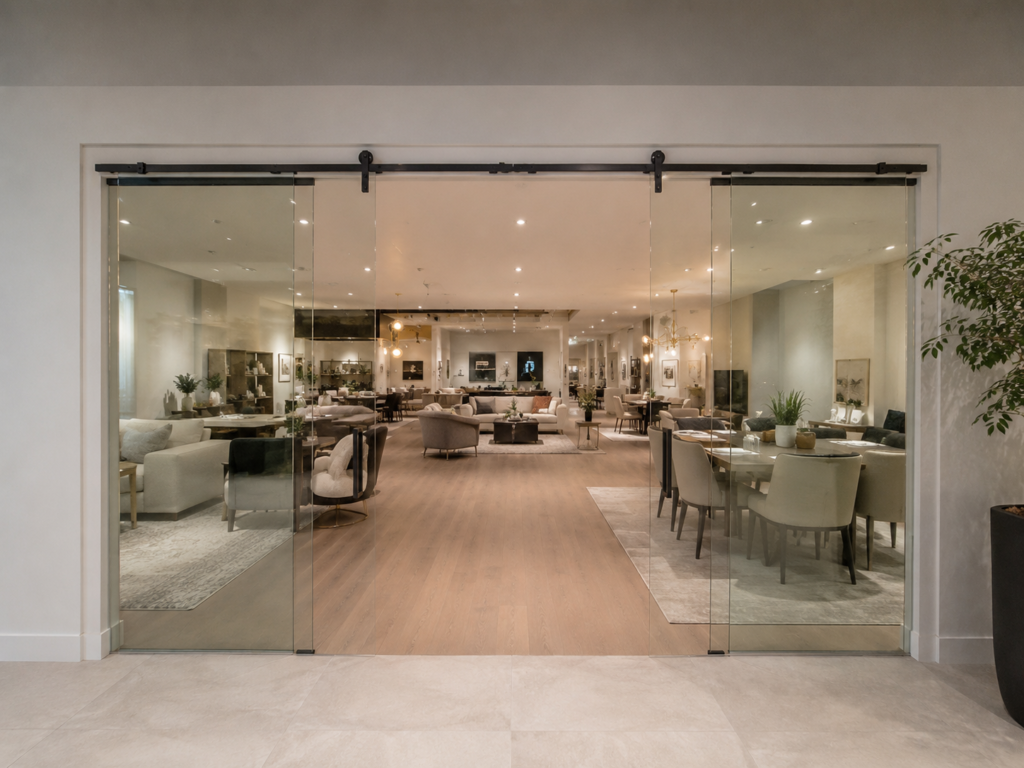
Soft-Close Damper and Buffer: Useful, But Not a Fix for Wrong Hardware
Soft-close hardware is valuable for interior sliding glass doors. It reduces impact at the end of travel and improves the user experience, especially in offices, hotels and residential rooms.
In many systems, the soft-close damper starts working near the final part of closing, often around the last 80–100mm of travel depending on the design. This helps prevent hard impact against the stopper and reduces noise when the door closes.
For frequent-use office partitions, a soft-close and roller system tested around 100,000 cycles can be a useful reference, if the supplier provides this test data. The test should not only be about the track. The roller, damper and connection points also matter.
But soft-close is not a repair for poor hardware selection.
If the roller is under-rated, the track is not straight, the floor guide is unstable, or the glass panel is too heavy for the damper, the soft-close function will not solve the root problem. It may even feel inconsistent after repeated use.
Compact pulley and buffer damper designs are useful where the project needs quieter closing without making the sliding system too bulky. But the damper must still match the door weight, travel distance and track system.
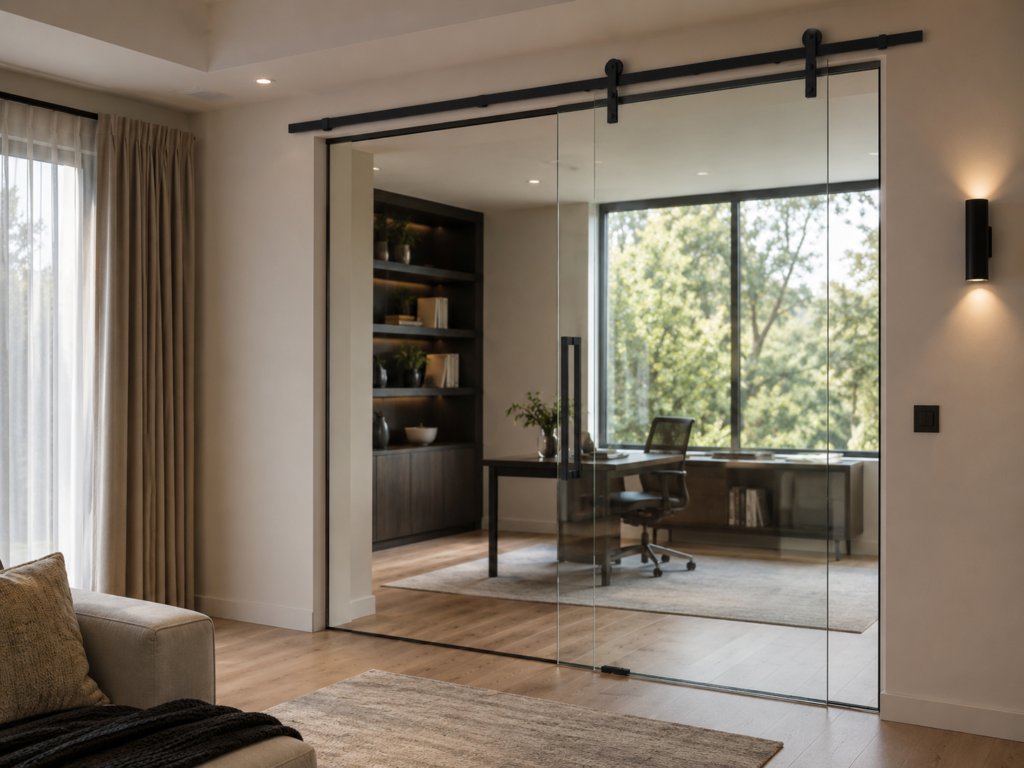
Floor Guides, End Stops and Anti-Jump Devices
Even with a top-hung system, the bottom of the glass panel usually needs a floor guide. Without it, the panel can swing in or out at the base, especially when the door is tall, wide or used many times per day.
The floor guide should match the glass thickness and leave enough clearance for smooth movement while still controlling side movement. If the clearance is too large, the panel may shake. If it is too tight, the door may rub.
End stops should be checked together with the soft-close mechanism. A soft-close damper timed for one stop position may not perform correctly if the end stop is installed in the wrong place.
For barn-door style or surface-mounted systems, an anti-jump / anti-derail device is also worth checking. It helps prevent the panel from lifting out of the track if the door is pushed upward, hit from an angle or handled roughly.
These parts are small, but they have a strong effect on daily safety and long-term operation.
Common Problems from Wrong Sliding Door Hardware Selection
The track is long enough, but not strong enough
A track may fit the opening width but still be under-rated for the glass weight. Track length and load capacity should be checked separately.
The door becomes noisy after a few months
This is often a roller quality, bearing or track alignment issue. Lower-grade rollers may wear and develop play faster than precision-bearing rollers.
The glass panel does not stay aligned
Without a properly fitted floor guide, the bottom of the panel can drift. This is more obvious on wider panels or doors used frequently.
The soft-close does not engage properly
This often comes from a mismatch between the end stop position and the damper engagement point, not necessarily from a defective damper.
The configuration does not fit the available wall space
Bi-parting, telescoping and barn-style systems all need enough side space or panel parking space. If this is not checked early, the layout may need to change.
The lock does not align
Sliding locks depend on accurate stopping position. If the guide, stopper or track alignment is poor, the lock tongue may not line up with the keeper.
The hardware looks too bulky
For showrooms, villas and office interiors, oversized tracks or clamps can affect the visual design. The hardware must support the glass, but it should still match the scale of the space.
Practical Selection by Application
Office partitions and meeting rooms
Quiet operation matters most here. A top-hung system with stable floor guide, soft-close damper and good roller quality is usually preferred. If privacy is required, the sliding lock should be checked together with panel overlap and stopping position.
Showrooms and retail interior spaces
Showrooms may use wider panels or telescoping layouts to create a cleaner display opening. Track and carrier capacity should be checked against the actual glass size, not only the opening width. The hardware should look clean but still support repeated use.
Residential room dividers and closets
Residential sliding glass doors usually focus on smooth hand feel, quiet closing and appearance. Barn-door style hardware, slim tracks and soft-close systems can be suitable when the structure and panel weight allow.
Kitchen and study partitions
Kitchen sliding partitions need cleaning access and finish durability because the door may face grease, moisture and frequent touching. Study room doors need quieter movement and better alignment because they are often used in quiet spaces.
Hotel interior partitions
Hotel interiors need quiet, controlled movement and consistent finish. Hardware should match nearby pull handles, glass locks, bathroom hardware and other visible fittings. Maintenance access should also be considered.
How Metech Supports Sliding Glass Door Projects
Metech Hardware supports interior sliding glass door projects with sliding door hardware and matching architectural fittings.
Our product range can include sliding door kits, roller and pulley systems, tracks, floor guides, end stoppers, soft-close or buffer damper options, glass clamps or hangers, sliding door locks, pull handles and related glass door hardware.
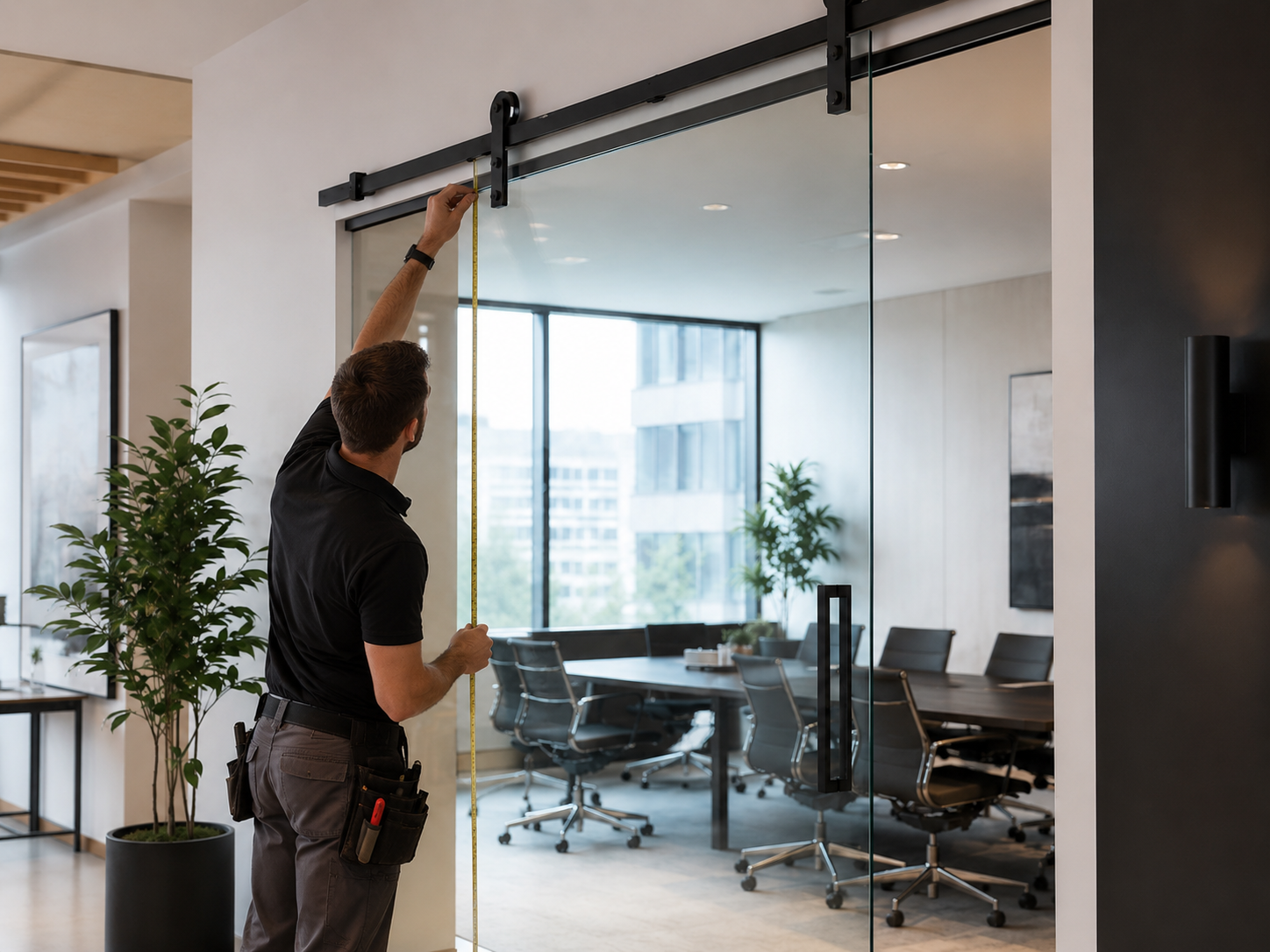
Before recommending hardware, we prefer to check the glass thickness, door width, door height, estimated door weight, configuration, usage frequency, top-hung or bottom-rolling requirement, soft-close requirement, locking requirement and finish preference.
For overseas buyers, contractors and distributors, Metech can also support mixed hardware orders, OEM packaging and export packing. This is useful when one project needs sliding hardware, locks, handles and other glass door fittings in the same shipment.
FAQ
What information is needed before choosing sliding glass door hardware?
Useful details include glass thickness, door width, door height, estimated panel weight, door configuration, top-hung or bottom-rolling requirement, soft-close requirement, locking requirement and finish preference.
What is the difference between single, bi-parting and telescoping sliding doors?
A single sliding door uses one panel moving to one side. A bi-parting door uses two panels that slide apart from the center. A telescoping system uses two or more panels that stack together to create a wider opening with less side space.
Is top-hung or bottom-rolling sliding hardware better?
Neither is always better. Top-hung systems keep the floor cleaner and look more minimal, but the upper structure must carry the door weight. Bottom-rolling systems reduce load on the top structure but may affect cleaning and walking comfort.
Can soft-close dampers be used on glass sliding doors?
Yes. Soft-close dampers can reduce closing impact and noise, but they must match the door weight, track system, travel distance and stop position.
Does a sliding glass door need a floor guide?
In most cases, yes. Even with a top-hung system, a floor guide helps keep the bottom of the panel from swinging in or out, especially for wider or frequently used doors.
Can Metech supply tracks, rollers, locks and handles together?
Yes. Metech can support mixed orders for sliding door kits, tracks, rollers, floor guides, soft-close dampers, sliding locks, pull handles and related glass door hardware.
Need Sliding Glass Door Hardware for an Interior Project?
Send us your glass thickness, door width, door height, estimated panel weight, configuration, usage frequency, soft-close requirement, locking requirement and finish preference. Metech Hardware can help recommend suitable sliding glass door hardware for offices, showrooms, hotels and residential interiors.