In a frameless glass door project, one of the most important decisions happens long before the hardware arrives on site. It happens at the glass fabrication stage, when the factory prepares the notches and holes before tempering.
For patch fitting doors, the glass panel and the hardware cannot be treated as separate items. The top patch, bottom patch, overpanel fitting, patch lock, floor spring and top pivot all depend on accurate glass preparation. If the cutout drawing is wrong, the installer may not be able to solve the problem on site.
This is especially important for tempered glass. Once glass has passed through the tempering furnace, it cannot be safely cut, drilled, shaved or enlarged again. A wrong notch, wrong hole position or wrong lock cutout usually means the glass panel must be remade.
For project managers, glass fabricators, contractors and hardware distributors, a patch fitting cutout drawing is not just a small technical file. It decides whether the door system can be assembled, aligned and operated correctly.
The correct process is simple:
Confirm the hardware model first, check the cutout drawing second, and temper the glass only after both are approved.
1. Why Cutout Drawings Must Be Confirmed Before Tempering
Many patch fitting problems are discovered during installation, but the real mistake often happens earlier.
A contractor may order the glass first and choose the patch fitting later. This seems convenient, but it is risky. Patch fittings from different suppliers may look similar, especially when they use stainless steel cover plates with similar shapes. However, the internal clamping body, screw position, spindle insert, pivot center and gasket design may not be the same.
For example, two bottom patch fittings may both be used for 10mm or 12mm glass. Both may have a rectangular stainless steel cover. But one model may require a different corner notch, different hole spacing or a different spindle clearance. If the glass has already been tempered according to the wrong drawing, the new patch fitting may not sit correctly.
This can lead to several problems. The floor spring spindle may not align with the bottom patch. The top pivot may not match the top patch. The lock may not engage with the keeper. The glass edge may be too close to the metal body. The door may also become difficult to adjust after installation.
A correct cutout drawing is therefore part of the door system design. It should be confirmed before glass production, not after the hardware reaches the site.
2. The Anatomy of a Patch Fitting Cutout
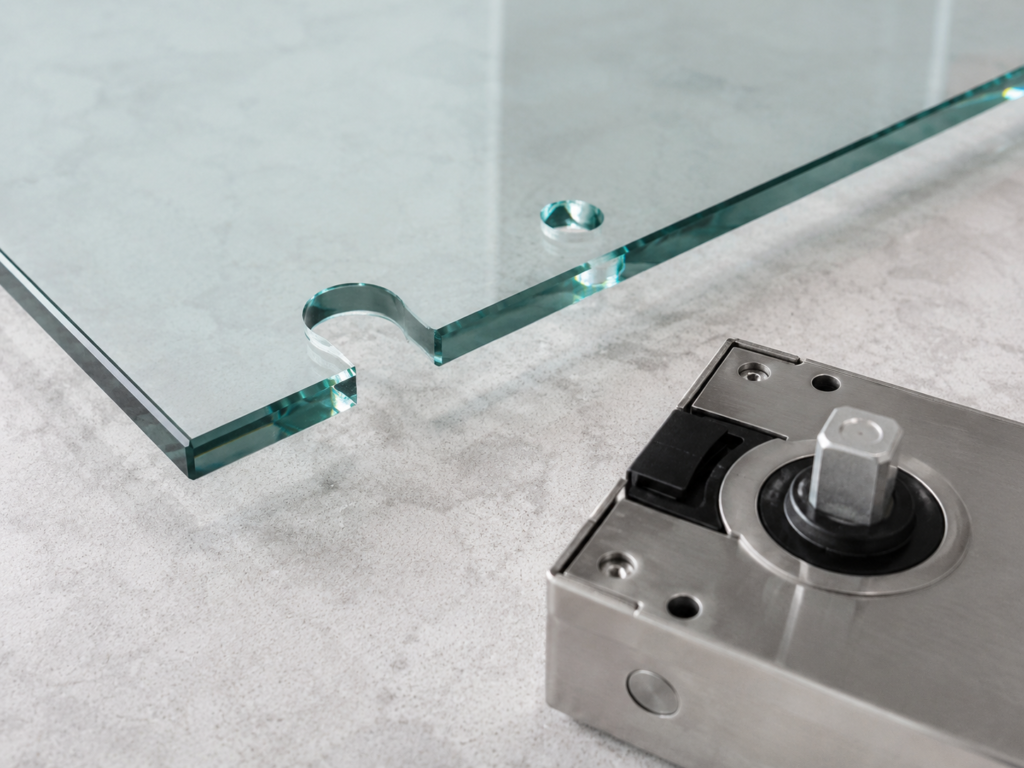
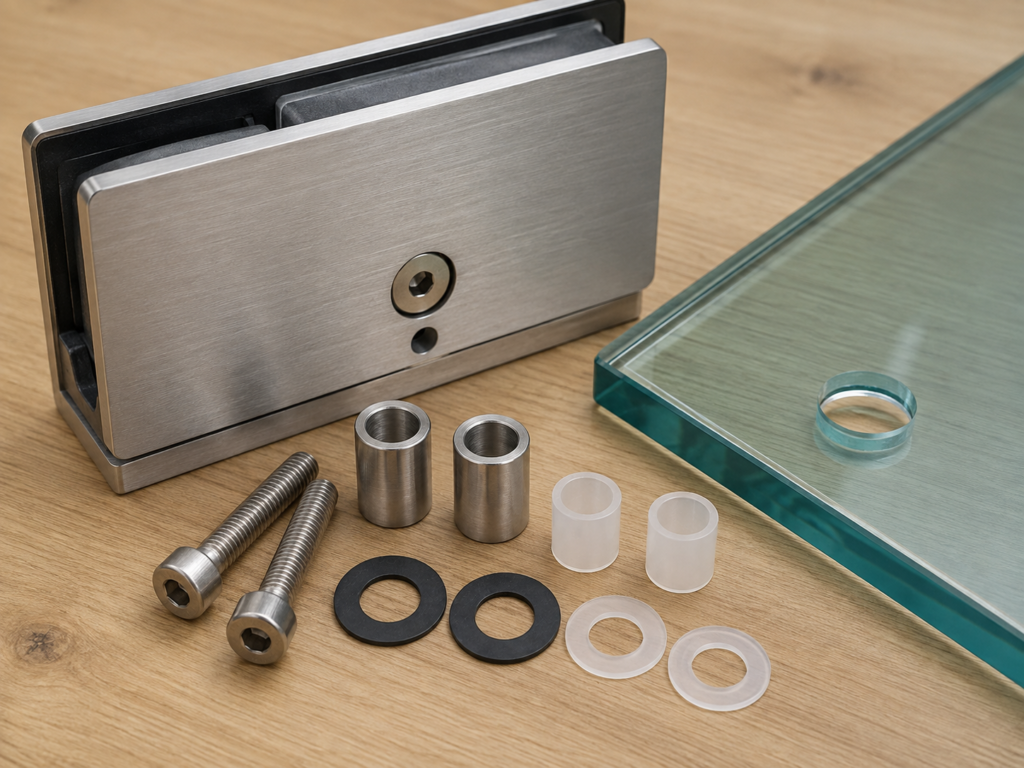
A patch fitting does not simply clamp onto a flat piece of glass. Most commercial patch fittings require a prepared cutout, usually including a corner notch and circular holes.
The cutout has two main purposes.
The first purpose is mechanical interlocking. Internal bolts or fixing parts pass through the holes in the glass. This helps prevent the heavy glass door from slipping under gravity and repeated movement. For heavier commercial doors, this mechanical connection is much more reliable than depending only on surface friction.
The second purpose is pivot clearance. A bottom patch fitting must connect to the floor spring spindle. A top patch fitting must connect to the top pivot or overpanel fitting. The corner notch gives clearance for the pivot block and allows the glass door to rotate without the bare glass edge hitting the metal mechanism.
This is why a patch fitting cutout drawing must show more than the outside cover size. It should show the notch shape, hole diameter, hole spacing, glass edge distance and pivot center line.
For a frameless glass door, the cutout is not only about fitting the metal body onto the glass. It defines how the whole door rotates.
3. Why Similar Patch Fittings May Use Different Cutouts
One of the most common mistakes is assuming that all commercial patch fittings use one universal cutout.
They do not.
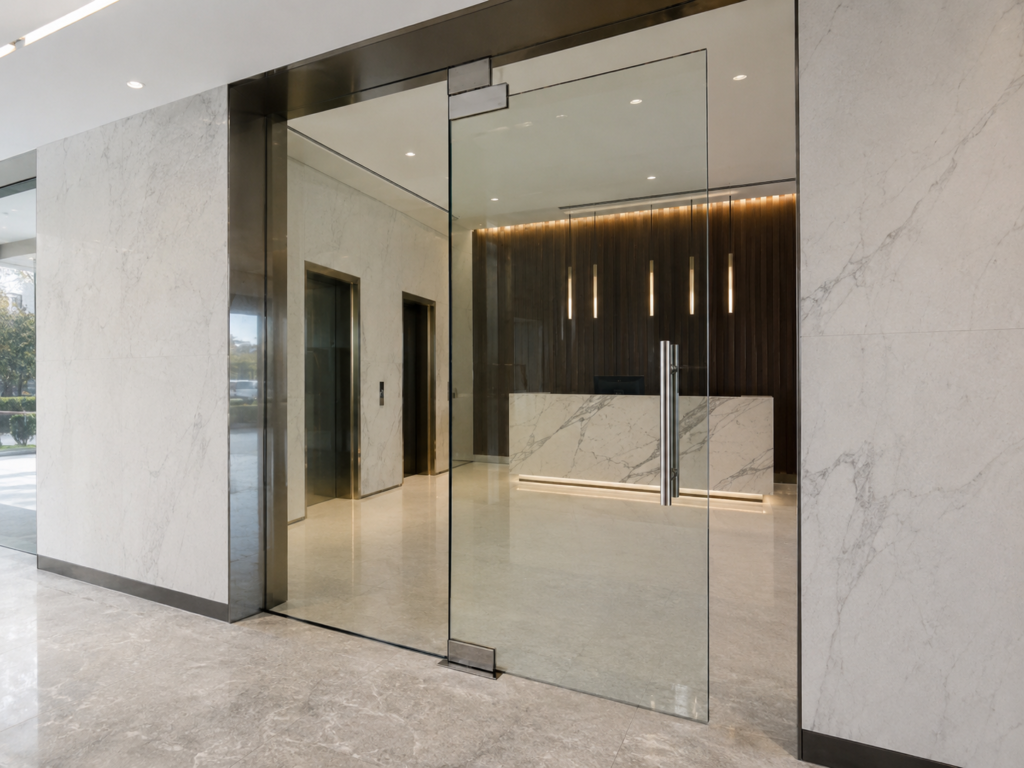
Some standard commercial patch fittings may use cover plates around 164mm × 51mm, and from the outside they may look almost identical. But a similar cover plate does not guarantee the same internal geometry.
The most important dimension is often the pivot center distance. In many commercial patch fitting systems, pivot center distances such as 55mm or 65mm are common, depending on the model, supplier and regional hardware standard. If the glass is prepared for one pivot center but the actual hardware uses another, the whole door axis changes.
Hole spacing is another key point. If the glass factory drills the bolt holes even 5mm away from the correct position, the bolts may not pass through the glass. If the hole is too small, the bolt and sleeve may not fit. If the hole is too large, the fitting may lose proper positioning and the door may slip or sag over time.
This is why buyers should not send a generic patch fitting drawing to the glass factory. The cutout drawing should come from the exact hardware model being used. For professional projects, a PDF drawing or CAD-style template should be checked before the glass is cut and tempered.
4. Pivot Axis: Top Patch, Bottom Patch and Floor Spring Alignment
For a frameless pivot glass door, the top patch and bottom patch must follow the same vertical axis.
The bottom patch connects the glass door to the floor spring spindle. The top patch connects the upper part of the door to the top pivot or overpanel fitting. Together, these two points define the swing axis of the door.
If the pivot axis is wrong, the problem cannot be solved by simply tightening screws.
Even a 2mm to 3mm pivot misalignment can create visible problems in a frameless glass door system. The door may not return to center correctly. The bottom edge may rub against the floor. The lock may not align with the keeper. The gap between the moving door and the fixed glass may become uneven.
This is why the cutout drawing should show the pivot center line clearly. The installer and glass factory should not only check the notch size. They must also check whether the pivot center matches the floor spring, top pivot and overpanel fitting.
For common commercial doors using 10mm or 12mm tempered glass, the pivot center, floor spring position, door clearance and glass dimensions should be reviewed together. If the project uses a larger or heavier glass door, this review becomes even more important.
5. Clearance, Sleeves and Metal-to-Glass Isolation
A professional cutout drawing often shows holes that are larger than the metal bolt diameter. This is not a mistake.
For example, a 10mm bolt may require a 16mm or 20mm hole in the glass, depending on the patch fitting design. The extra space allows for sleeves, gaskets and installation tolerance. It also prevents direct metal-to-glass contact.
Tempered glass is strong against surface compression, but its edges and drilled holes are sensitive to hard contact and stress concentration. If a steel bolt touches the raw glass hole directly, repeated door movement may create edge stress, micro-cracks or long-term risk of glass breakage.
This is why isolation sleeves are important. High-density plastic sleeves or spacer tubes are placed around the bolt to separate metal from glass. Gaskets also help distribute clamping pressure across the glass surface.
The goal is not simply to hold the glass tightly. The goal is to hold it securely without creating concentrated stress points.
A good patch fitting system should match the glass thickness, hole diameter, sleeve size, gasket thickness and bolt length as one complete package.
6. Glass Thickness and Gasket Allowance
Most commercial patch fittings are designed for common glass thicknesses such as 10mm and 12mm. Some projects may use thicker glass, such as 15mm, especially for oversized entrance doors or heavier commercial panels.
In many cases, the 2D cutout shape may remain similar when moving from 12mm to 15mm glass. However, the internal gasket, sleeve, bolt length and cover fit may need to change.
If the gasket is too thick, the cover may not close properly. If the gasket is too thin, the clamping pressure may be uneven. If the bolt is too short, the fitting may not be tightened securely. If the spacer sleeve is not matched to the hole, the fitting may move slightly under repeated use.
This is why glass thickness must be confirmed before ordering patch fittings. It is not enough to say “standard glass door hardware.” The supplier needs to know whether the project uses 10mm, 12mm or 15mm glass, and whether the door is a standard commercial door or a heavier entrance panel.
For project supply, glass thickness, cutout drawing and gasket package should be checked together.
7. Patch Lock, Overpanel and Fixed Glass Cutouts
Patch fitting drawings are not only for top and bottom corners. Patch locks, bottom locks, overpanel fittings and side panel connectors may also require accurate cutouts.
A patch lock may need a body cutout, cylinder hole and lock tongue clearance. A bottom patch lock may also need to align with a floor keeper or floor strike. For double doors, the active leaf and inactive leaf may use different lock and keeper arrangements.
The most common lock problem is not that the lock cannot be installed. The problem is that it cannot lock smoothly after installation. If the lock body sits too high, too low or too far from the edge, the lock tongue may hit the keeper instead of entering it. If the floor keeper position is wrong, the user may need to push the door hard before locking.
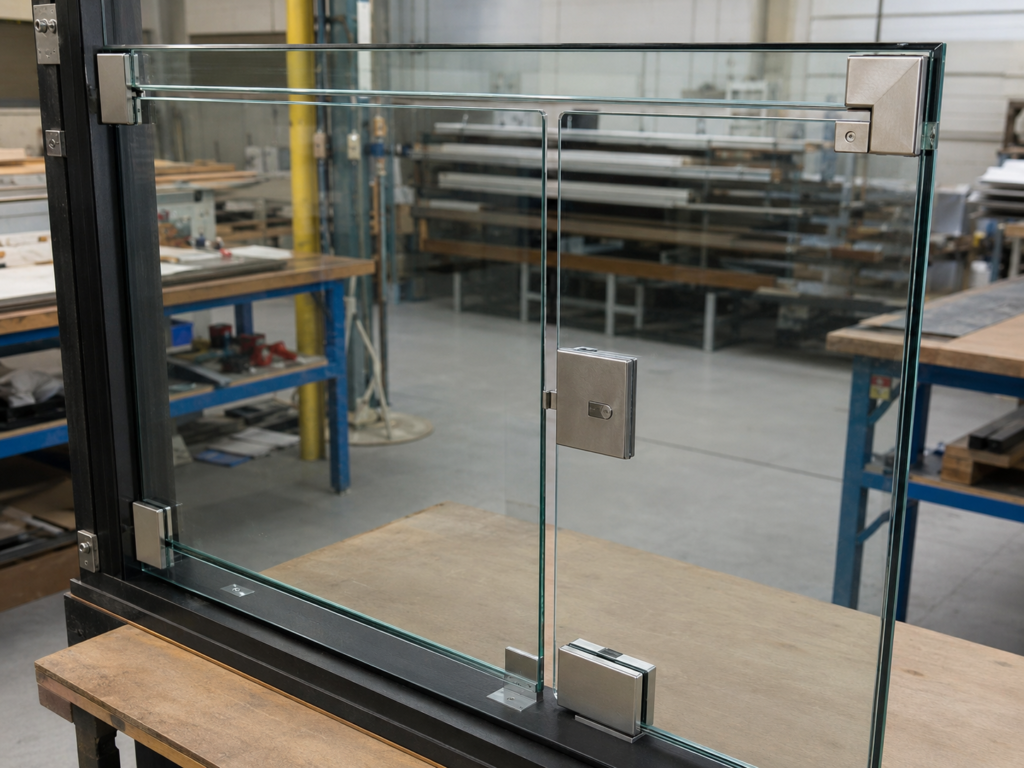
Fixed glass also needs attention. In many frameless entrance systems, the top pivot is supported by an overpanel fitting or a fitting connected to a fixed side panel. If the overpanel cutout is wrong, the pivot axis changes even if the moving door leaf is correct.
For this reason, the moving door, overpanel and side panel should be checked as one system before tempering. A correct door leaf drawing is not enough if the fixed glass drawing is wrong.
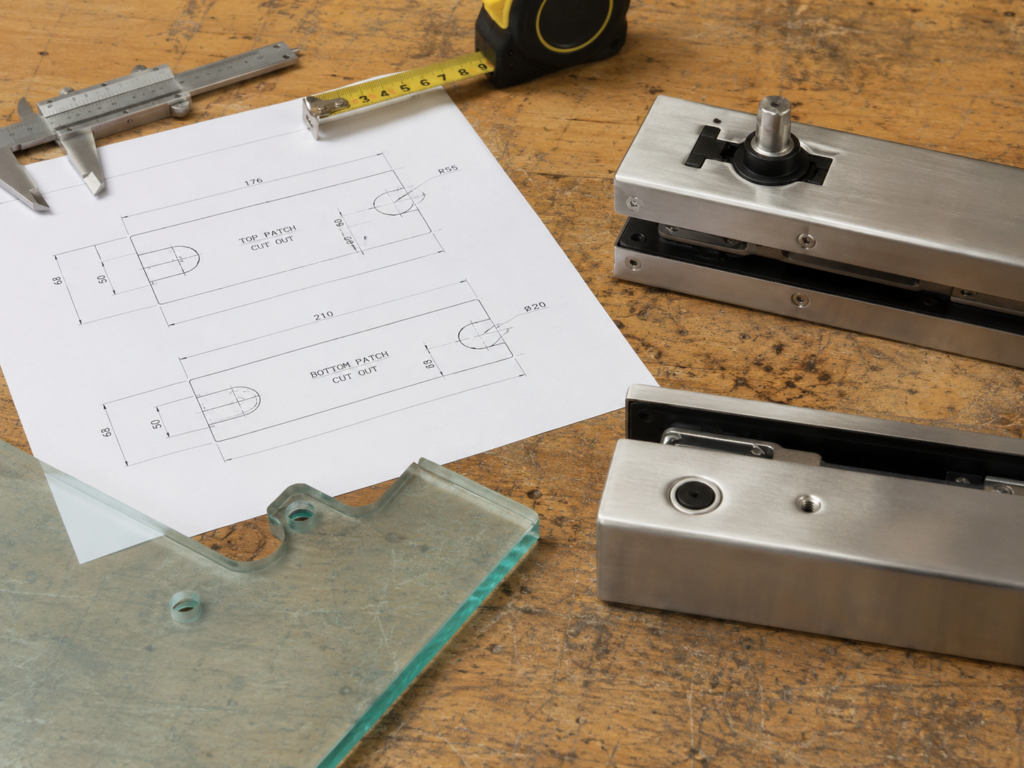
8. Common Cutout Preparation Mistakes
The first mistake is using one generic cutout drawing for different patch fitting models. Similar cover plates do not mean identical internal dimensions. Always check the exact drawing for the selected model.
The second mistake is changing the pivot position to reduce the visible door gap. Some contractors move the pivot closer to the wall or frame to make the gap smaller. But if the pivot point is moved too far, the trailing edge of the glass may bind against the frame when the door opens to 90°.
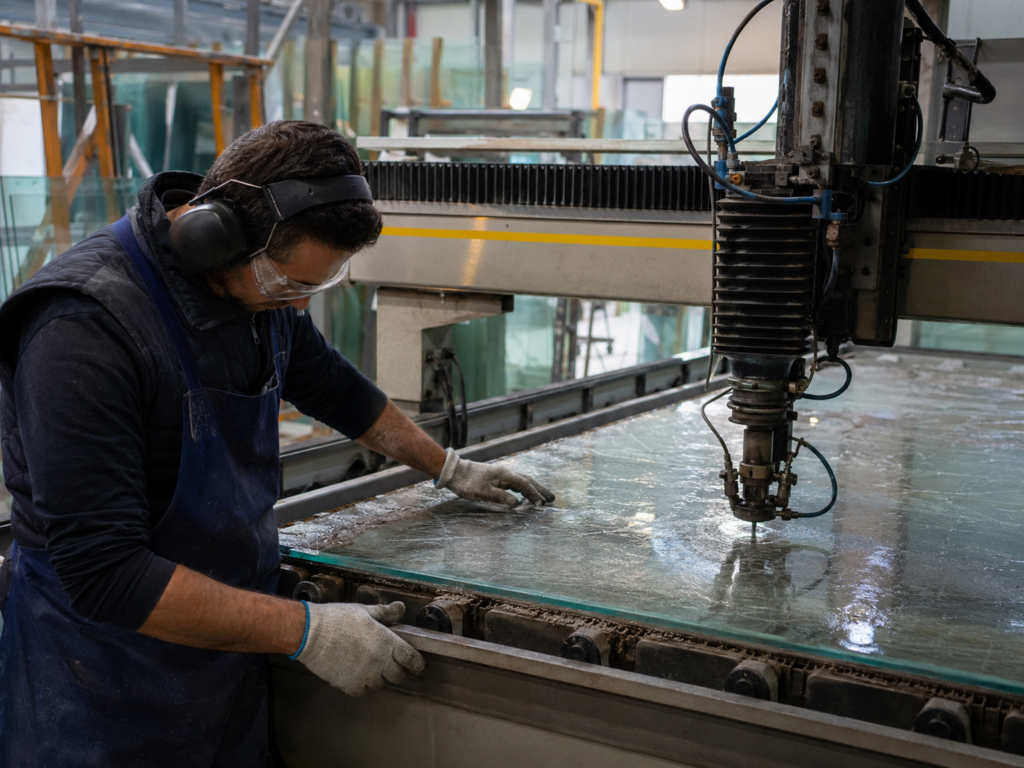
The third mistake is using manual cutting instead of accurate CNC or waterjet processing for complex notches. Manual cutting can leave small chips or edge flaws inside the notch. When the patch fitting clamps the glass, these flaws may become stress points.
The fourth mistake is forgetting the overpanel or fixed glass cutout. Contractors may prepare the moving door correctly but forget that the top pivot, corner connector or overpanel fitting also requires accurate glass preparation.
The fifth mistake is assuming old glass can always accept new patch fittings. In retrofit projects, the existing cutout was made for a specific old fitting. A new patch fitting may have a different spindle insert, gasket position, hole spacing or lock layout.
These mistakes are costly because tempered glass cannot be corrected like metal or wood. If the cutout is wrong, the safest solution may be to remake the glass panel.
9. What to Send Before Ordering Patch Fittings
Before ordering patch fittings, buyers should provide the key door and glass information.
For a new project, send the glass thickness, door width and height, door type, selected patch fitting model, floor spring type, top pivot arrangement, lock requirement, finish and quantity. If the project includes fixed glass, overpanel or side panels, those drawings should also be checked.
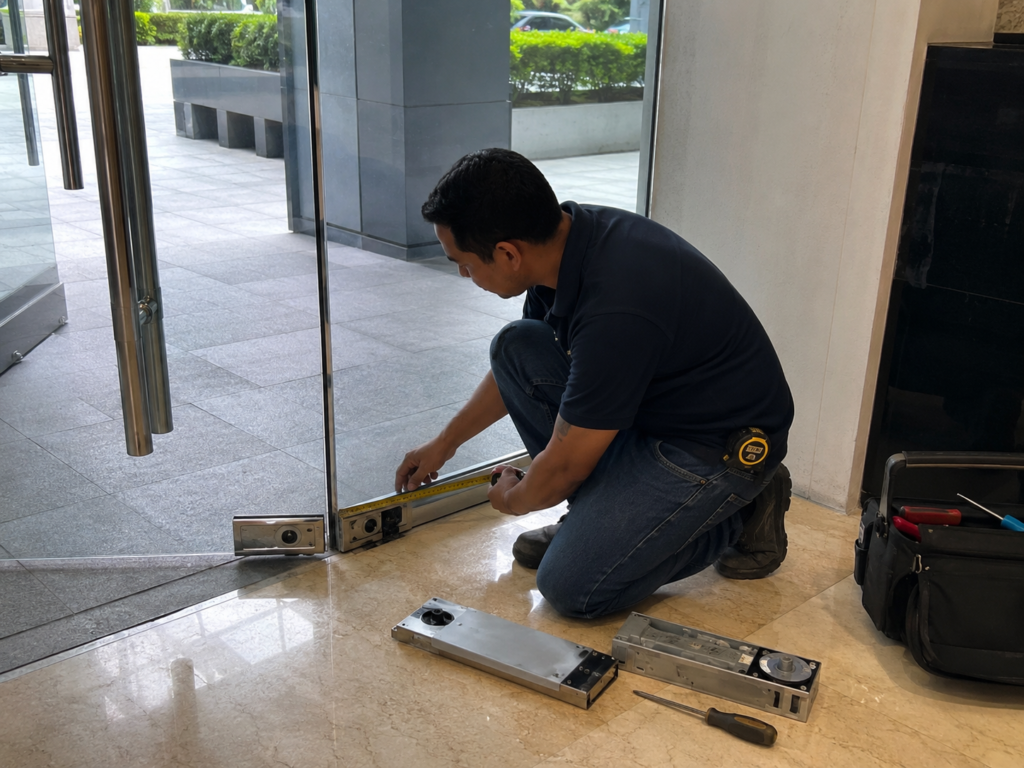
For a replacement project, photos are very important. Send clear pictures of the old top patch, bottom patch, patch lock, glass notch, drilled holes, floor spring spindle and door gap. If possible, provide simple measurements of the existing cutout, hole diameter, hole spacing and glass thickness.
For both new and replacement projects, the hardware model and glass cutout should be confirmed before production. If tempered glass is already finished, the supplier must compare the existing cutout with the new hardware before confirming whether it can be installed.
Patch fittings, locks, top pivots and floor springs should not be quoted as isolated items. They should be reviewed as one complete glass door system.
10. How Metech Supports Patch Fitting and Glass Door Projects
Metech Hardware supplies architectural glass door hardware for commercial and residential projects, including top patch fittings, bottom patch fittings, overpanel fittings, corner patch fittings, patch locks, floor springs, top pivots and related glass door accessories.
For new glass door projects, we can help buyers review the basic door configuration, glass thickness, patch fitting type and cutout requirement before quotation. For replacement projects, we can check existing hardware photos, old cutout information and floor spring details to help match suitable models.
For distributors and project buyers, Metech can support mixed orders that combine patch fittings with floor springs, pull handles, glass door locks, door closers, shower hinges, glass clamps and other architectural glass hardware items.
Before authorizing glass tempering, buyers can send us the door size, glass thickness, hardware finish, quantity and available cutout drawing or site photos. This helps reduce mismatch between the glass factory, hardware supplier and installation team.
FAQ
Can tempered glass be cut again if the patch fitting cutout is wrong?
No. Tempered glass cannot be safely cut, drilled, shaved or enlarged after tempering. Even a small modification may cause the panel to break because of internal stress. If the cutout is wrong, the glass panel usually needs to be remade.
Are patch fitting cutouts standard?
Not completely. Some commercial patch fittings may look similar and may use cover plates around 164mm × 51mm, but the pivot center, hole spacing, gasket design and internal clamping body may differ. The cutout drawing should always match the exact hardware model.
Why are the inner corners of the cutout rounded?
Sharp 90° internal corners create stress concentration in glass. Rounded internal corners, such as R5mm or R8mm depending on the design, help reduce stress concentration and are easier to produce with CNC or waterjet processing.
Do bottom patch fittings and top patch fittings use the same cutout?
Sometimes they may use similar or matching cutouts, especially in standard commercial door sets. However, this is not guaranteed. The top patch, bottom patch, overpanel fitting, patch lock and floor lock may all require different drawings.
Can I replace old patch fittings without changing the glass?
Yes, but only if the new patch fitting matches the existing glass cutout, glass thickness, pivot center, spindle position and lock arrangement. Photos and measurements should be checked before ordering.
What happens if the hole is too large?
If the hole is too large, the fitting may lose accurate positioning or mechanical engagement. This can lead to movement, sagging or poor alignment over time. The hole diameter should follow the hardware manufacturer’s exact drawing.
What information should I send before ordering patch fittings?
Send the glass thickness, door width and height, door type, existing cutout drawing or photos, floor spring spindle information, lock requirement, hardware finish and quantity. For new tempered glass, confirm the hardware drawing before production.