floor spring troubleshooting, floor spring for glass door, glass door floor spring, hydraulic floor spring, floor spring replacement, floor spring leaking oil, glass door not closing properly, glass door not returning to center, glass door scraping floor, floor spring cement box, floor spring spindle profile, flat tapered spindle, square spindle floor spring, floor spring patch insert, floor spring zero position, heavy duty floor spring, hydraulic floor spring replacement guide
A frameless glass door floating smoothly in a commercial entrance depends on a mechanical device hidden below the finished floor. This device is the floor spring.
Unlike an overhead door closer, which mainly controls door closing speed from the top of the door, a floor spring has a more demanding role. It controls the closing movement, works as the bottom pivot, and helps support a heavy glass door through its spindle and bearing system.
In many commercial projects, a glass door may weigh 100kg or more. Oversized entrance doors can reach 150kg–200kg or higher depending on glass size, thickness and hardware configuration. The floor spring must control this weight while handling repeated opening cycles, wind pressure, user impact, floor cleaning water and long-term wear.
When a glass door starts scraping the floor, slamming shut, leaking oil or failing to return to center, many buyers immediately assume the floor spring is broken.
Sometimes it is. But not always.
A floor spring failure may come from hydraulic seal damage, but it may also come from pivot misalignment, loose patch fittings, compressed gaskets, worn spindle inserts, undersized load capacity, poor cement box support or incorrect replacement matching.
The key question is:
Is the problem caused by the floor spring body, or by the glass door system around it?
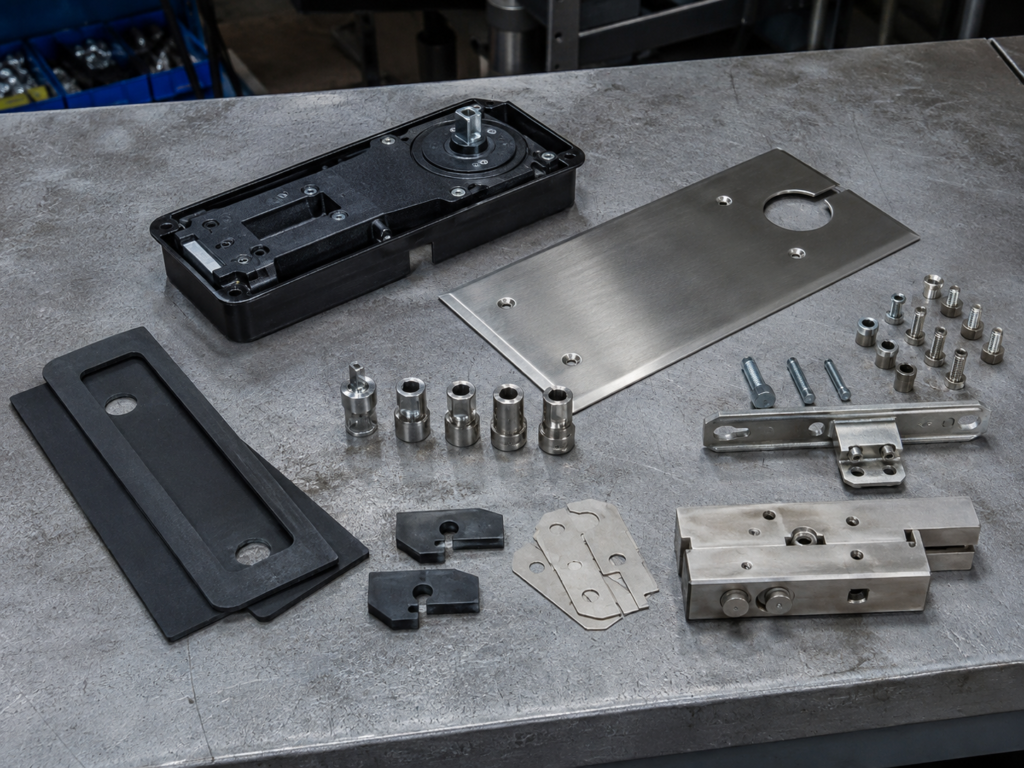
1. Why Floor Spring Problems Are Often Misdiagnosed
A floor spring does not work alone. It works together with the bottom patch fitting, top pivot, glass door leaf, floor box, spindle insert, lock, pull handle and surrounding floor structure.
If one of these parts is wrong, the door may show symptoms that look like floor spring failure.
A door may fail to return to center because the hydraulic cam system is worn. But it may also happen because the top pivot and bottom spindle are not on the same vertical axis. A door may scrape the floor because the internal bearing has dropped, but in many cases the real cause is a loose bottom patch fitting or compressed gasket. A door may close too fast because the speed valve is open too much, but visible oil in the cement box usually points to hydraulic seal failure.
Common causes include:
- hydraulic oil leakage;
- worn internal cam or thrust bearing;
- undersized floor spring capacity;
- pivot axis misalignment;
- loose top or bottom patch fittings;
- compressed patch fitting gaskets;
- worn spindle insert;
- wrong spindle profile;
- floor box movement or corrosion;
- wind pressure or air pressure;
- high-frequency commercial use.
Before replacing a floor spring, buyers should first diagnose whether the problem comes from hydraulic control, load capacity, pivot alignment, patch fitting connection or cement box condition.
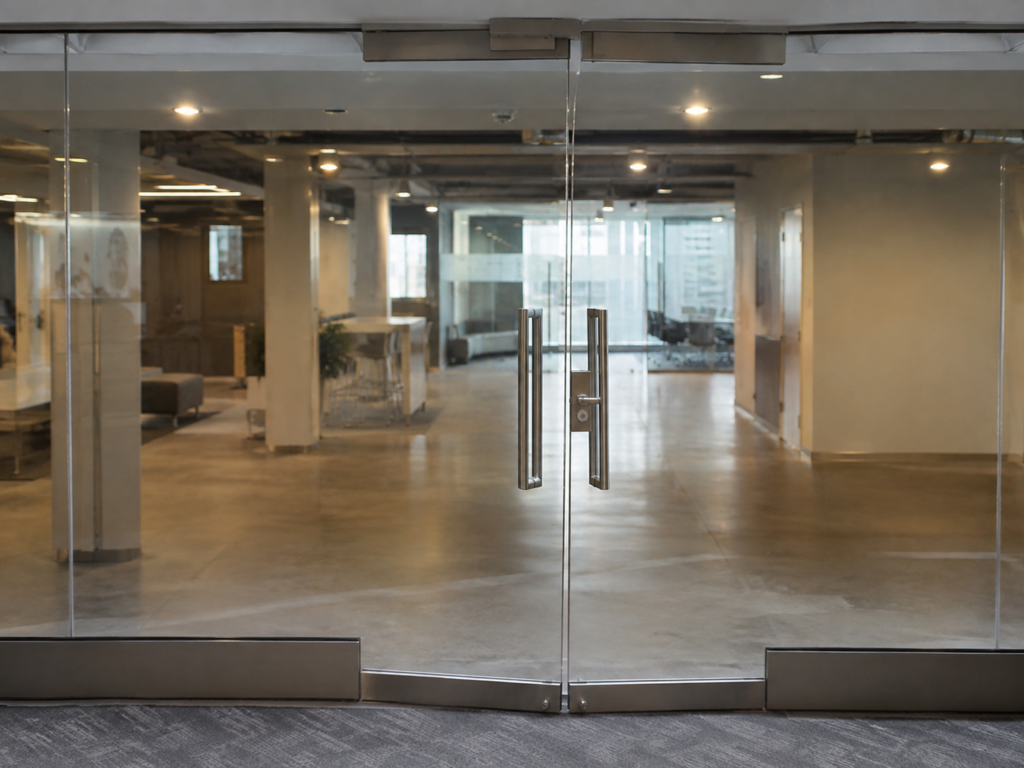
2. How a Floor Spring Supports and Controls a Glass Door
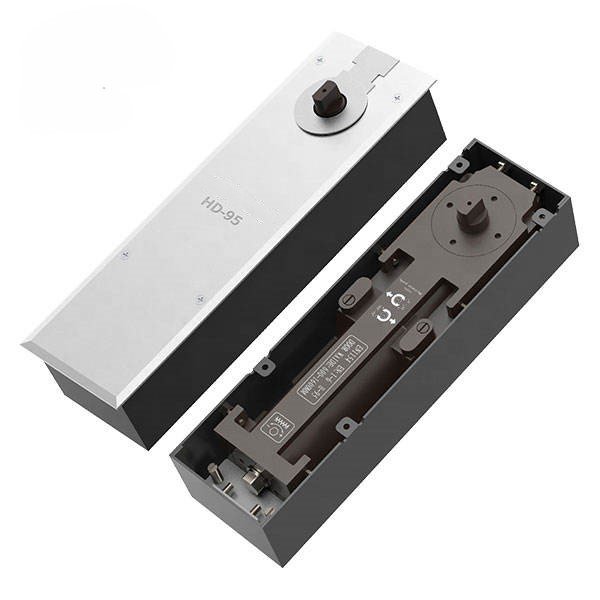
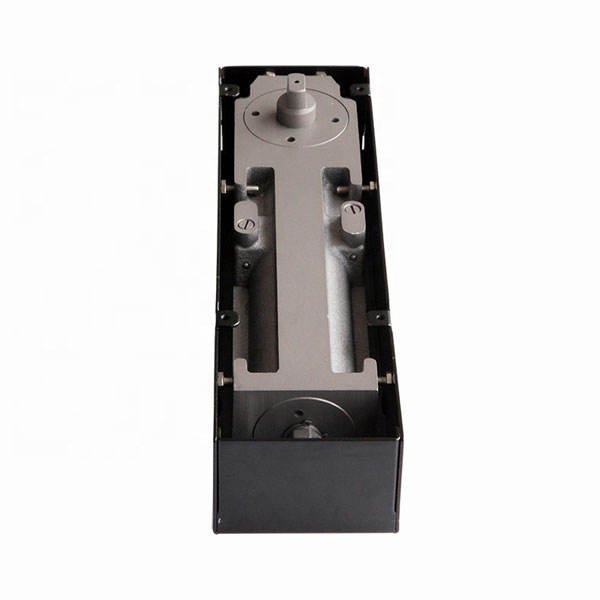
A hydraulic floor spring is installed inside a cement box below the finished floor. Its spindle extends upward and connects to the bottom patch fitting. The top pivot supports the upper part of the door. Together, the top pivot and bottom spindle form the vertical rotation axis of the glass door.
Inside the floor spring body, a mechanical spring provides closing force. Hydraulic oil and internal valves control the closing speed. When the door opens, the spring stores energy. When the door is released, the spring pushes the door back, while hydraulic resistance controls how fast the door moves.
A floor spring usually controls several movement zones.
The main closing movement is controlled by the closing speed valve. The final closing zone, often the last 10° to 15°, is controlled by the latch speed setting. Some floor springs include backcheck, which may begin around 70° to 85° depending on model and installation. Some models also include hold-open positions, commonly 90° or 135°, depending on floor spring type.
This means a floor spring does more than close the door. It also defines the bottom pivot point, supports the door movement and affects lock alignment, door gap and user experience.
For commercial glass doors, common glass thicknesses include 10mm and 12mm. Heavy or oversized doors may use 15mm glass. As the door becomes wider, taller or heavier, the floor spring must provide more stable hydraulic control and stronger mechanical support.
3. Problem 1: Glass Door Scrapes the Floor or Door Sagging
A glass door scraping the floor is one of the most common complaints in floor spring systems.
The bottom edge of the glass, bottom patch fitting or metal rail may grind against the floor tile, stainless steel cover plate or threshold. Because frameless glass doors often have only a small bottom clearance, even a 2mm to 3mm drop can create visible rubbing.
The floor spring may be responsible if the internal thrust bearing, spindle support or floor spring body has dropped because of overload, severe pivot misalignment or long-term wear.
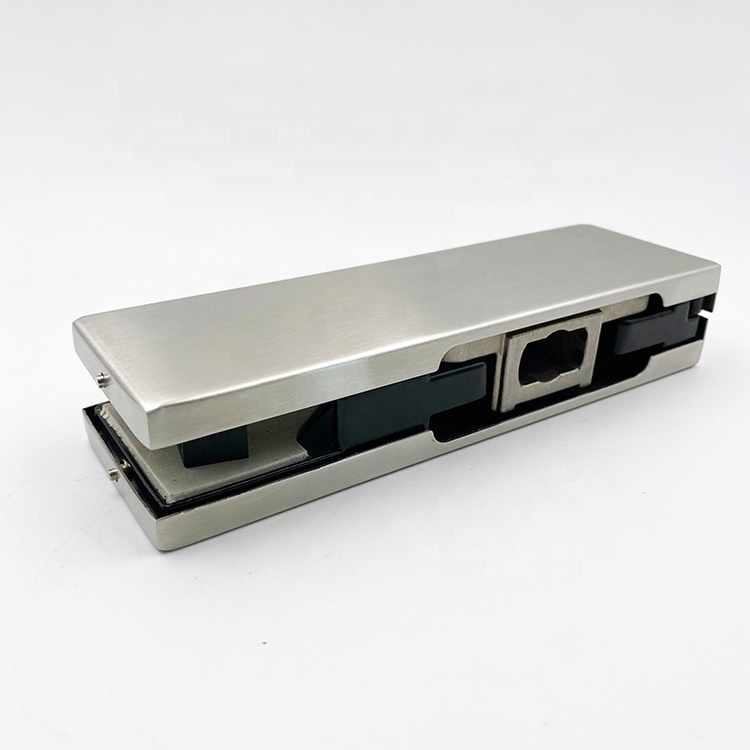
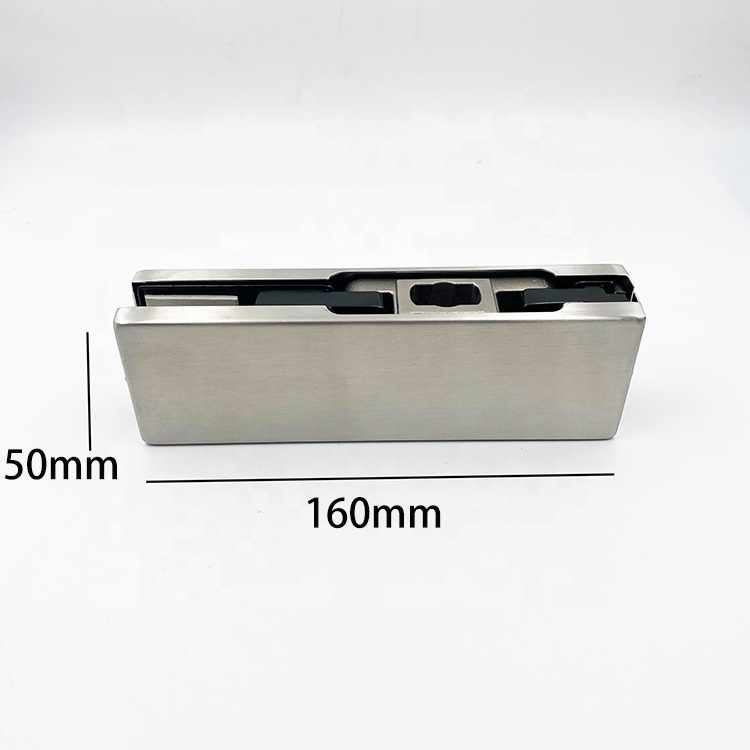
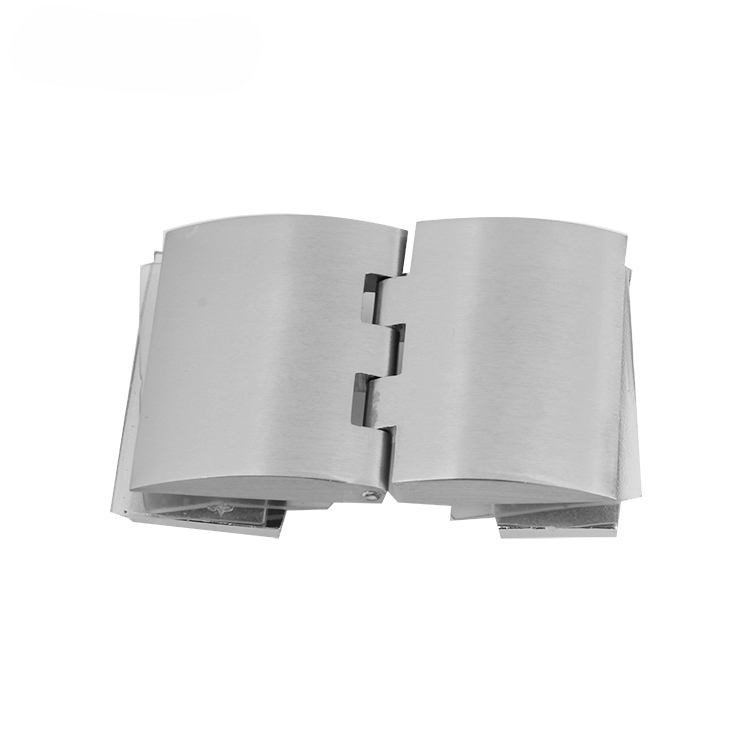
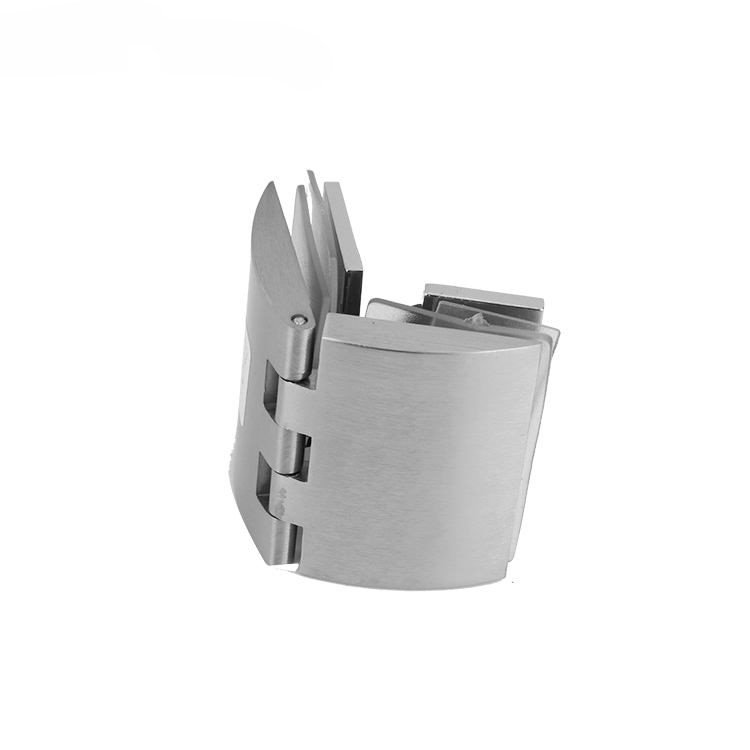
But in many replacement cases, door sag is not caused by the floor spring itself. It comes from the bottom patch fitting. If the clamping bolts loosen, or if the internal gaskets compress over time, the heavy glass panel may slip slightly inside the metal patch fitting. The floor spring may still be working, but the glass has moved downward.
A simple diagnostic check is to inspect the relationship between the glass edge and the bottom patch fitting. If the glass has slipped down inside the fitting, the patch fitting may need to be repositioned, re-torqued or fitted with new gaskets.
The cause may also be:
- loose bottom patch fitting;
- compressed gaskets;
- worn spindle insert;
- floor box movement;
- floor settlement;
- insufficient bottom clearance;
- pivot axis misalignment;
- door weight exceeding hardware capacity.
Some floor springs allow small adjustment inside the cement box. Depending on model, vertical adjustment may be around 2mm–4mm, with lateral or longitudinal adjustment around 3mm. However, if the door has dropped by 10mm, the problem is usually not solved by floor spring adjustment alone. The glass position, patch fitting and support system must be checked.
A scraping glass door should not be forced open and closed repeatedly. This can damage the glass edge, floor finish, spindle connection and patch fitting.
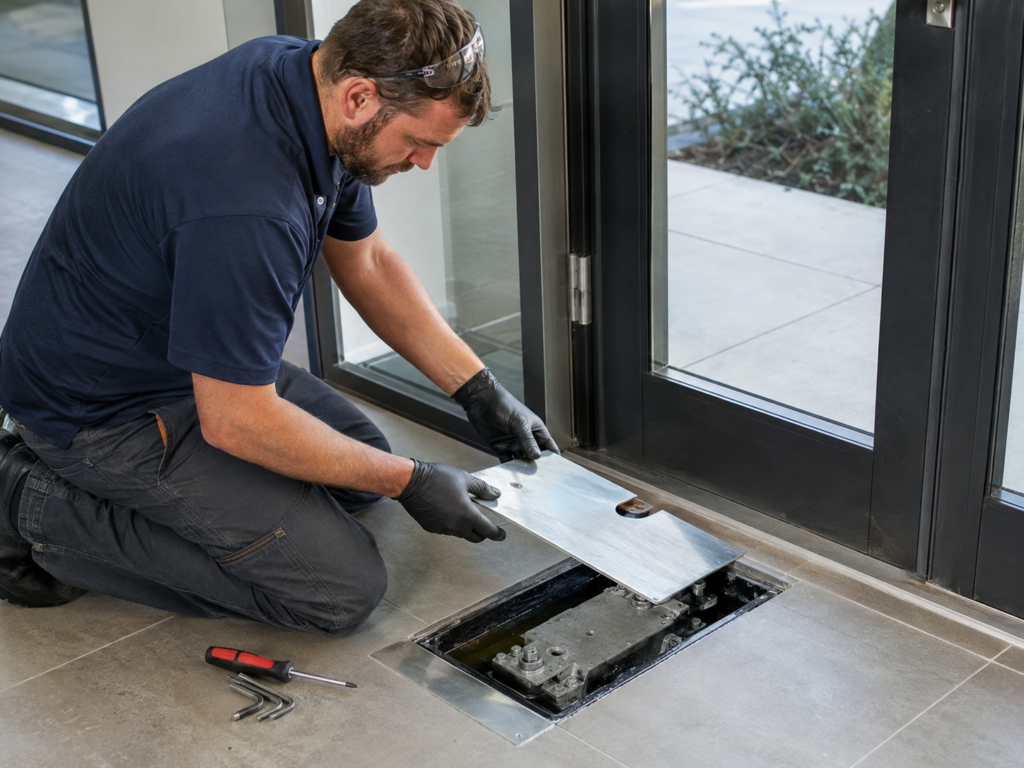
4. Problem 2: Door Fails to Return to Center / Loss of Zero-Point
A normal frameless glass door should return to the 0° closed position smoothly and consistently.
If the door stops at 3° or 5° off center, the problem becomes more than visual. The door gap changes. A central patch lock may not align with the keeper. An electric drop bolt may fail to enter the receiver. Double glass doors may no longer meet cleanly at the center line.
This is often called loss of zero-point.
One possible cause is hydraulic wear inside the floor spring. The internal cam and spring mechanism are designed to guide the spindle back to the zero position. After long-term use, strong wind, forced operation or overloading, the cam edges may wear and the door may lose its precise centering.
Another common cause is pivot misalignment. The top pivot and floor spring spindle must be on the same vertical axis. Even 2mm to 3mm of misalignment can create visible problems. The door may return inconsistently, rub at the bottom or fail to lock smoothly.
Spindle insert mismatch is another important cause. A square patch fitting insert used on a flat-tapered spindle, or a worn insert used on a new spindle, can create mechanical play. This looseness prevents the door from finding a stable closed position.
Common spindle profiles may include:
- flat-tapered spindle;
- square spindle;
- splined or star profile spindle;
- other supplier-specific insert types.
If the internal cam is worn, the spindle insert is loose, or the spindle profile does not match the bottom patch fitting, adjustment alone may not restore accurate zero position.
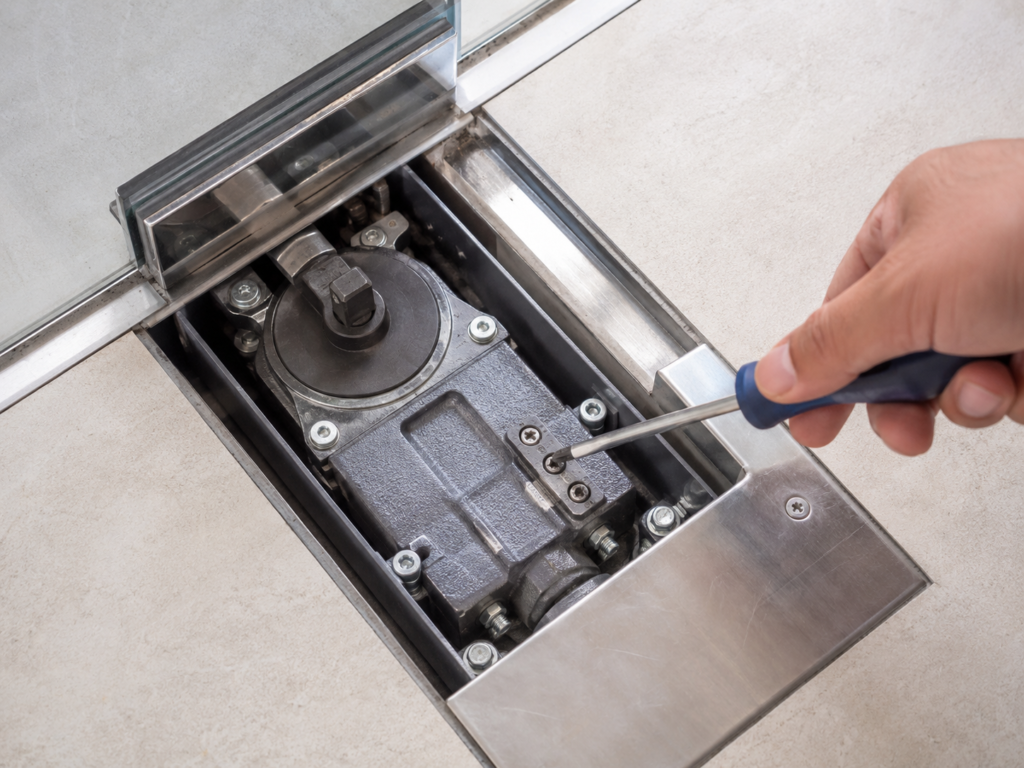
5. Problem 3: Oil Pooling in the Cement Box
Oil leakage is one of the clearest signs of hydraulic floor spring failure.
In many cases, the problem becomes visible only after removing the stainless steel cover plate. If the cement box contains dark hydraulic oil, or if oil stains appear around the floor spring cover, the internal sealing system has likely failed.
A leaking floor spring may show several symptoms:
- door closes too fast;
- speed adjustment no longer works;
- movement becomes inconsistent;
- door slams near the end of closing;
- door no longer returns smoothly;
- oil appears inside the cement box.
Oil leakage may be caused by seal aging, poor-quality O-rings, overload, high-frequency use, temperature changes, dynamic shock, water inside the cement box, corrosion or severe pivot misalignment.
Dynamic shock can happen when users forcefully push the glass door closed faster than the hydraulic valves allow. This can create a pressure spike inside the cylinder and damage the seals. Pivot misalignment can also create side stress on the spindle and internal components.
In most commercial replacement projects, a leaking floor spring should be replaced. Once hydraulic oil is lost, valve adjustment usually cannot restore stable long-term closing control.
If the cement box is also rusted, wet or loose in the concrete, the site condition should be repaired before installing a new floor spring. Otherwise, the replacement unit may be affected by the same environment.
6. Problem 4: Slamming or Loss of Speed Control
A glass door that closes too fast or slams may have a simple adjustment problem, but it may also have lost hydraulic control.
Most floor springs have two adjustment valves. Valve 1, often used for sweep speed, controls the main closing movement from the open position down toward the final closing zone. Valve 2, often used for latch speed, controls the final 10° to 15° before the door closes and locks.
Small adjustments should be made carefully, often a quarter turn at a time. Turning the valve too far can affect hydraulic control or damage the valve.
If the valve turns but the door speed does not change, the internal valve thread may be damaged, the oil may have leaked, or the hydraulic system may no longer respond.
Temperature can also affect lower-grade hydraulic systems. In hot environments, oil may become thinner and the door may close faster. In colder conditions, oil may become thicker and the door may close slowly or fail to latch. For export projects with high temperature changes, buyers may consider floor springs with more temperature-stable hydraulic control, depending on model specification.
If the floor spring leaks oil and the door slams, replacement is usually more practical than repeated adjustment.
7. Load Capacity, Door Width and Overload
Floor spring capacity should not be selected only by door weight.
A 100kg floor spring does not automatically suit every 100kg glass door. A narrow 100kg glass door and a wide 100kg glass door create different torque on the spindle and hydraulic system. Door width matters because a wider door creates more leverage.
Daily use frequency also matters. A hotel lobby, school entrance, retail storefront or office building entrance may open and close many times every day. Exterior doors may face wind pressure. Large pull handles may add extra operating force. All of these conditions can increase working load.
For ordinary commercial glass doors, floor springs may be selected according to actual door weight with a suitable margin. For heavy or oversized entrance doors, buyers may need to consider higher-capacity floor springs such as 150kg, 300kg or 450kg series, depending on door size and project condition.
For heavy, wide, exterior or high-frequency doors, a practical approach is to allow around 30% working margin instead of selecting a model exactly equal to the calculated door weight.
If a floor spring is undersized, the door may fail to return to center, slam under wind pressure, close inconsistently or wear out earlier than expected.
8. Replacement Matching: Cement Box, Spindle Profile and Hold-Open Angle
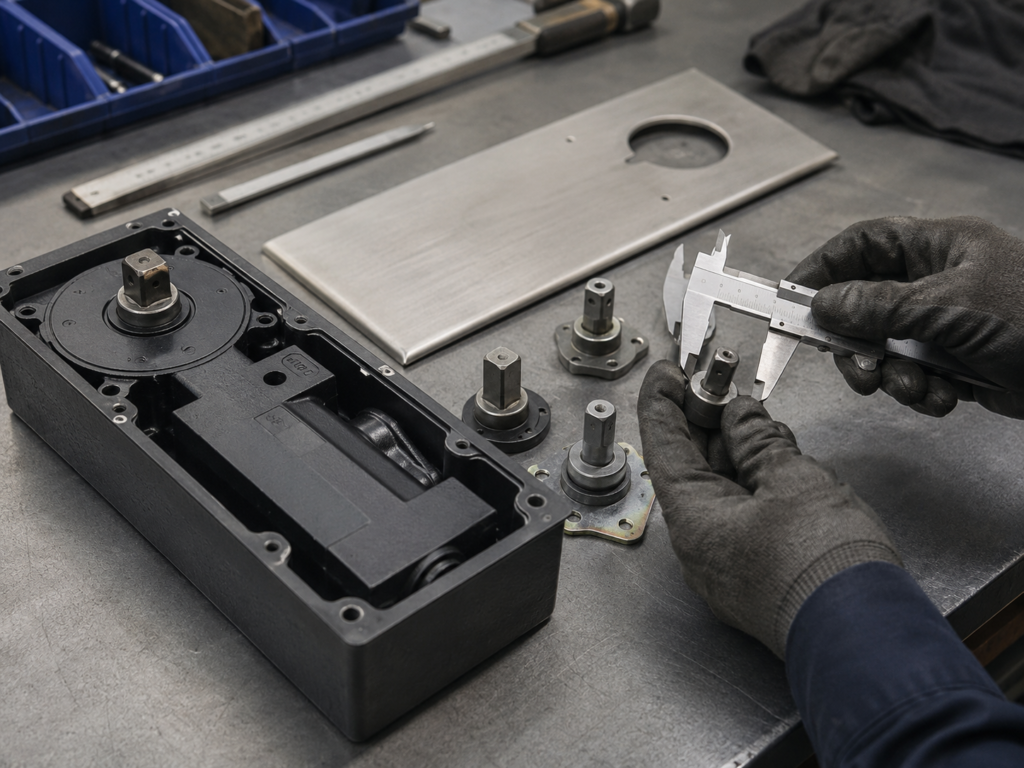
When a floor spring must be replaced, dimensional matching is critical.
Many replacement projects fail because the buyer checks only the stainless steel cover plate. A similar cover plate does not mean the floor spring body, cement box, spindle position, hold-open angle and fixing holes are the same.
For a drop-in replacement, the contractor should remove the cover plate and measure the cement box:
- length;
- width;
- depth;
- fixing hole position;
- spindle position;
- cover plate size;
- available clearance around the body.
If the new floor spring does not fit the old cement box, the finished floor may need to be cut. In a commercial lobby, hotel entrance or retail storefront, this can be disruptive and expensive.
Spindle profile must also match the bottom patch fitting insert. Common replacement questions include:
- Is the spindle flat-tapered?
- Is it square?
- Is it splined or star profile?
- What is the spindle height?
- Does the existing bottom patch insert match the new spindle?
- Is the old insert worn?
Hold-open requirement should also be confirmed. Some floor springs hold open at 90°. Some models hold open at 135°. Some projects require non-hold-open models. For fire-rated partitions, security entrances or access-controlled doors, non-hold-open may be required so the door always returns and locks.
A replacement floor spring should match the existing site condition, not only the old product appearance.

9. The Golden Rule: Check or Replace the Patch Insert
When a commercial floor spring has worked for years, the bottom patch fitting insert may also be worn.
If a brand-new floor spring with a sharp spindle is installed into an old, loose insert, the connection may still have mechanical play. The door may immediately show centering problems, clicking noise or loose movement at the zero position.
For commercial replacement projects, it is strongly recommended to check the bottom patch insert. In many cases, replacing the spindle insert together with the floor spring is a safer approach. If the bottom patch fitting is already loose, corroded or damaged, replacing the entire bottom patch fitting may be more practical.
This is especially important when changing brands or spindle profiles.
A new floor spring cannot perform accurately if the connection between the spindle and patch fitting is loose.
10. Adjust or Replace: How to Decide
Not every floor spring problem requires replacement. Some issues can be improved by adjustment, tightening patch fittings, cleaning the cement box or correcting alignment. Other symptoms indicate that replacement is more likely.
| Symptom | Try Adjustment First? | Replacement More Likely When |
|---|---|---|
| Door closes too fast | Yes | Oil leakage or valve failure |
| Door does not return to center | Yes | Pivot axis is correct but the spring cannot hold zero |
| Door scrapes the floor | Limited | Door sag, patch fitting slip or spindle support problem |
| Oil in cement box | Limited | Visible oil stains and loss of hydraulic control |
| Door is too hard to open | Check model and hold-open setting | Floor spring is too strong or wrong type |
| Door cannot hold open | Check hold-open angle | Internal mechanism worn or wrong model |
| Clicking at zero position | Check spindle insert | Insert, spindle or internal cam is worn |
| Floor box rusted or loose | No | Floor repair and replacement are needed |
The important point is diagnosis. Replacing the floor spring without checking the top pivot, bottom patch fitting, spindle insert and cement box may lead to the same problem again.
11. Common Mistakes When Buying Replacement Floor Springs
The first mistake is buying by cover plate size only. A similar cover plate does not guarantee the same body size, cement box depth, spindle position, hold-open angle or load capacity.
The second mistake is ignoring door width and torque. A wide glass door needs more control than a narrow door with the same weight.
The third mistake is replacing the floor spring without checking patch fittings. If the bottom patch fitting is loose or the spindle insert is worn, a new floor spring may still perform poorly.
The fourth mistake is ignoring spindle type and height. Spindle mismatch can cause installation failure, door looseness or inaccurate centering.
The fifth mistake is using light-duty floor springs on exterior glass doors. Wind pressure and frequent use may require heavier specifications.
The sixth mistake is not checking cement box corrosion or water damage. A new floor spring installed into a rusted or unstable box may not last long.
The seventh mistake is choosing the hold-open angle without confirming project requirement. 90° hold-open, 135° hold-open and non-hold-open models serve different door conditions.
12. What to Confirm Before Ordering a Floor Spring
Before ordering a replacement floor spring, buyers should prepare the key door and site information.
For new projects, the supplier needs to know the door width, door height, glass thickness, estimated door weight, single or double leaf layout, indoor or outdoor condition, daily use frequency and required hold-open angle.
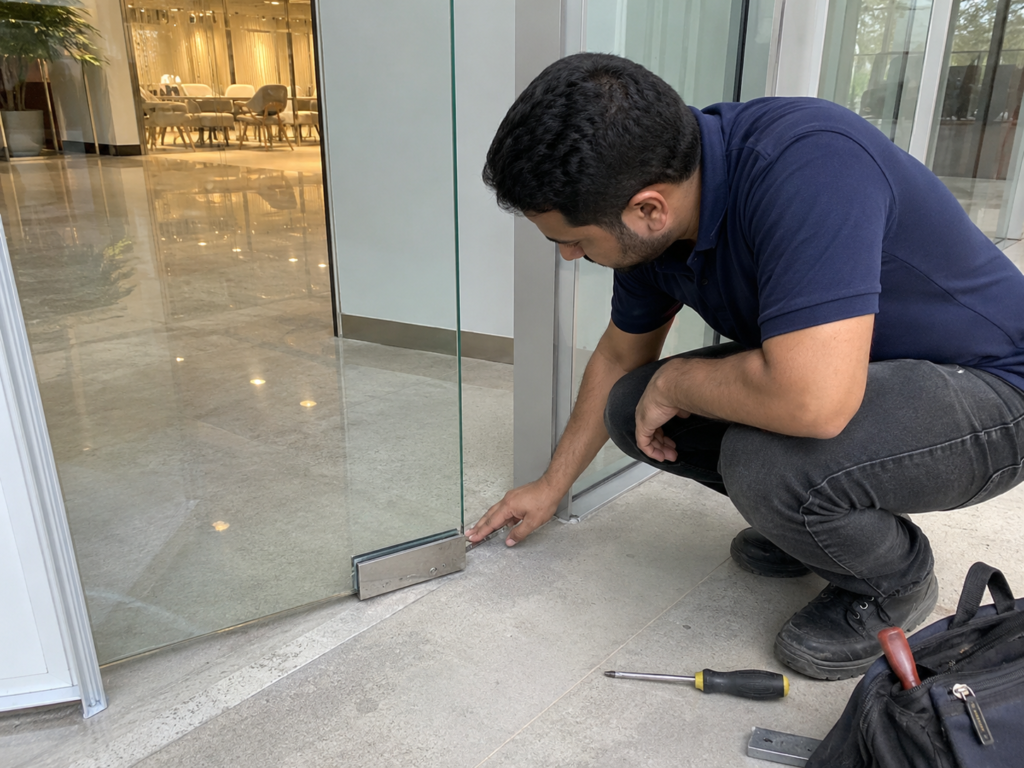
For replacement projects, photos and measurements are especially important. Buyers should send photos of the existing floor spring, stainless steel cover plate, cement box, spindle, bottom patch fitting, top pivot and the current door problem.
Useful measurements include:
- cement box length, width and depth;
- cover plate size;
- spindle height;
- spindle profile;
- glass thickness;
- door width and height;
- bottom clearance;
- hold-open angle;
- old model number, if visible.
The buyer should also describe the symptom clearly: not returning to center, closing too fast, oil leakage, scraping the floor, door sagging, hard opening, clicking noise or hold-open failure.
Floor springs should not be selected only by price. The model must match the door size, glass weight, spindle connection, patch fitting and cement box condition.
13. How Metech Supports Floor Spring Retrofit and New Projects
Metech Hardware supplies floor springs and related glass door control hardware for commercial and residential projects, including standard floor springs, heavy-duty floor springs and high-capacity floor springs for larger entrance doors.
For project buyers, we can help review door width, door height, glass thickness, estimated door weight, hold-open angle, indoor or outdoor condition and expected use frequency before quotation. For replacement projects, existing floor spring photos, cement box dimensions and bottom patch fitting details can help us recommend a more suitable model.
Metech can also support matching hardware such as patch fittings, top pivots, pull handles, glass door locks, door closers and related architectural glass hardware. For distributors and contractors, mixed hardware orders can help reduce procurement complexity across different glass door projects.
To request a quotation, send the door size, glass thickness, estimated weight, floor spring photos, cement box size, spindle type, bottom patch fitting photos, required hold-open angle, finish and quantity.
FAQ
Why does my glass door not return to center?
Poor centering may be caused by speed adjustment, hydraulic wear, pivot axis misalignment, loose patch fittings, worn spindle insert, undersized floor spring or excessive door weight. The top pivot and bottom spindle alignment should be checked first.
Why does my floor spring leak oil?
Floor spring oil leakage is usually caused by internal seal failure, overload, high-frequency use, aging, forced door movement, water inside the cement box or corrosion. Once hydraulic oil is lost, replacement is usually more practical than adjustment.
Can I repair a leaking floor spring?
In most commercial projects, a leaking floor spring should be replaced. Once hydraulic oil is lost, valve adjustment usually cannot restore stable long-term closing control.
Why does my glass door scrape the floor?
A scraping glass door may be caused by loose bottom patch fittings, compressed gaskets, door sagging, worn spindle insert, floor box movement, floor settlement or insufficient bottom clearance. It is usually a geometry or support problem.
Can I adjust the height of a floor spring if the door is dragging?
Some floor springs allow minor adjustment inside the cement box, such as vertical adjustment around 2mm–4mm and lateral or longitudinal adjustment around 3mm, depending on model. If the door has dropped around 10mm, the glass or patch fitting position should be checked instead of relying only on floor spring adjustment.
Why does my floor spring make a clicking noise at the zero position?
A clicking or clunking sound near the closed position may indicate loose play between the spindle and patch fitting insert, worn insert edges or internal cam wear. The spindle connection should be inspected.
How do I adjust the closing speed?
After removing the stainless steel cover plate, many floor springs have two adjustment valves. Valve 1 usually controls the main sweep speed, and Valve 2 controls the final latch speed around the last 10°–15°. Adjust in small increments, such as a quarter turn at a time.
Can I replace a floor spring with another brand?
Yes, but only if the new floor spring matches the cement box size, spindle profile, spindle height, load capacity, cover plate size and bottom patch fitting connection. Replacement photos and measurements should be checked before ordering.
Do I have to remove the glass door to replace the floor spring?
In most replacement cases, yes. The glass door must be safely lifted off the floor spring spindle by trained installers using proper lifting tools. This is not usually a one-person maintenance task.
What is the difference between 90° and 135° hold-open?
A 90° hold-open floor spring can hold the door open around 90°, while a 135° hold-open model allows a wider hold-open angle depending on door opening design. The correct option depends on the entrance layout and project requirement.
What information should I send before ordering?
Send the door width, door height, glass thickness, estimated weight, existing floor spring photos, cement box size, spindle profile, bottom patch fitting photos, hold-open requirement and current problem description.