In commercial glass door projects, choosing the wrong floor spring is a serious specification risk.
Many buyers still use a one-size-fits-all approach, ordering the same standard floor spring for every door in a building. It may simplify purchasing, but it often creates problems after installation.
If the floor spring is undersized, the door may fail to return to center, lose closing power, misalign with the lock, overload the hydraulic system, or develop oil leakage over time. If the floor spring is oversized, the door may become too stiff to push, creating poor user experience and accessibility concerns in public entrances.
Choosing a floor spring is not guesswork.
It is a mechanical selection process based on glass weight, door width, leverage force, wind load, traffic frequency, hydraulic control, and safety margin.
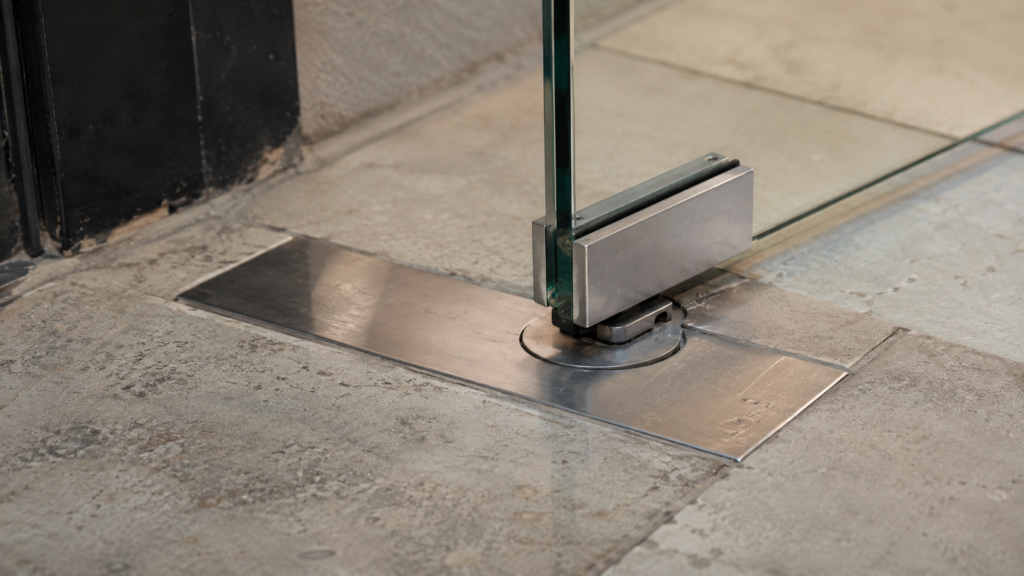
Step 1: Calculate the Base Glass Door Weight
Before selecting a floor spring, start with the base glass weight.
For tempered glass, a practical calculation formula is:
Door Weight (kg) = Height (m) × Width (m) × Glass Thickness (mm) × 2.5
The number 2.5 means that each 1mm thickness of glass weighs approximately 2.5kg per square meter.
For example, if a frameless glass door is 2.4m high, 1.0m wide, and uses 12mm tempered glass:
2.4 × 1.0 × 12 × 2.5 = 72kg
So the glass panel itself weighs about 72kg, before adding patch fittings, pull handles, locks, seals, or other accessories.
This number is only the first step.
A light-duty floor spring rated around 60kg would be underspecified for this door and may fail prematurely in commercial use. For a 72kg glass panel, a commercial floor spring rated around 80kg to 100kg would usually be a more reasonable starting point, depending on door width, traffic level, and installation environment.
Step 2: Door Width and the Leverage Effect
The most common floor spring selection mistake is checking the door weight but ignoring the door width.
A floor spring does not only carry vertical weight. It controls rotating force around the spindle. In mechanical terms, door width increases leverage force, or torque.
An 80kg door with a 900mm width and an 80kg door with a 1200mm width do not create the same stress on the floor spring.
The wider door creates stronger leverage against the pivot point. This affects the internal cam, spring mechanism, spindle, hydraulic control, and long-term closing stability.
| Door Example | Door Weight | Door Width | Floor Spring Stress |
|---|---|---|---|
| Door A | 80kg | 900mm | Lower torque |
| Door B | 80kg | 1200mm | Higher torque |
A floor spring may be strong enough for the door weight, but still unsuitable if the door width exceeds its torque range.

The engineering rule is simple:
If the door width is close to or beyond the model’s maximum specification, upsize to the next heavy-duty floor spring tier, even if the glass weight still looks acceptable.
This is especially important for hotel entrances, office building doors, shopping mall doors, and wide retail storefront glass doors.
Step 3: Wind Load, HVAC Drafts and Safety Margin
A floor spring does not work in a laboratory. It works in a real building.
Exterior glass doors face wind pressure, sudden gusts, rain, dust, and rough public use. A street-facing storefront door or commercial lobby entrance may be pushed open suddenly by wind or by users applying uneven force.
Interior doors can also face air pressure problems.
In high-rise office buildings, hotels, and commercial complexes, HVAC systems, elevator shafts, and stack effect can create positive and negative air pressure. A door that closes well in a quiet showroom may fail to close properly in a real corridor or lobby.
For exterior doors or strong-draft areas, contractors often reserve a 20% to 30% safety margin after calculating the base door weight.
For example, if the glass panel weighs around 90kg, do not select a floor spring rated exactly at 90kg or 100kg for a windy exterior entrance. A 130kg or 150kg heavy-duty model may provide a safer working margin, depending on door width and site conditions.
This margin helps reduce the risk of:
- weak closing force
- wind-related door drift
- lock misalignment
- premature hydraulic overload
- oil leakage
- spindle wear
- repeated maintenance calls
A small safety margin during specification often prevents expensive callbacks after installation.
Step 4: Two-Stage Hydraulic Valve Control
A commercial floor spring must not only carry the door. It must control how the door closes.
For commercial glass doors, a good floor spring should have independent two-stage hydraulic valve control.
Closing Speed: 130° to 15°
This valve controls the main sweep of the door from a wide opening angle to the near-closed position.
If the speed is too fast, the door feels unsafe and aggressive. If it is too slow, the entrance becomes inefficient and users may push or pull the door manually, adding stress to the system.
Latching Speed: 15° to 0°
This valve controls the final closing section.
The final 15° is where many glass door problems appear.
This is the zone where the door must overcome the resistance of weather seals, acoustic drop seals, magnetic seals, patch locks, or electric strike locks. If the latching speed is too weak, the door may not lock. If it is too strong, the door may slam, rebound, or create noise.
For commercial doors with locks or seals, latching speed is not a small adjustment. It directly affects daily usability.
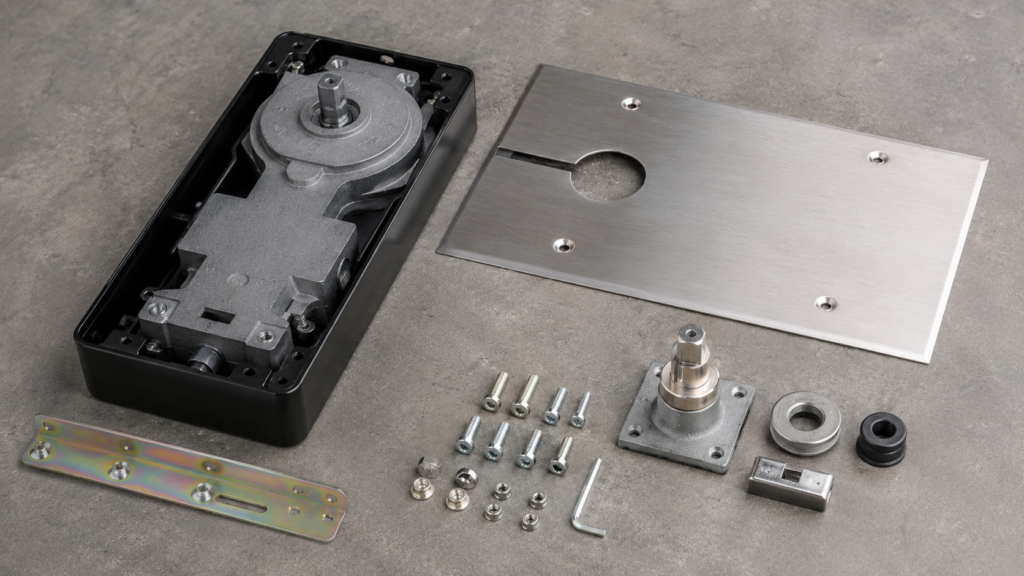
Step 5: Durability, Back-Check and Centering Accuracy
After weight, width, wind load, and valve control, the next step is long-term performance.
Commercial doors are not used like residential doors. A commercial entrance may open hundreds of times per day. For high-traffic glass doors, a 500,000-cycle durability test is a practical benchmark, not just a marketing number.
Back-check is another important function.
Back-check usually activates around 70° to 85°, depending on the model design. It slows the door when it is pushed open aggressively, helping reduce impact damage before the door hits a wall, fixed glass panel, door stop, or surrounding structure.
Back-check protects more than the floor spring. It helps protect:
- patch fittings
- top pivots
- spindle components
- fixed glass panels
- door stops
- surrounding walls
- lock alignment
Centering accuracy also matters.
For commercial doors with patch locks, bottom locks, magnetic seals, or strict visual alignment, centering accuracy such as ±0.5° can make a visible difference. Poor return-to-center performance may cause lock misalignment, uneven door gaps, air leakage, and repeated adjustment problems.
A good commercial floor spring should not only close the door. It should return the door to the correct position, again and again.
The Floor Spring Specification Checklist
Before submitting a purchase order, confirm these details for each specific door opening.
| Required Specification Data | Why It Matters |
|---|---|
| Door height × width | Calculates base glass weight and leverage torque |
| Glass thickness | 10mm, 12mm, or 15mm glass changes total weight |
| Door width | Determines torque on the spindle |
| Environment | Exterior, interior, wind load, HVAC draft, dust, moisture |
| Traffic frequency | Determines whether 500,000-cycle durability is needed |
| Action type | Single-action or double-action door movement |
| Hold-open requirement | 90° or 105° hold-open may be needed for traffic flow |
| Lock or seal requirement | Requires stable latching speed and centering accuracy |
| Floor condition | Affects installation, cement box stability, and maintenance |
If these details are missing, the selection is only a guess.
Common Mistakes Before Ordering
The first mistake is selecting only by maximum door weight. A model may carry the glass weight but still struggle if the door is too wide and creates excessive torque.
The second mistake is using the same floor spring for every door in a project. A small interior glass door, a hotel lobby entrance, and a windy storefront door should not automatically use the same specification.
The third mistake is ignoring wind load and HVAC drafts. Exterior doors and strong-airflow corridors need more safety margin than controlled indoor test conditions.
The fourth mistake is adjusting only the closing speed and ignoring the latching speed. Many lock alignment and rebound problems happen in the final 15° of closing.
The fifth mistake is choosing a low-spec model to save cost. A cheaper floor spring may reduce the initial purchase price, but oil leakage, poor centering, and door misalignment can create higher maintenance costs later.
Floor Spring Selection by Application
| Project Type | Selection Focus |
|---|---|
| Office building entrance | 500,000 cycles, stable centering, heavy-duty spindle |
| Hotel lobby glass door | Smooth closing, quiet movement, premium cover plate |
| Retail storefront door | Weather resistance, back-check, lock alignment |
| Shopping mall entrance | High traffic durability and easy maintenance |
| Exterior glass door | Wind load margin, sealed body, anti-rust treatment |
| Interior commercial glass door | Moderate force, smooth closing, easier opening |
| Oversized glass door | Check both weight and width, then upsize |
Selection should follow the actual door condition, not only the project name.
Specify with Confidence
The right floor spring is not the strongest model in the catalog.
It is the model that matches the real working condition of the glass door.
For light interior glass doors, a standard floor spring may be enough. For commercial entrances, selection should start from glass weight, door width, torque, traffic frequency, wind load, centering accuracy, and latching performance.
For high-traffic or exterior glass doors, choose a heavy-duty floor spring with tested cycle durability, stable hydraulic control, back-check function, reliable return-to-center performance, and enough safety margin.
A properly selected floor spring helps the whole glass door system work better: smoother opening, stable closing, accurate locking, reduced impact damage, and fewer maintenance calls.
Need a Floor Spring Specification Review?
Send us your door height, door width, glass thickness, estimated door weight, single-action or double-action requirement, interior or exterior use, traffic level, lock or seal requirement, finish requirement, and quantity.
Metech can help match your commercial glass door project with the right floor spring specification, from standard 100kg models to heavy-duty floor springs for large commercial entrance doors.